I’ve not been here for a while, and it’s been even longer since I posted. But recently I’ve found myself drawn back to naval fiction and alternate history - helped I’m sure by a few long car journeys where my only company was Alistair Maclean audio books.
For entertainment (of myself mainly) I’ve started fiddling with pictures and doing bits and bobs of writing - in a variety of styles.
Hope you find them half as much of an entertaining diversion as I have.
Nautical Vignettes
Re: Nautical Vignettes
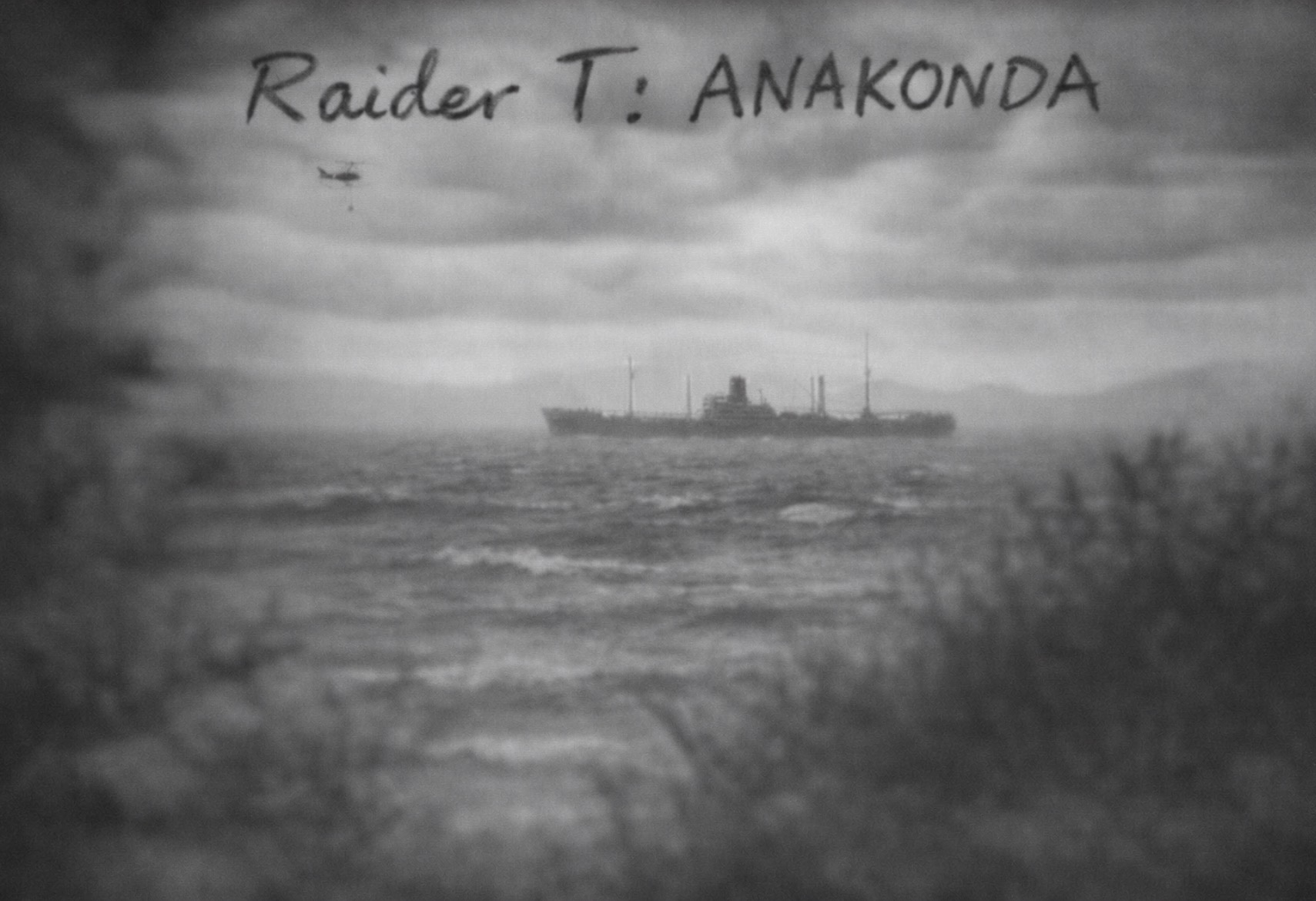
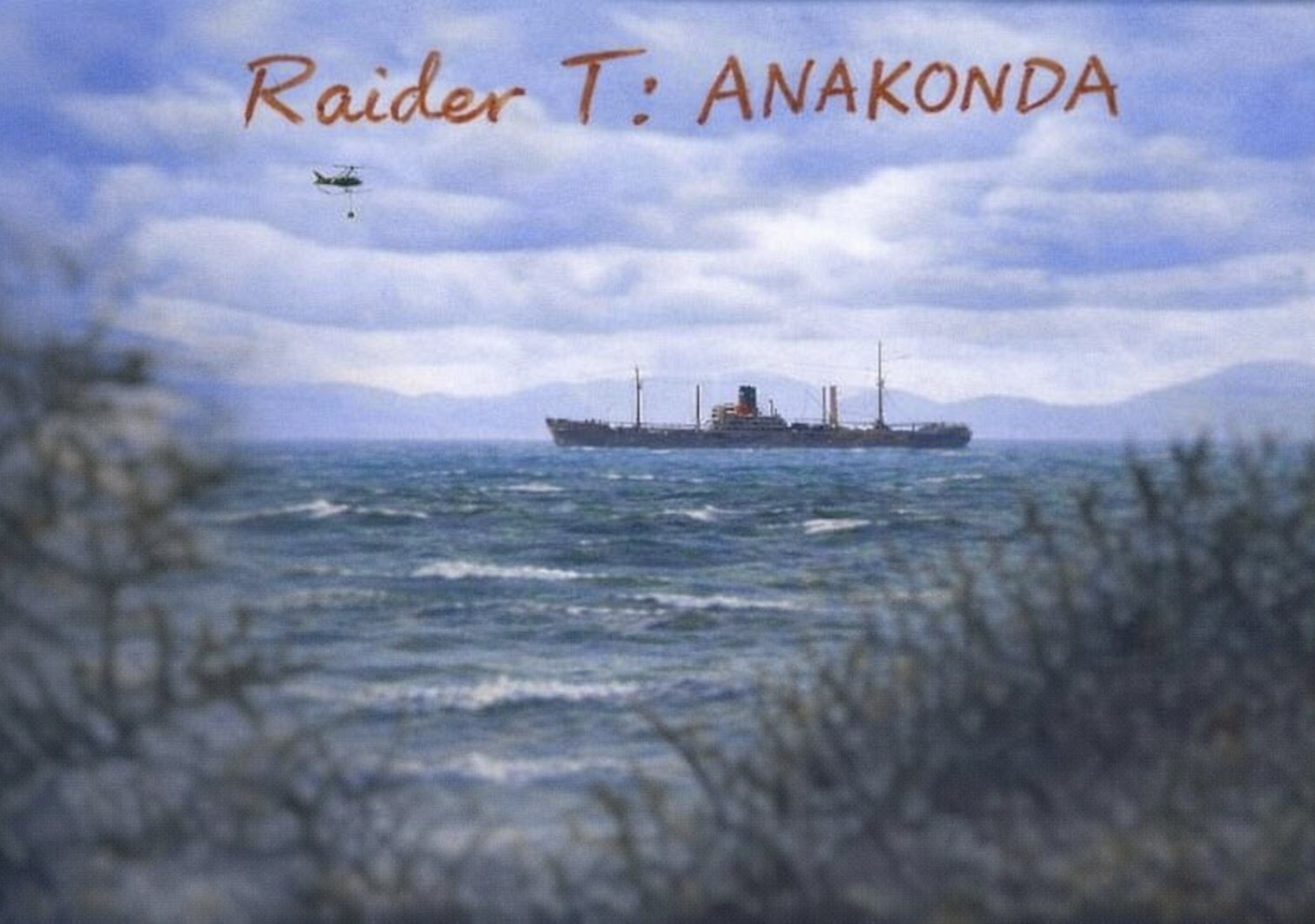
Kreigsmarine Handelsstörkreuzer ANAKONDA receiving stores from a Fa 223 Drache helicopter off Flensburg, photographed covertly by an agent of the Danish security service Sikkerhedspolitiet. At the time of observation the vessel was operating under the guise of the merchantman Kärntenmann, ostensibly conducting sea trials prior to commencing service on the East Asia route. Following this rendezvous, ANAKONDA transited the Little Belt and proceeded into the North Sea.
Second image: later colourised version of the original black-and-white intelligence photograph; colours are conjectural and should not be taken as an accurate representation of original appearance.
Re: Nautical Vignettes
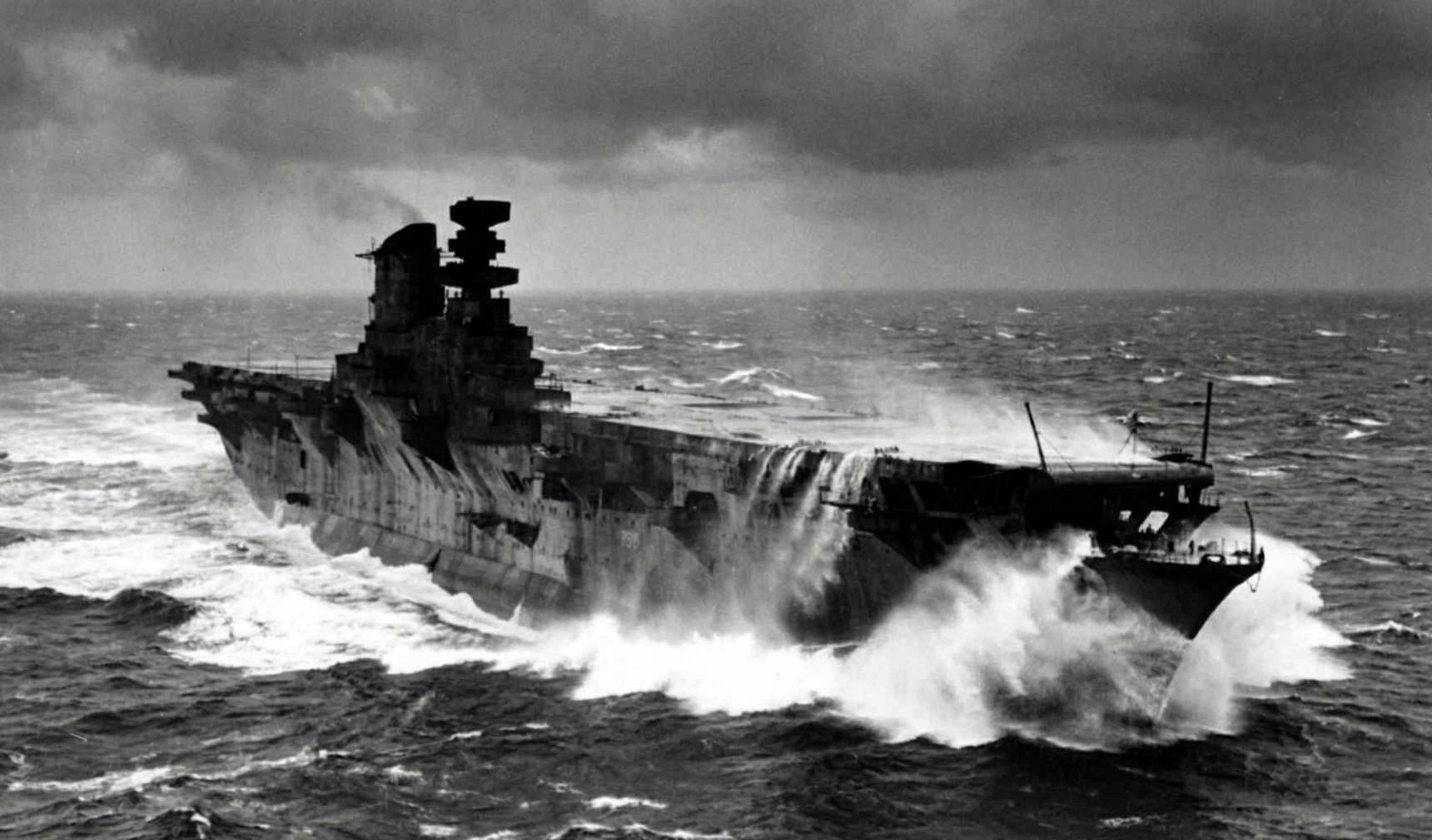
Portaerei Falco labours through a heavy swell around off the Horn of Africa on her maiden visit to Somalia Italiana. Bound for Mogadishu, and supported by battleship Impero, cruisers Pola, Eugenio di Savoia, Paolo Emilio and Vipsanio Agrippa, and eight modern destroyers, it was the first major Italian deployment into the Indian Ocean and a cause for major concern for the Royal Navy.
The flotilla was tailed at a respectful distance by the Royal Navy minelayer Welshman.
A converted ocean liner formerly known as Augustus, Falco and her sister Aquila (formerly Roma) became Italy’s first two aircraft carriers after arduous conversions at Ansaldo in Genoa.
Both liners were completely gutted to allow replacement of the machinery and the addition of a hangar deck and workshops. Deep bulges were added to either side of the hull to improve stability, hull form and provide some element of torpedo defence.
The hull was also lengthened to take advantage of the increased power of the new machinery, and the bow flare increased to increase seaworthiness and provide additional space for air requirements.
The carrier’s new machinery was derived from that fitted to the Capitani Romani-class light cruisers, with each carrier receiving the equivalent of two cruiser sets, with an installed capacity of 151,000shp, enough to reach 30knots.
Initial plans had included a complex system of rails, elevators and catapults to move aircraft around the ship, experience and insight from the Kreigsmarine’s Graf Zeppelin and first to commission Aquila resulted in Falco commissioning with more conventional flight deck arrangements.
Much like Aquila however, her arrestor and recovery systems left a lot to be desired, although fitting of crash barriers improved the situation somewhat.
While Italy’s first through deck aircraft carriers provided opportunity for a burgeoning fleet air arm, their operating areas were beyond Mare Nostrum, with Supermarina wary of the lack of sea room to avoid both air and submarine attack, and Regia Aeronautica’s belief that aircraft carriers were not required for Italian air superiority in the Mediterranean. Compared to the Royal Navy’s Fleet Carriers the sisters were limited but reflective of the internal rivalries within the Italian military.
Italy’s first aircraft carrier built from the keel up: Leonardo Da Vinci, would commission as the European arms race reached its climax in 1949, with a design rooted in lessons learned from Aquila and Falco.
Re: Nautical Vignettes
MOST IMMEDIATE
MOST SECRET
From: Commander-in-Chief, Eastern Fleet
To: Admiralty
1 October 1946
For First Sea Lord and Chiefs of Staff Committee.
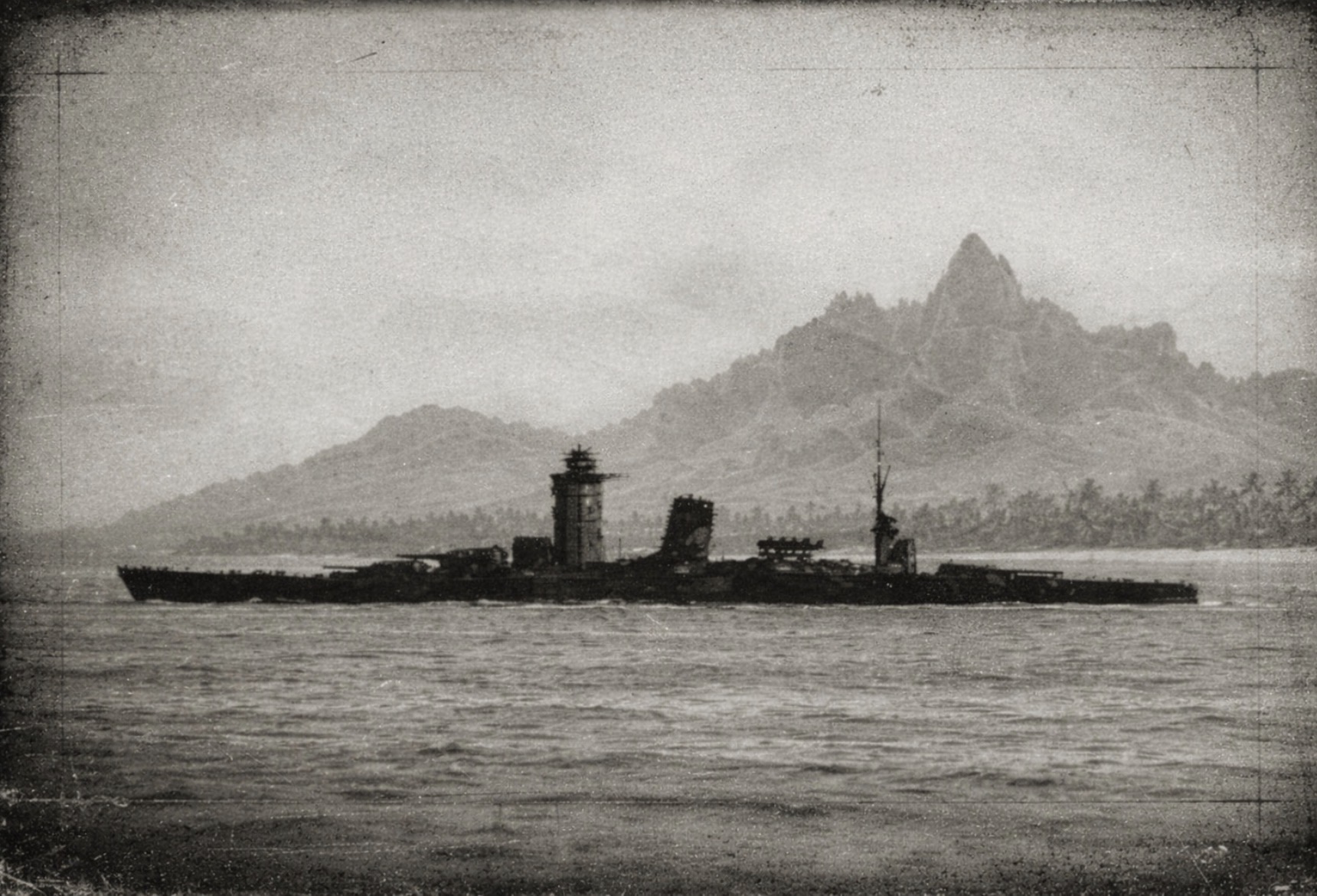
Local Intelligence reports receipt of first photographic evidence of new large Japanese cruisers. Both vessels recently completed fitting-out at Kure Naval Arsenal.
From examination of the photographs, together with other available intelligence, we continue to believe these ships are approximately 30,000 tons deep load, armed with nine 12-inch guns in three triple turrets; maximum speed believed to approach 35 knots. A heavy torpedo armament is also considered probable.
Present assessment remains that these ships were designed and laid down as units of the Japanese battle fleet, intended to engage opposing cruiser and destroyer screens in advance of a general fleet action. In this role they supplement, and are intended in due course to replace, KONGO-class battle-cruisers.
While primarily fleet units, it is also considered likely that in war they could be employed independently against trade, and they carry aircraft for reconnaissance.
Japanese naval authorities appear to assume that we remain unaware of the true character and scale of these vessels, continuing to describe them publicly as “heavy cruisers” intended to replace the FURUTAKA class.
Photograph, together with an approximate profile sketch, will be forwarded to Admiralty as matter of urgency. Copies have also been issued to Captains, Eastern Fleet.
Names of ships are believed to be KITA and YARI, in accordance with Japanese practice of naming first-class cruisers after mountains. Photograph, taken early last month at Truk Lagoon, is believed to show YARI.
Should circumstances require, and when opportunity permits, it is intended to engage these vessels with battle-cruisers.
Burnett.
Re: Nautical Vignettes
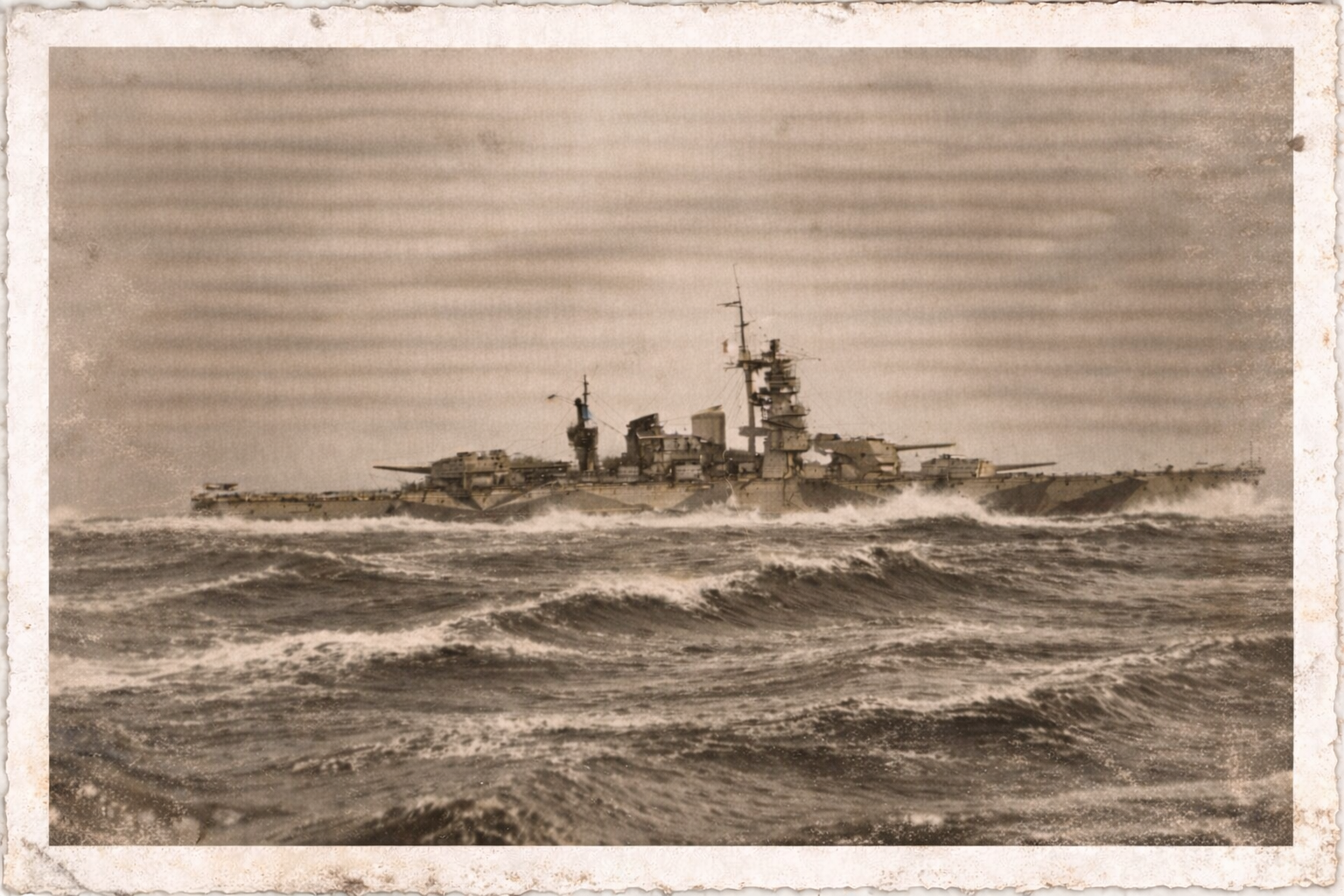
The third pair of Littorio-class battleships were laid down in late 1939 as part of the Regia Marina’s ambitious 1938–39 major fleet plan. The two capital ships were ordered alongside 20 destroyers and 60 submarines, as well as the requisition of the liners Roma and Augustus for conversion to fleet carriers.
In the wake of the orders for Roma and Impero, Supermarina briefly examined the possibility of developing a larger class of battleship armed with 16-inch guns. This option was ultimately rejected on pragmatic grounds, with Italian naval leadership electing instead to repeat the nominally 35,000-ton Littorio-class, retaining its 15-inch gun battery.
Constructed at Cantieri Riuniti dell’Adriatico in Trieste, Lepanto and Venezia took names heavy with historical symbolism: the former invoking one of the foundational battles—and enduring myths—of Italian national unity, the latter recalling the first Italian polity to exercise sustained maritime dominance in the Mediterranean.
Both ships incorporated a series of evolutionary improvements over their predecessors, including revised torpedo-defence arrangements, strengthened anti-aircraft batteries, and updated electronic and fire-control systems.
Despite the concurrent authorisation of two fleet carriers, the new battleships retained organic air complements, initially operating Reggiane Re.2001 fighters, which were replaced by more advanced interceptor aircraft after their commissioning.
The construction of the fifth and sixth Littorio-class units, alongside the first two Sachsen-class battleships of the Kriegsmarine, prompted corresponding French and British responses. The Marine Nationale authorised Alsace and Normandie, while the Royal Navy accelerated work on Monarch and Centurion, the final members of the Lion class, underscoring the renewed capital-ship competition of the early 1940s.
The photograph reproduced here shows Lepanto making speed in rising swells in the Arabian Sea during her first ‘oceanic’ deployment outside the Mediterranean in early 1945. This voyage underscored Italy’s enduring interest in the Indian Ocean—an ambition viewed with continued unease by British naval planners.
-
jemhouston

- Posts: 6547
- Joined: Fri Nov 18, 2022 12:38 am
Re: Nautical Vignettes
Thank you for sharing.
-
Belushi TD
- Posts: 1901
- Joined: Thu Nov 17, 2022 11:20 am
Re: Nautical Vignettes
OOOoooo, I see some interesting stuff here....
Is this part of a universe you're developing, or is it the logical extension of naval construction in the absence of a general war not starting until the late 40's? Either way, I want more!
Belushi TD
Is this part of a universe you're developing, or is it the logical extension of naval construction in the absence of a general war not starting until the late 40's? Either way, I want more!
Belushi TD
Re: Nautical Vignettes
Hotel am Tiergarten
Berlin
30 June 1941
Dear George,
When we met Sunday last, I said I would send you a dispatch from my travels in Germany if I came across anything of interest. It may be that a man of your means knows all of what is to follow, but I dare not omit anything that may be useful.
As expected, our friend from the Ministry invited me to the launch of Bülow in Kiel. We generally talked shop – he did let fall one or two interesting things about German cruiser policy. I shall show you my copious notes at Clementine’s wedding in two weeks.
In advance of that, however, I wanted to let you know about an intriguing and, I think, instructive story that was recounted to me by one of the senior bods at Germaniawerft.
Unlike our vessels, German ships, irrespective of their size, are named at launch and not before. Before launch, they are known by a letter. Bülow was Kreuzer Q. She is, of course, named after Friedrich Wilhelm Freiherr von Bülow, Graf von Dennewitz, the Defender of Berlin.
The chap I was speaking to told me that the Reichsmarine ship naming committee had decided some months before that the ship was to be named Schleicher, after the late General Kurt von Schleicher, whose taste for intrigue, you will remember, brought him to an unhappy end on the Night of the Long Knives in ’34.
At the shipyard, all the preparations had been made for Kreuzer Q to be named Schleicher, from the invites to the nameplates, even the ship’s bell. The man from the Ministry even dropped into conversation that the late General’s sister, Thusnelda von Gaudecker, had been approached to christen the ship.
The response to this proposal, however, is perhaps an indication that the reconciliation amongst the different German factions is not as complete as we may suppose. I was told that when news of that name reached the Government, especially the subcommittees of the State Coordination Commission (StKK), there was uproar.
Several of the usual suspects still in Government, most prominently Todt and Hanke on the State Administration Committee and Frick on the State Security Committee, reckoned the choice unnecessarily inflammatory considering the nature of Schleicher’s demise. There were, they argued, many more deserving Germans to honour before a ‘Prussian office boy’ who had spent the last war on the General Staff rather than in the field. They regarded it as an anti-Nazi gesture and reminded their colleagues that the Nazis remained a necessary part of the Government of National Necessity. One could not, they suggested, disregard either their place in the Government or the number of their supporters who might still be brought out on to the streets.
When the Oberkommando der Marine, the German naval high command and never particular friends of the Nazis, indicated they would continue with the name, they were apparently told in no uncertain terms that the tentative reconciliation would be challenged and that there could be civil unrest and violence from old SS men in a number of cities across the country.
It appears that this warning was eventually heeded by the OKM and the decision was taken at short notice that the name would need to change. Quite how it was managed, my sources could not say, nor how Bülow came to be chosen, but very quickly Frau von Gaudecker was told, with many regrets, that she would not be needed after all, while the shipyard hurried to have new nameplates and a new bell cast.
I cannot say whether the threat of disorder was quite as serious as it was represented. It was enough, at any rate, to remind the OKM that discretion is the better part of valour. One does wonder how united the ‘new’ Germany really is, when the naming of a ship can cause such a row.
The ship was launched last week, and I understand that she is expected to be ready for sea before the end of 1943. I enclose a photo which came my way in Kiel, and a reminder of the published particulars for this class of cruiser, for what they are worth.
I shall commit no more to paper. I hope this letter finds you well, and I look forward to seeing you at Alderley Park.
Yours,
Robert
Enc.
Albrecht der Beherzte/‘Repeat Hipper’
(Albrecht der Beherzte, Bülow, 3 more vessels building)
10,000 tons; 665ft oa; 8x8in (4x2); 12x4.1in; 12x21in torpedo tubes
32kts, triple screws
You do not have the required permissions to view the files attached to this post.
-
Belushi TD
- Posts: 1901
- Joined: Thu Nov 17, 2022 11:20 am
Re: Nautical Vignettes
8 x 8 inch guns, 32 knots on 10K tons? Either someone's lying or they're poorly armored.
Very cool!
Where are you getting the pictures from?
Belushi TD
Very cool!
Where are you getting the pictures from?
Belushi TD
Re: Nautical Vignettes
Thanks!Belushi TD wrote: ↑Tue Oct 27, 2026 2:31 pm 8 x 8 inch guns, 32 knots on 10K tons? Either someone's lying or they're poorly armored.
Very cool!
Where are you getting the pictures from?
Belushi TD
On the 10,000t point, as you may surmise, is the nominal weight of the ships...much like the earlier Hippers/
I am getting the pictures from real ones (this is an original picture of Prinz Eugen launching) and then using trial and error on ChatGPT to tweak things over a period of time.
Re: Nautical Vignettes
Thanks - and apologies for not responding sooner!Belushi TD wrote: ↑Tue Feb 10, 2026 2:39 pm OOOoooo, I see some interesting stuff here....
Is this part of a universe you're developing, or is it the logical extension of naval construction in the absence of a general war not starting until the late 40's? Either way, I want more!
Belushi TD
In terms of the scenario
It is a very loosely plotted 1940s/50s which has become a sandpit for me to play in - whether that's photo editing or writing little snippets like this. The basic outline is that the Oster conspiracy succeeds, and there is a transition to a right wing, authoritarian conservative government - initially military led, known as Regierung der nationalen Notwendigkeit (RNN) - the Government of National Necessity. This is also referred to as the ‘emergency government period’ and runs from 1938-1946. The RNN is lead by the Staatskoordinationkommission (StKK) State Coordination Commission which has 25 members all appointed by the military, and lead by a Chairman from within its numbers.
In 1946, this begins to change, and there is a referendum on a new constitution. It marks an evolution to a governing ideology of Germany, set out in the new constitution, as Militärziviltechnokratie. A form of governance characterized by the integration of military command structures, the civil administration, and technocratic leadership.
In the 1940s, this Germany calls 1933-1938 the Krisenzeiten - the crisis times, and the transition away from the Nazis is demonstrated by a return for the old imperial flag. Nazi's remain - with only the 'Hitlerites' killed during the coup, and they remain a well supported political party. Due to their levels of support, they do hold some power within the new Government, but distance themselves from the behaviour of the 'Hitlerites' who they say peverted true Nazi-ism.
Anyway, that's how it works in my head!
You do not have the required permissions to view the files attached to this post.
Last edited by RJGFox on Tue Oct 27, 2026 10:04 pm, edited 1 time in total.
Re: Nautical Vignettes
A Junkers Ju 350 B – one of 18 B-series aircraft built – climbs out of Theodorichshafen in Festung Gothia. The Ju 350 played a key role in supplying distant German outposts across Eastern Europe.
Gothia was established in 1943, once the Heer had driven the Western Soviet (the contemporary USSR) out of the Don Basin and stabilised the front on a line midway between Moscow and Kazan. Unlike other Germanic states created in the same period, such as the Germanisch-Baltischer Freistaat (Variously known in embassy’s around the world as: Baltic Free State; Baltic Republic, Livonia and the ‘so-called Baltic Free State’) or the Freistaat der Wolgadeutschen (Volgaland), Gothia made no pretence of being anything other than a German colony. It was founded, it was claimed, on "ancestral Germanic soil, home of the Goths who fought off the Asiatic hordes, now renewed as a mighty Festung on the Black Sea, home to a new generation of Germans. The southernmost bastion in the great arc of the Germanic frontier, and the keystone of our destiny as not merely a European power, but a world power."
By 1950 Gothia's 350,000 German colonists, resettled from across Europe, lived alongside 200,000 Crimean Tatars, who had limited rights of self-government within the colony. Theodorichshafen hosted a large Luftstreitkräfte airbase and was home port to a flotilla of light cruisers and destroyers that policed the Black Sea.
Yet Gothia was not only a Festung: it was also a burgeoning tourist destination, with several spa towns being developed and new mountain resorts built inland.
You do not have the required permissions to view the files attached to this post.
-
Belushi TD
- Posts: 1901
- Joined: Thu Nov 17, 2022 11:20 am
Re: Nautical Vignettes
Ok, so there was a WWII analog. The only countries I can deduce were involved are the new Germany and the Soviet Union. I assume Poland was swallowed in the process.
I also very much like the pic of the Ju 350 B. Did the Germans go in for labeling each evolution of a plane with a letter? I thought they used a different system.
Are there more of these vignettes sitting around, or are we in the position of waiting for your muse to come for a visit?
Belushi TD
I also very much like the pic of the Ju 350 B. Did the Germans go in for labeling each evolution of a plane with a letter? I thought they used a different system.
Are there more of these vignettes sitting around, or are we in the position of waiting for your muse to come for a visit?
Belushi TD
Re: Nautical Vignettes
Thanks!Belushi TD wrote: ↑Wed Oct 28, 2026 1:00 pm Ok, so there was a WWII analog. The only countries I can deduce were involved are the new Germany and the Soviet Union. I assume Poland was swallowed in the process.
I also very much like the pic of the Ju 350 B. Did the Germans go in for labeling each evolution of a plane with a letter? I thought they used a different system.
Are there more of these vignettes sitting around, or are we in the position of waiting for your muse to come for a visit?
Belushi TD
In my timeline/sandpit, the 1938 Oster coup prevents the Second World War as we know it, leaving Britain and Germany in a prolonged phoney war rather than open conflict. The situation changes in 1942, when a Soviet invasion of the Baltic states triggers what I call the Eastern War proper. Moscow claims it is acting to protect the independence of the Baltic peoples from German hegemony, but Germany responds by sending forces through Poland to repel the Soviet advance. This develops into a rapid German-led offensive analogous to Operation Barbarossa, although I haven’t yet explored the Polish role in the campaign - or the phoney war for that matter - in any detail.
The German advance is initially very successful. By 1943, the Heer has driven Soviet forces out of the Don Basin, and the front first stabilises in 1944, with the broad territorial settlement is established by 1946. By 1950, the war has effectively frozen, although is generally considered to be on pause rather than over.
There is no formal armistice or comprehensive peace settlement. Instead, German forces and the surviving Soviet authorities agree to a generally observed ceasefire, running roughly along an Arkhangelsk–Astrakhan line, although some sectors are considerably hotter than others. My initial thinking is that Moscow remains within a Reichskommissariat in the first instance. The result is an uneasy and heavily militarised frontier, with neither side (the former USSR now called the ‘Western Soviet and only effectively controlling what’s left of western USSR) having formally abandoned the possibility of resuming the war.
Behind the front line, Germany establishes a belt of aligned states and dependent territories, partly to consolidate its gains and partly to ensure that Russia remains divided. Volgaland is a regime that depends heavily on German support and is propped up by the activities of the little grey men. The Baltic Free State (Latvia and Estonia) has a defence treaty with the Reich and hosts German military bases, while Lithuania remains independent but German aligned. Further north, the Joint Republic of Novgorod and Neva incorporates St Petersburg, while Moscow is eventually envisaged as an International City, although I haven’t yet worked out the precise relationship between that status and its initial incorporation into a Reichskommissariat.
To the south, there is Ukraine, and Don Republic with further towards the Caspian, the Kalmyk Republic. Combined this fits into the broader German strategy of dividing the former Russian territories and preventing the emergence of a single, powerful successor state while also allowing German exploitation of natural resources and population in the area.
Crimea is a special case. Gothia is an explicitly German colonial possession rather than a nominally independent state. I see Gothia as an example of Germany’s more direct imperial ambitions, in contrast to the client states elsewhere in its sphere of influence. I’m exploring the possibility of another colony elsewhere, but not made much progress there.
Beyond this German-dominated belt lies the Western Soviet: the remnants of the Soviet Union left in the west. Beyond that, things become much less certain, and I haven’t yet worked out what the political geography of the territories further east looks like yet.
Overall, the idea is that by 1951 Germany has won a significant - but temporary - military victory without actually ending the war. It has established a new order across much of Eastern Europe and western Russia, but that order remains dependent on military power, a collection of often fragile client regimes, and a ceasefire that could break down at any time.
Apologies this is a bit of a stream of consciousness. It’s my current main form of stress relief so I’m colouring in with vignettes and then trying to make it fit/retconning after!
I have a few more vignettes in final form and then a few other in various stages of completion - and then I have a (probably fantastical) desire to write a central narrative too.
In terms of the numbering of the Ju 350. It’s a EF100 in real life with a RLM number estimated from the ranges given to Junkers.
They did use the lettering sequence although seperate from the number and often in their phonetic alphabetic (for eg the most famous being Bf109 Emil and Fw190 Dora)
Wikipedia says that
Once accepted by Deutsche Lufthansa or the Luftwaffe, major variants of the aircraft were suffixed alphabetically with a capital letter. For example, the major variants of the Me 262 were numbered Me 262 A, Me 262 B, and Me 262 C, often using the German "spelling alphabet" for each major variant's letter. While usually sequential alphabetically, this was not always followed; the He 111H followed the He 111P, and the Ju 87R was a long-range (Reichweite) variant of the Ju 87B.
More minor variants were then suffixed numerically, beginning with "-0" for pre-production evaluation versions. Thus, the first batch of Me 262 As supplied by Messerschmitt were designated Me 262 A-0, followed by production versions Me 262 A-1 through to (in the case of this particular aircraft) Me 262 A-5.
More minor variants still were given a lower case alphabetical suffix. When the Me 262 A-1a was to be experimentally equipped with different engines, in this given case the BMW 003 units, it became the Me 262 A-1b.