Star Trek: United Kingdom – The Last Bastion (AU/AI Lore | 1940–2402)

Fiction stories and articles written by members.
Lordroel
Posts: 1420
Joined: Thu Nov 17, 2022 10:49 am
Contact:

Re: Star Trek: United Kingdom – The Last Bastion (AU/AI Lore | 1940–2402)

Post by Lordroel »

So last one for today, would love to hear comments, what you guys think, what you love to see and other things.

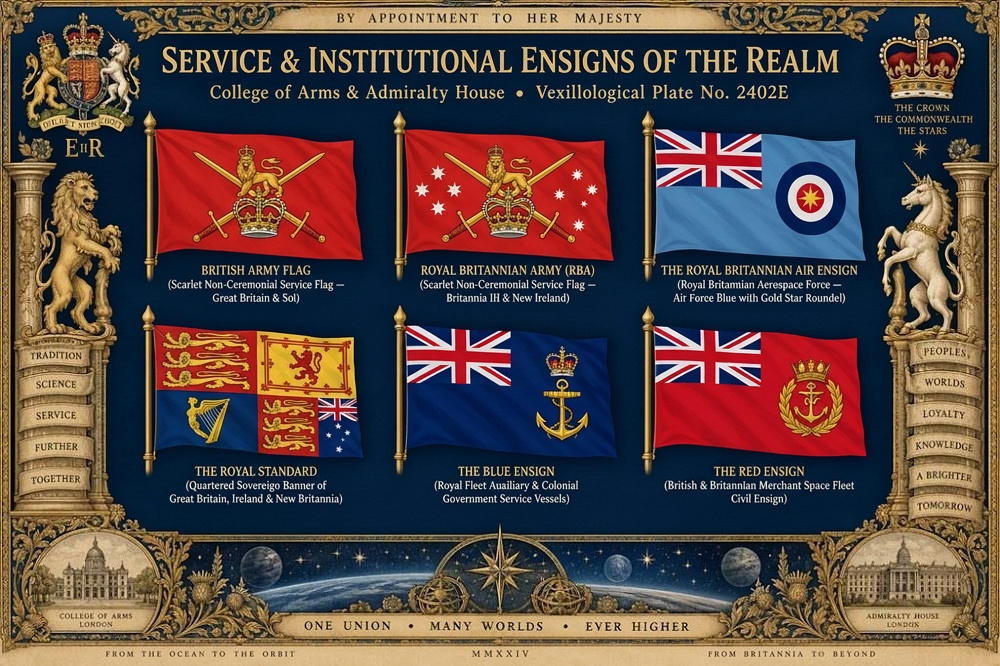
College of Arms & Admiralty House — Vexillological Plate No. 2402E: Service & Institutional Ensigns of the Realm (2402)
Image

Institution: College of Arms (London, Earth & New London, Britannia III) & Admiralty House

Motto: "One Union • Many Worlds • Ever Higher" ("From the Ocean to the Orbit • From Britannia to Beyond") Complementing Vexillological Plate No. 2402 (Heraldry, Flags & Ensigns of the Dual Union) and Vexillological Plate No. 2402C (Provincial Flags of Britannia III), this official College of Arms and Admiralty House reference chart presents the six principal military, royal, auxiliary, and civil service flags flown across Great Britain, Sol, Epsilon Indi, and the Three Crown Protectorates in 2402:

• British Army Flag (Non-Ceremonial Service Flag — Great Britain & Sol): Scarlet-red service banner bearing the gold Royal Crest (crowned Lion statant upon the Royal Crown) over two crossed gold swords—flown over Horse Guards, Whitehall, and British Army garrisons across Earth and the Sol System.

• Royal Britannian Army (RBA) Flag (Non-Ceremonial Service Flag — Britannia III & New Ireland): Modelled directly on the British Army's scarlet service banner—retaining the identical scarlet field, gold Royal Crest, and crossed gold swords—charged with four white-and-gold stars of the Southern Cross flanking the central crest to signify New Britannia (Britannia III) and the Beta Quadrant command.

• The Royal Britannian Air Ensign (Royal Britannian Aerospace Force — RBAF): Air-force sky-blue service ensign with the Dual-Union Flag in the upper hoist canton and the Britannian Aerospace Roundel (red-white-and-blue target charged with an eight-pointed gold star) in the fly—flown over RBAF New Cranwell, New Aldergrove, and Epsilon Indi aerospace stations.

• The Royal Standard (Quartered Sovereign Banner of Great Britain, Ireland & New Britannia): Quartered sovereign banner uniting the three Lions passant guardant of England, the Lion rampant of Scotland, the gold Harp of Ireland/New Ireland, and the Golden Lion & Southern Cross of New Britannia—flown wherever His/Her Majesty is in residence, from Buckingham Palace and Windsor Castle to Victoria House and aboard HMS Sovereign.

• The Blue Ensign (Royal Fleet Auxiliary & Colonial Government Service Vessels): Deep royal-blue naval auxiliary ensign with the Dual-Union Flag in the canton and a gold fouled anchor surmounted by the Royal Crown in the fly—flown by Royal Fleet Auxiliary (RFA) fleet replenishment tankers, ammunition ships, and Crown Protectorate government vessels.

• The Red Ensign ("The Red Duster" — British & Britannian Merchant Space Fleet): Crimson-red civil ensign with the Dual-Union Flag in the canton and a gold Trinity House star-and-anchor badge in the fly—flown by Cunard-White Star Interstellar luxury liners, Royal Mail express packets, and independent British merchantmen across the Alpha and Beta Quadrants.
Lordroel
Posts: 1420
Joined: Thu Nov 17, 2022 10:49 am
Contact:

Re: Star Trek: United Kingdom – The Last Bastion (AU/AI Lore | 1940–2402)

Post by Lordroel »

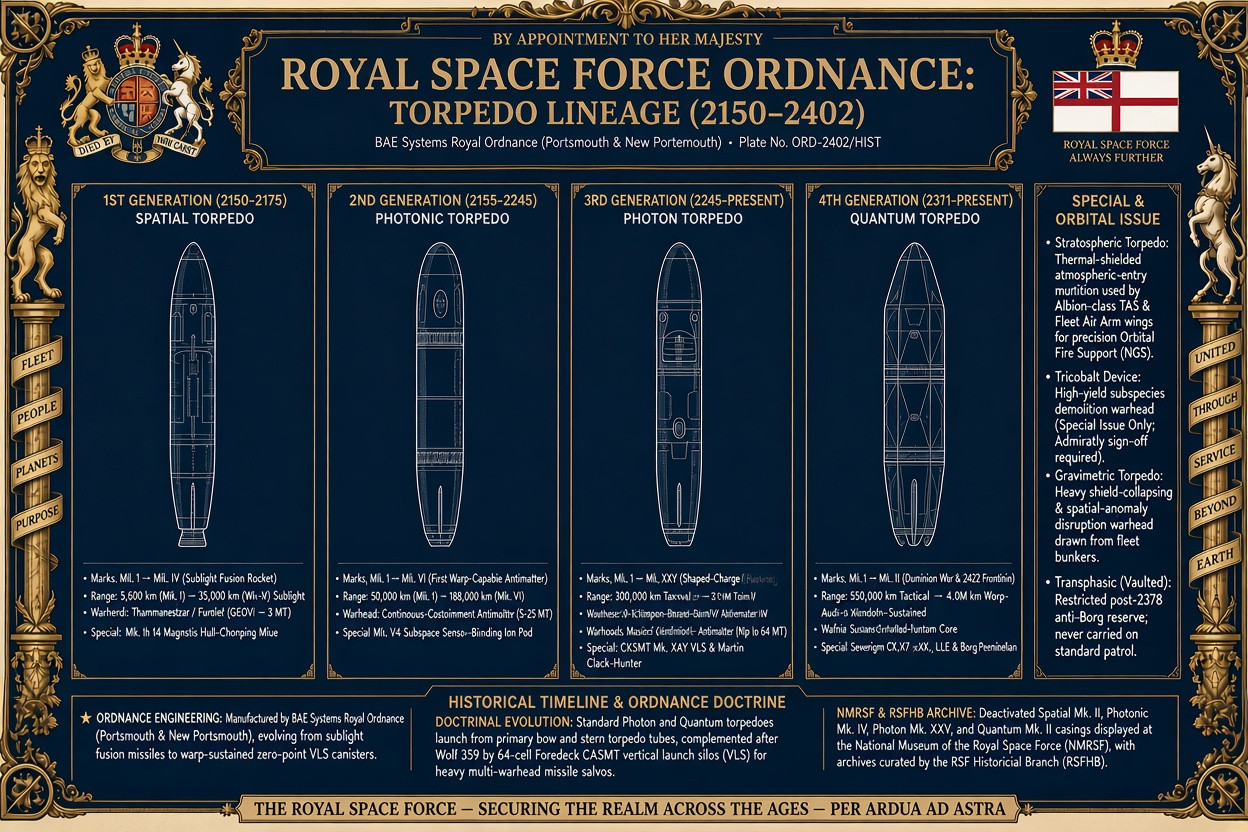
Admiralty Directorate of Naval Ordnance & National Museum of the Royal Space Force — Plate No. ORD-2402/HIST: Royal Space Force Ordnance — Torpedo Lineage (2150–2402)

Image

Manufacturer: BAE Systems Royal Ordnance (Broad Oak, Portsmouth & New Portsmouth, Britannia III)
Institutions: Admiralty Directorate of Naval Ordnance, Royal Space Force Historical Branch (RSFHB) & National Museum of the Royal Space Force (NMRSF — Portsmouth & New Portsmouth)
Motto: "Securing the Realm Across the Ages • Per Ardua ad Astra"

Tracing over two and a half centuries of British naval missile and torpedo engineering from the early sublight patrol cruisers of the 2150s to the 64-cell Foredeck CASMT vertical launch silos (VLS) of 2402's Type 100 Lion-class battlecruisers and Type 82 heavy cruisers, this official Admiralty and National Museum of the Royal Space Force (NMRSF) technical chart profiles the four generations of Royal Space Force (RSF) space torpedoes alongside specialized mission-issue warheads:

• 1st Generation — Spatial Torpedo (2150–2175 | Mk. I → Mk. IV):

- Propulsion & Guidance: Sublight solid/chemical plasma rocket engine with radar and early LIDAR seeker (incapable of warp flight).
- Effective Range: 5,000 km (Mk. I) → 25,000 km (Mk. IV) sublight ballistic arc.
- Warhead & Yield: Conventional high-explosive / shaped thermonuclear fusion warhead (500 kt → 5 MT).
- Special RSF Variant: Mk. III-M Magnetic Hull-Clamping Anti-Ship Mine, widely deployed by early RSF destroyers during the 2156–2160 Earth–Romulan War.

• 2nd Generation — Photonic Torpedo (2155–2245 | Mk. I → Mk. VI):

- Propulsion & Guidance: Micro-impulse thruster with early warp-field sustainer coils—Britain's first warp-capable torpedo, achieving over fifty times the effective range of the Spatial Torpedo.
- Effective Range: 50,000 km (Mk. I) → 180,000 km (Mk. VI).
- Warhead & Yield: Variable-yield matter/antimatter warhead (5 MT → 25 MT) requiring continuous magnetic containment power inside armoured shipboard magazines.
- Special RSF Variant: Mk. V-I Subspace Sensor-Blinding Ion Pod, engineered to disrupt early Romulan targeting arrays.

• 3rd Generation — Photon Torpedo (2245–Present | Mk. I → Mk. XXV):

- Propulsion & Guidance: High-output warp-field sustainer coils paired with multi-spectrum autonomous AI seekers and self-contained magnetic containment bottles.
- Effective Range: 300,000 km standard tactical engagement range → 3,500,000 km maximum warp-sustained range.
- Warhead & Yield: Shaped-charge pure positron-electron antimatter core (1.5 kg max reactant = 64 MT standard; up to 80 MT on Mk. XXV) designed to penetrate modern deflector shields and Chobham-Duranium armour.
- Special RSF Variants: CASMT Mk. XXV (Vertical Launch System modular cluster canister), Merlin-P (Tachyon Cloak-Hunter), and unarmed Class-8/9 scientific probe casings.

• 4th Generation — Quantum Torpedo (2371–Present | Mk. I → Mk. III):

- Propulsion & Guidance: Advanced warp-sustainer drive with zero-point inertial dampeners and quantum-lock target acquisition inside a faceted stealth-charcoal BAE Systems VLS casing.
- Effective Range: 350,000 km standard tactical engagement range → 4,000,000 km maximum warp-sustained range.
- Warhead & Yield: Plasma/antimatter initiator paired with a zero-point quantum-vacuum energy core (160+ MT equivalent destructive output—over twice the yield of a standard Mk. XXV photon torpedo).
- Special RSF Variants: Sovereign CASMT-Q (Heavy VLS anti-capital and Borg shield-penetration warhead), standardized across frontline RSF battlecruisers, heavy cruisers, and destroyers following post-Wolf 359 modernization.

• Special & Orbital Issue (Mission-Specific Loadout):

In routine patrol and fleet operations, RSF warships launch standard Photon and Quantum torpedoes from primary bow and stern torpedo tubes, complemented after Wolf 359 by 64-cell Foredeck CASMT vertical launch silos (VLS) for heavy multi-warhead missile salvos. Specialized warheads are drawn strictly for dedicated missions:

- Stratospheric Torpedo: Thermal-shielded atmospheric-entry munition carried operationally by Albion-class Transorbital Assault Ships (TAS) and Fleet Air Arm strike wings for precision Orbital Fire Support / Naval Gunfire Support (NGS) without the catastrophic collateral fallout of full-yield antimatter warheads.
- Tricobalt Device: Ultra-high-yield subspace demolition warhead stored in hardened HMNB bunkers (Special Issue Only; Fleet Flag Officer / Admiralty sign-off required due to subspace-rift hazards).
- Gravimetric Torpedo: Heavy shield-collapsing and spatial-anomaly disruption warhead drawn from fleet ordnance bunkers for specialized operations.
- Transphasic Torpedo (Vaulted Reserve): Strictly compartmentalized post-2378 anti-Borg reserve held under joint Admiralty–Starfleet security protocols; never carried on standard patrol.
- Isolytic Subspace Weapons: Strictly prohibited under the Second Khitomer Accords; RSF tactical sensors monitor for isolytic signatures solely to detect treaty violations.

Archive Note: Deactivated Spatial Mk. II, Photonic Mk. IV, Photon Mk. XXV, and Quantum Mk. II casings—together with original BAE Systems Royal Ordnance technical blueprints curated by the Royal Space Force Historical Branch (RSFHB)—are preserved on permanent display at the National Museum of the Royal Space Force (NMRSF) in Portsmouth and New Portsmouth.
User avatar
jemhouston
Posts: 6606
Joined: Fri Nov 18, 2022 12:38 am

Re: Star Trek: United Kingdom – The Last Bastion (AU/AI Lore | 1940–2402)

Post by jemhouston »

Do they replace the warhead and use an instrument package?
Lordroel
Posts: 1420
Joined: Thu Nov 17, 2022 10:49 am
Contact:

Re: Star Trek: United Kingdom – The Last Bastion (AU/AI Lore | 1940–2402)

Post by Lordroel »

jemhouston wrote: ↑Fri Nov 27, 2026 10:21 pm Do they replace the warhead and use an instrument package?
If you mean torpedoes being used as probes, then yes they are like the once used by Starfleet are converted standard photon torpedo casings into probes, The RSF and the those who do studying remove the positron-antimatter warhead from a standard Photon Torpedo (Mk. XXV) casing and bolt in a modular BAE Systems / Royal Society sensor and telemetry package. Because the casing already has its own warp-sustainer drive, thrusters, and subspace transmitter, any ship with standard torpedo tubes can fire quick, expendable reconnaissance probes at warp—saving the much larger 42-metre Shackleton-class heavy hazard probes (carried in battlecruiser and heavy cruiser shuttlebays) for extreme environments like stellar coronas, collapsing binary stars, or heavily jammed combat zones.
Lordroel
Posts: 1420
Joined: Thu Nov 17, 2022 10:49 am
Contact:

Re: Star Trek: United Kingdom – The Last Bastion (AU/AI Lore | 1940–2402)

Post by Lordroel »

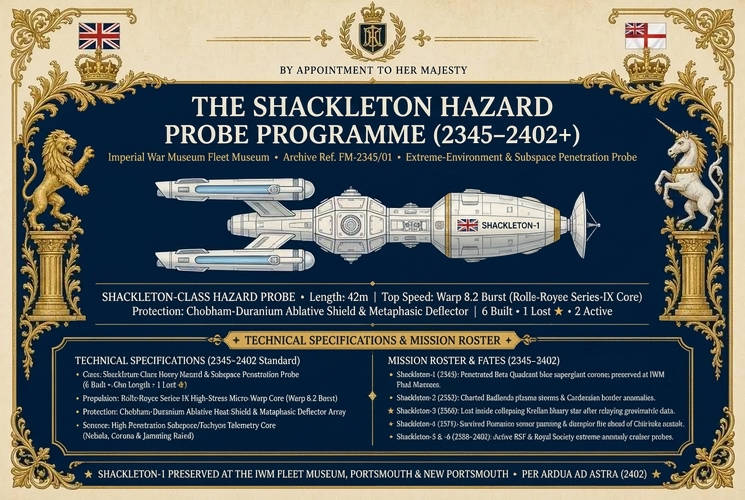
Imperial War Museum Fleet Museum Archive Ref. FM-2345/01 — The Shackleton Hazard Probe Programme (2345–2402+)

Image

Institution:

Imperial War Museum (IWM) Fleet Museum (Orbital Annex above New Britannia [Britannia III], HMNB Portsmouth & HMNB New Portsmouth) Operating Service: Royal Space Force (RSF) Astrometrics, RSF Intelligence & The Royal Society Spacecraft Class: Shackleton-Class Heavy Hazard & Subspace Penetration Probe (6 Built • 42m Length • 1 Lost ★ • 2 Active) Propulsion & Top Speed: Rolls-Royce Subspace & Warp Systems Series-IX High-Stress Micro-Warp Core (Warp 8.2 Burst Speed) Protection & Sensors: Chobham-Duranium Composite Ablative Heat-Shield Nose Cone & Metaphasic Navigational Deflector Array; High-Penetration Subspace/Tachyon Telemetry Core (Rated for Stellar Coronas, Dense Nebulae & Heavy Subspace Jamming)

Motto: "Per Ardua ad Astra" (Through Adversity to the Stars)

Architecture & Historical Significance:

Named after polar explorer Sir Ernest Shackleton and evolved directly from the proven catamaran-nacelle chassis of the 2212–2255 Cook Interstellar Probe Programme, the six unmanned Shackleton probes (Shackleton-1 through Shackleton-6) were commissioned in the mid-24th century to penetrate extreme astrophysical hazards and heavily jammed combat zones where crewed starships could not safely enter. Replacing the Cook's long forward sensor truss with an armoured Chobham-Duranium ablative heat-shield cone and a high-output metaphasic deflector dish, the Shackleton-class proved indispensable during the Cardassian Border Wars, the Dominion War, and 25th-century deep-space anomaly surveys.

Mission Roster & Fates (2345–2402+):

• Shackleton-1 (Launched 2345): Prototype metaphasic-shielded hazard explorer; plunged into the upper corona of a Beta Quadrant blue supergiant before being recovered and preserved intact at the IWM Fleet Museum alongside Beagle-1 and Cook-1.

• Shackleton-2 (Launched 2352): Mapped dense plasma storms in the Badlands and monitored Cardassian border anomalies; retired to Royal Society orbital calibration duty in 2381.

• ★ Shackleton-3 (Launched 2368): Lost inside a collapsing binary star system near the Krellan frontier after transmitting breakthrough gravimetric telemetry; memorialized on the IWM Fleet Museum Roll of Honour.

• Shackleton-4 (Launched 2374): Deployed during the Dominion War into heavily jammed Dominion sensor corridors ahead of the Chin'toka offensive, surviving multiple Jem'Hadar disruptor hits to relay fleet targeting coordinates; decommissioned in 2392.

• Shackleton-5 & Shackleton-6 (Launched 2388 & 2395): Active front-line extreme-environment probes embarked aboard RSF Type 82 Heavy Cruisers and Royal Society Survey Cruisers for deep-nebula, pulsar, and subspace-rift penetration in 2402.
Lordroel
Posts: 1420
Joined: Thu Nov 17, 2022 10:49 am
Contact:

Re: Star Trek: United Kingdom – The Last Bastion (AU/AI Lore | 1940–2402)

Post by Lordroel »

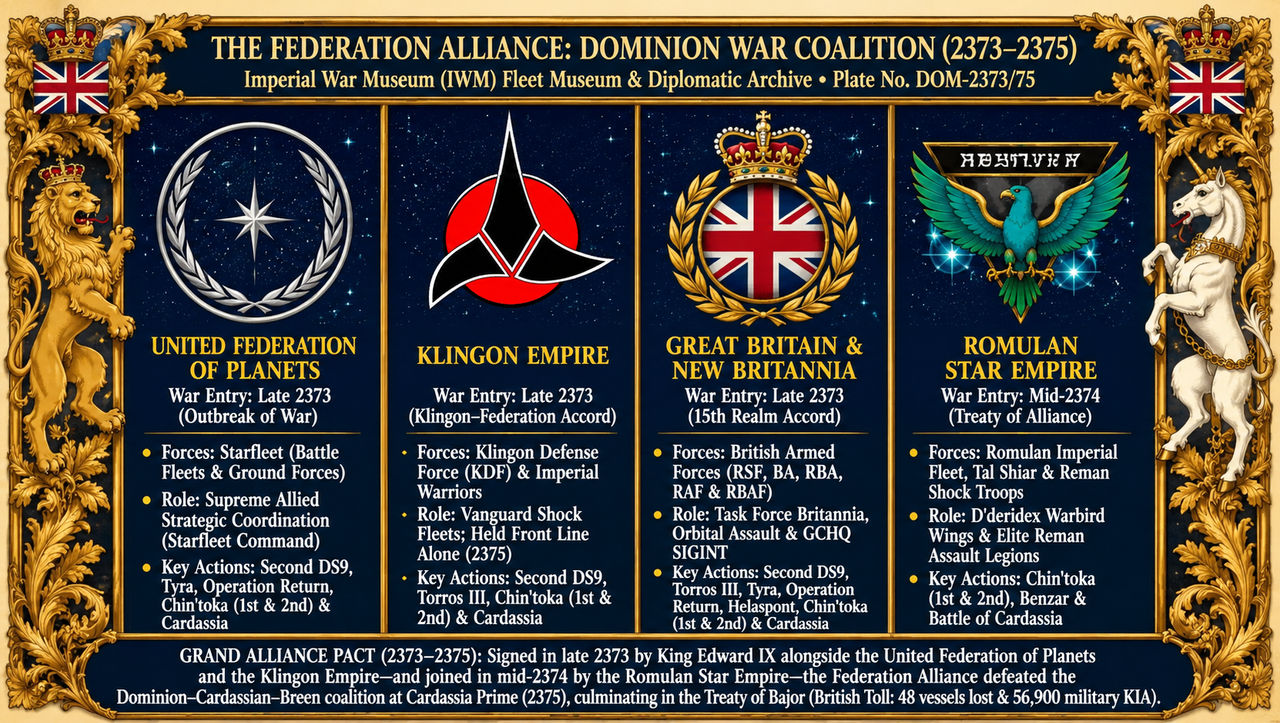
Imperial War Museum (IWM) Fleet Museum & Diplomatic Archive — Plate No. DOM-2373/75: The Federation Alliance — Dominion War Coalition (2373–2375)

Image

Institution: Imperial War Museum (IWM) Fleet Museum & Dual-Union Diplomatic Archive Motto: "Four Powers, One Front • Defending the Alpha & Beta Quadrants (2373–2375)" Preserved on permanent memorial display at the Imperial War Museum (IWM) Fleet Museum in orbit above New Britannia, this official diplomatic and military reference plate commemorates the four allied powers of the Federation Alliance during the Dominion War (2373–2375):

• United Federation of Planets (War Entry: Late 2373 — Outbreak of War): - Forces Under Command: Starfleet (Battle Fleets, Tactical & Starfleet Ground Forces). - Coalition Role: Supreme Allied strategic coordination through Starfleet Command, deploying multi-sector Defiant-, Galaxy-, and Sovereign-class battle fleets across every major front. - Key Actions: Second Battle of Deep Space 9 (2373), the devastating Battle of the Tyra System (2374 — where Starfleet's Seventh Fleet suffered 98 ships lost out of 112 committed), Operation Return (2374), First & Second Battles of Chin'toka (2374–2375), and the Battle of Cardassia (2375).

• Klingon Empire (War Entry: Late 2373 — Reinstatement of the Klingon–Federation Accord): - Forces Under Command: Klingon Defense Force (KDF) & Imperial Ground Warriors. - Coalition Role: Vanguard shock fleets and cloaked Bird-of-Prey raiding wings—famously holding the entire Allied front line alone during the 2375 Breen energy-dampening weapon crisis while Allied ships underwent urgent warp-core retrofits. - Key Actions: Second Battle of Deep Space 9 & Battle of Torros III (2373), Operation Return (2374), First & Second Battles of Chin'toka (2374–2375), and the Battle of Cardassia (2375).

• United Kingdom of Great Britain & New Britannia (War Entry: Late 2373 — Grand Alliance Pact & 15th Realm Accord): - Forces Under Command: British Armed Forces — Royal Space Force (RSF), British Army (BA), Royal Britannian Army (RBA), Royal Air Force (RAF), and Royal Britannian Air Force (RBAF). - Coalition Role: Upon the Dominion invasion of Deep Space Nine in late 2373, King Edward IX signed the Grand Alliance Pact while Britain's forward New Hobart squadron (HMS Belfast, HMS Dragon, and three frigates) covered DS9's evacuation, and a carrier strike group led by Queen Anne II-class light fleet carriers HMS Queen Anne II and HMS Invincible joined Starfleet and Klingon forces in destroying the Dominion shipyards at Torros III. Britain mobilized 620,000 personnel, reactivated 32 RSFRF Mount- and Boxer-class reserve hulls from Port Elizabeth (L5), and deployed Task Force Britannia backed by GCHQ tachyon signals intelligence. - Key Campaigns & British War Toll (2373–2375): • 2373: Covered the evacuation of Deep Space Nine during the Second Battle of Deep Space 9 and joined the Allied carrier strike at the Battle of Torros III. • 2374: An attached RSF task force fought alongside Starfleet's Seventh Fleet at the Battle of the Tyra System (where 98 of 112 Allied vessels were lost), before Task Force Britannia spearheaded Operation Return ("Sacrifice of Angels" — losing heavy cruiser HMS York), endured the tragic Helaspont Nebula Ambush (Operation Drake — losing 8 warships including battlecruiser HMS Repulse [BC-105] with 3,412 KIA before survivors led by HMS Belfast broke out), and joined the campaigns on Betazed, the Liberation of Benzar, and the First Battle of Chin'toka (supported by hazard probe Shackleton-4). • 2375: British ground units fought through the Siege of AR-558; RAF Orbital and Fighter Command helped repel the surprise Breen Attack on Earth (downing three raiders over the Channel while 16 Space Mobile Brigade, 1st Royal Gurkhas, 22 SAS, and SBS stormed the fourth wreck on Goodwin Sands); hardwired mechanical overrides saved several RSF ships from Breen energy-dampeners at the Second Battle of Chin'toka (where light carrier HMS Eagle was lost); and Task Force Britannia joined the final Allied victory at the Battle of Cardassia.

• Total British Dominion War Toll: 48 RSF warships and RSA/PAL transports lost (39 commissioned warships + 9 wartime transports), 56,900 military KIA, and 310 civilian deaths.

• Romulan Star Empire (War Entry: Mid-2374 — Treaty of Alliance): - Forces Under Command: Romulan Imperial Fleet (Galae), Tal Shiar, and Reman Shock Troops. - Coalition Role: D'deridex-class warbird wings, cloaked deep-strike flank offensives, and elite Reman assault legions—opening a decisive second front across Cardassian territory and turning the strategic tide of the war. - Key Actions: First Battle of Chin'toka (2374), Second Battle of Chin'toka (2375), Benzar Sector offensive, and the Battle of Cardassia (2375).

• Grand Alliance Pact (2373–2375): Signed in late 2373 by King Edward IX alongside the United Federation of Planets and the Klingon Empire—and expanded in mid-2374 with the entry of the Romulan Star Empire—the Federation Alliance defeated the Dominion–Cardassian–Breen coalition at Cardassia Prime (2375), culminating in the Treaty of Bajor.
Lordroel
Posts: 1420
Joined: Thu Nov 17, 2022 10:49 am
Contact:

Re: Star Trek: United Kingdom – The Last Bastion (AU/AI Lore | 1940–2402)

Post by Lordroel »

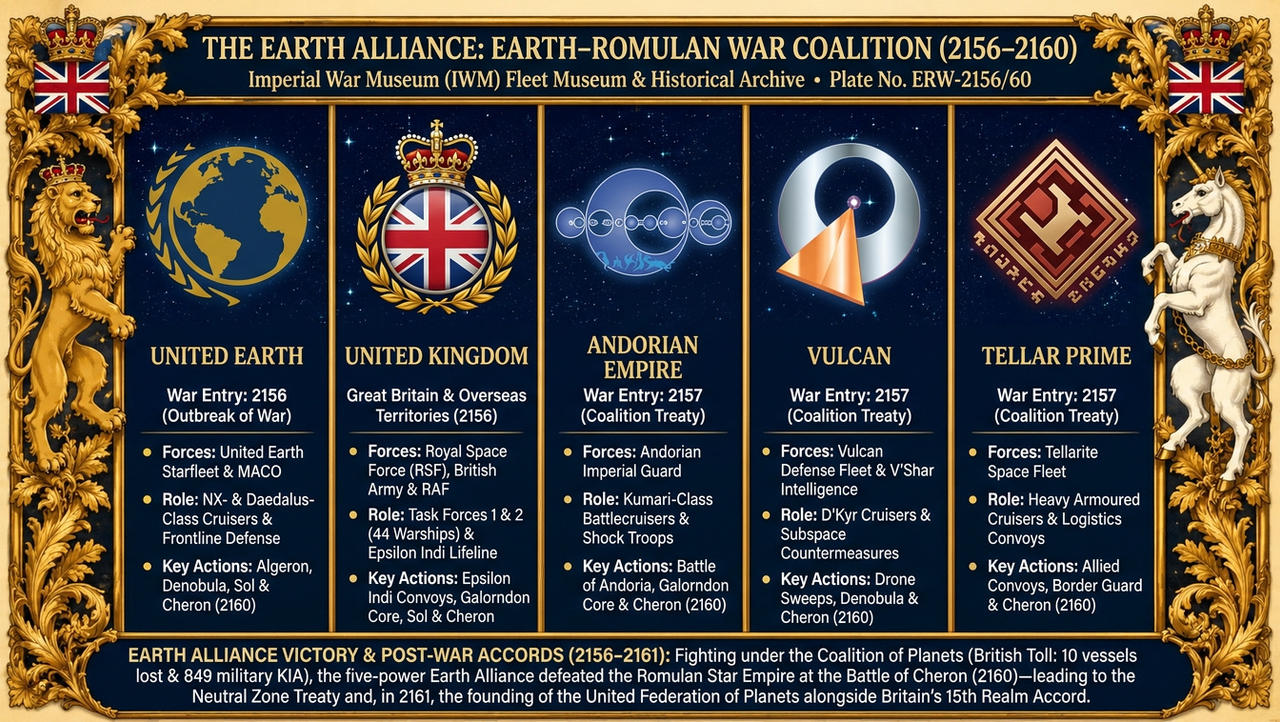
Imperial War Museum (IWM) Fleet Museum & Historical Archive — Plate No. ERW-2156/60: The Earth Alliance — Earth–Romulan War Coalition (2156–2160)

Image

Institution: Imperial War Museum (IWM) Fleet Museum & Historical Archive Admiralty Campaign Designation: First Romulan Conflict (Coalition Defence Campaign, 2156–2160)

Motto: "Five Powers, One Coalition • Per Ardua ad Astra" Preserved on permanent historical display alongside Archive Ref. FM-2156/ORBAT at the Imperial War Museum (IWM) Fleet Museum in orbit above New Britannia, this official diplomatic and military reference plate commemorates the five allied powers of the Earth Alliance during the Earth–Romulan War (2156–2160):

• United Earth (War Entry: 2156 — Outbreak of War): - Forces Under Command: United Earth Starfleet (NX- & Daedalus-class cruisers) & Military Assault Command Operations (MACO). - Coalition Role: Carried the primary deep-space strategic offensive across human frontier sectors following the Romulan Star Empire's surprise nuclear and plasma attacks in 2156—absorbing heavy early cruiser losses alongside MACO ground forces before Captain Jonathan Archer led the allied armada to victory at Cheron in 2160. - Key Actions: Algeron & Alpha Centauri (2156), Deneva & Denobula (2158), Battle of Sol / Earth & Mars (2160), and the Battle of Cheron (2160).

• United Kingdom of Great Britain & Overseas Territories (War Entry: 2156 — Coalition of Planets Mutual Defense): - Forces Under Command: Royal Space Force (RSF), British Army (BA), and Royal Air Force (RAF) — pre-2210 Act of Dual Union (flying the classic Union Flag). - Coalition Role: Commanded by Admiral Sir Thomas Pellew (Commander, RSF Expeditionary Forces, 2157–2160), Britain fielded 44 front-line warships and 12 Royal Space Auxiliary (RSA) deuterium tankers and troopships across Task Force 1 (Home & Sol Defense Squadron) and Task Force 2 (Epsilon Indi Expeditionary Force)—defending Sol, Britannia III, and the vital 11.8-light-year Sol–Epsilon Indi convoy lifeline (suffering 10 vessels lost: 7 commissioned RSF warships plus 3 RSA deuterium tankers and troopships, and 849 military KIA).

• Andorian Empire (War Entry: 2157 — Coalition of Planets Treaty): - Forces Under Command: Andorian Imperial Guard (Kumari-class battlecruisers & shock infantry). - Coalition Role: High-speed vanguard interceptor wings and aggressive border-sector counterstrikes against Romulan telepresence warbirds following the 2156 Battle of Andoria. - Key Actions: Battle of Andoria (2156), Border Raids, Galorndon Core (2158), and the Battle of Cheron (2160).

• Vulcan High Command (War Entry: 2157 — Coalition of Planets Treaty): - Forces Under Command: Vulcan Defense Fleet (D'Kyr-class combat cruisers) & V'Shar Intelligence. - Coalition Role: Subspace signal decryption, electronic countermeasures against Romulan telepresence drone networks, and heavy cruiser support at Denobula and Cheron. - Key Actions: Drone Sweeps, Denobula Relief (2158), and the Battle of Cheron (2160).

• Tellar Prime / United Planets of Tellar (War Entry: 2157 — Coalition of Planets Treaty): - Forces Under Command: Tellarite Space Fleet. - Coalition Role: Heavy armoured cruisers and deep-space logistics convoy escorts keeping Earth Alliance supply lines intact across contested sectors. - Key Actions: Allied Supply Convoys, Border Patrols, and the Battle of Cheron (2160).

Earth Alliance Victory & Post-War Accords (2156–2161): Fighting under the 2155 Coalition of Planets treaty during the conflict (designated by the Admiralty as the First Romulan Conflict), the five-power Earth Alliance defeated the Romulan Star Empire using atomic and spatial/photonic weapons at the decisive Battle of Cheron (2160)—leading directly to the Neutral Zone Treaty and, following the war in 2161, the founding of the United Federation of Planets alongside Britain's 15th Realm Accord.
Post Reply