Opinions expressed here are personal views of contributors and do not necessarily represent the companies, organizations or governments they work for. Nor do they necessarily represent those of the Board Administration.
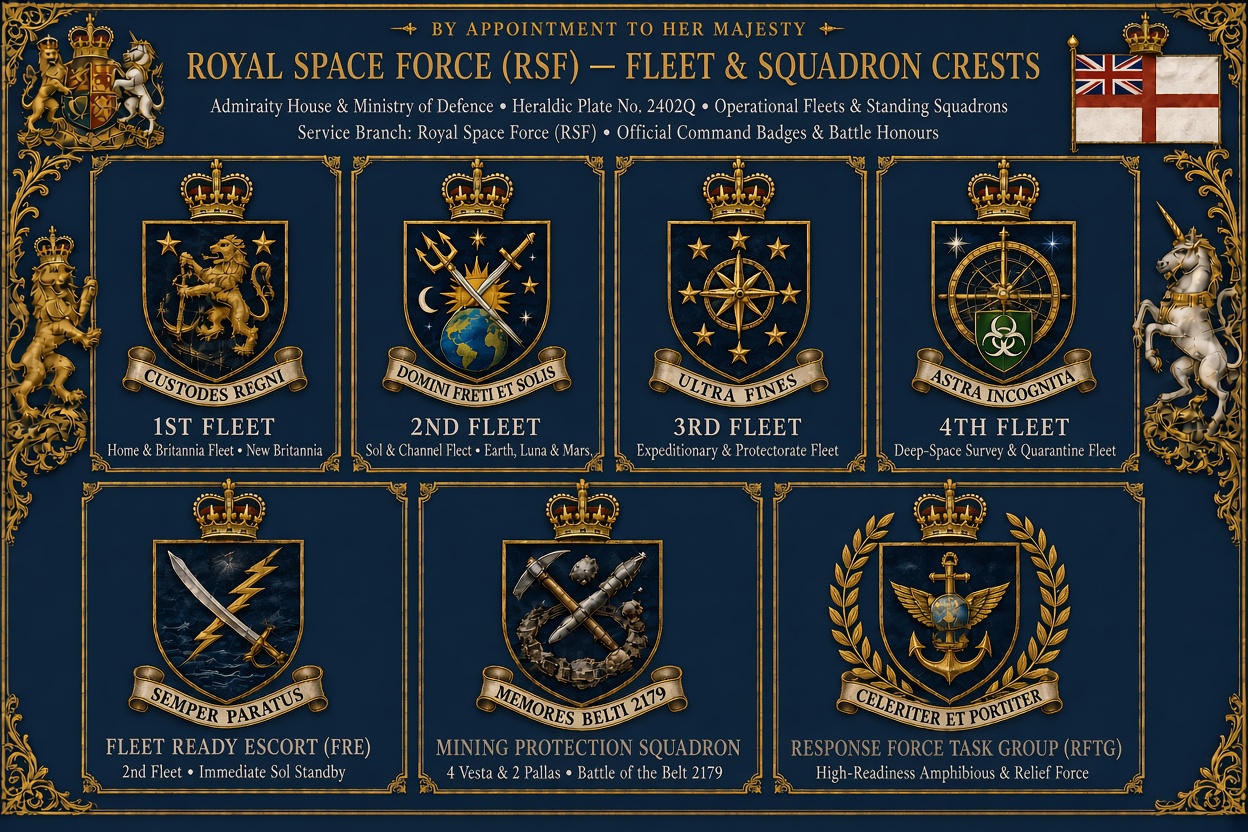
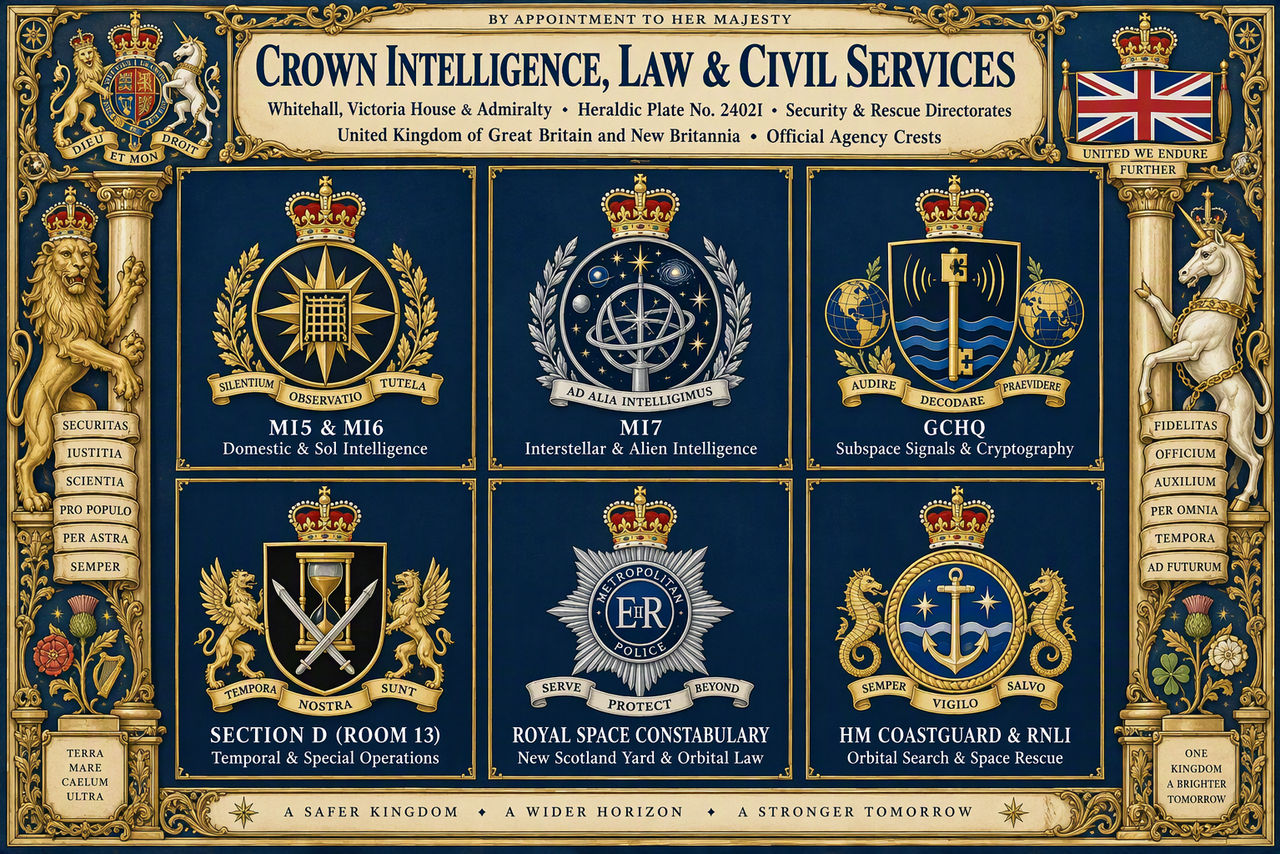
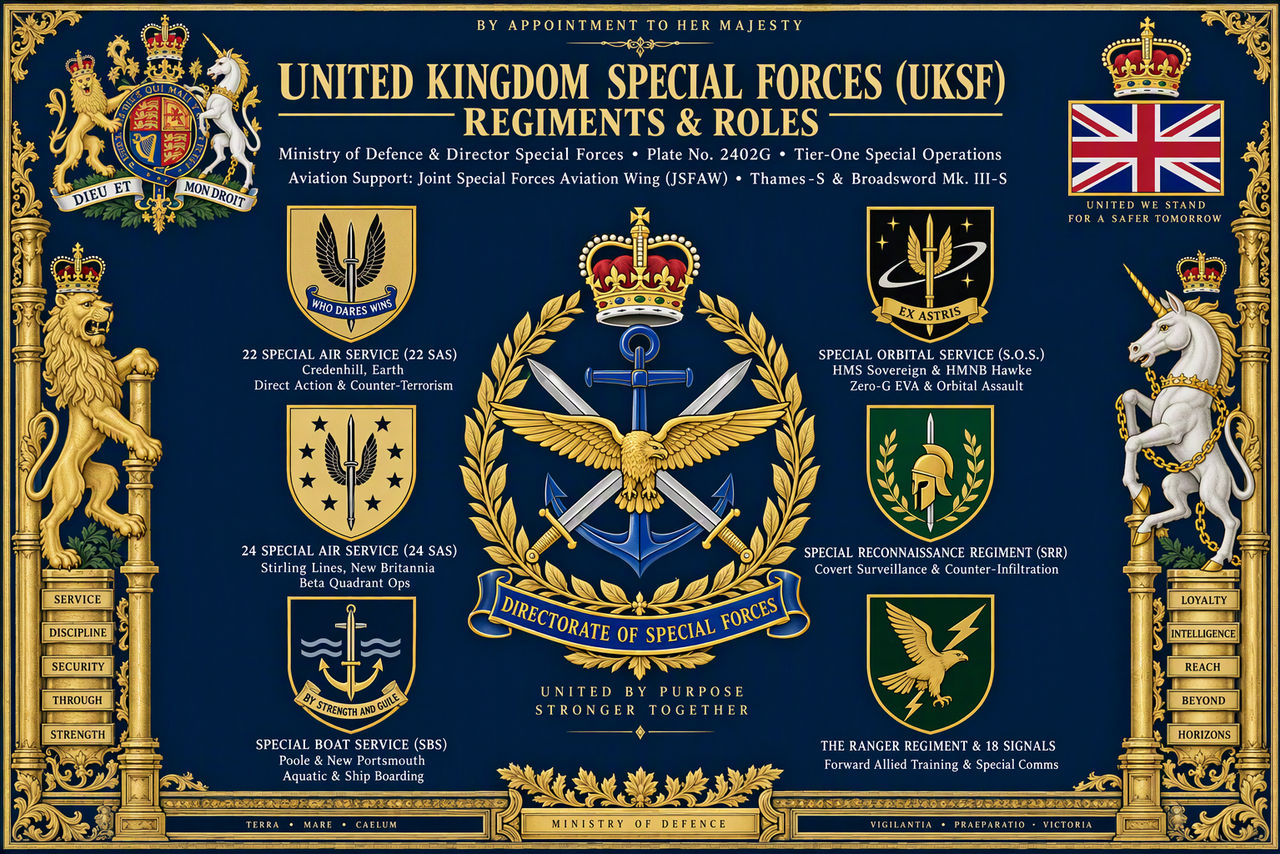
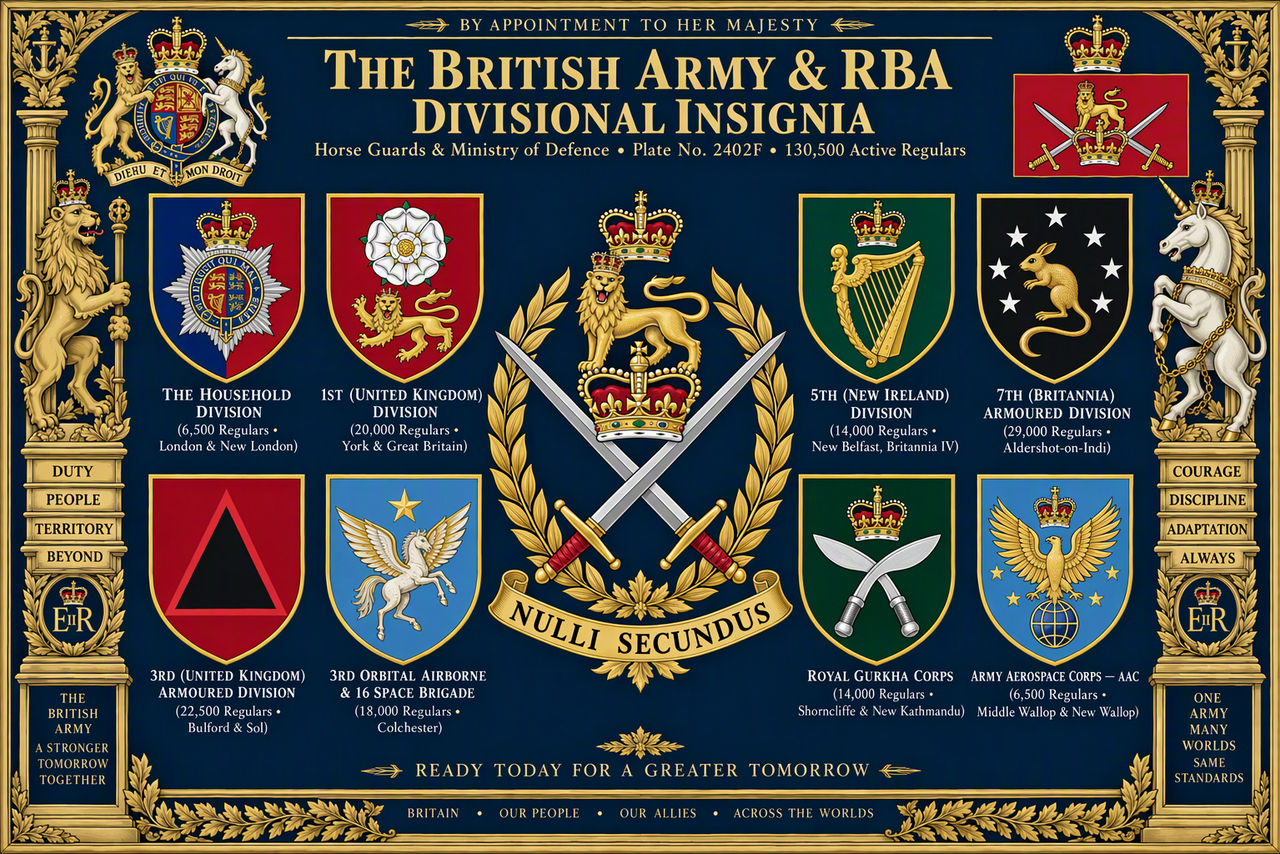
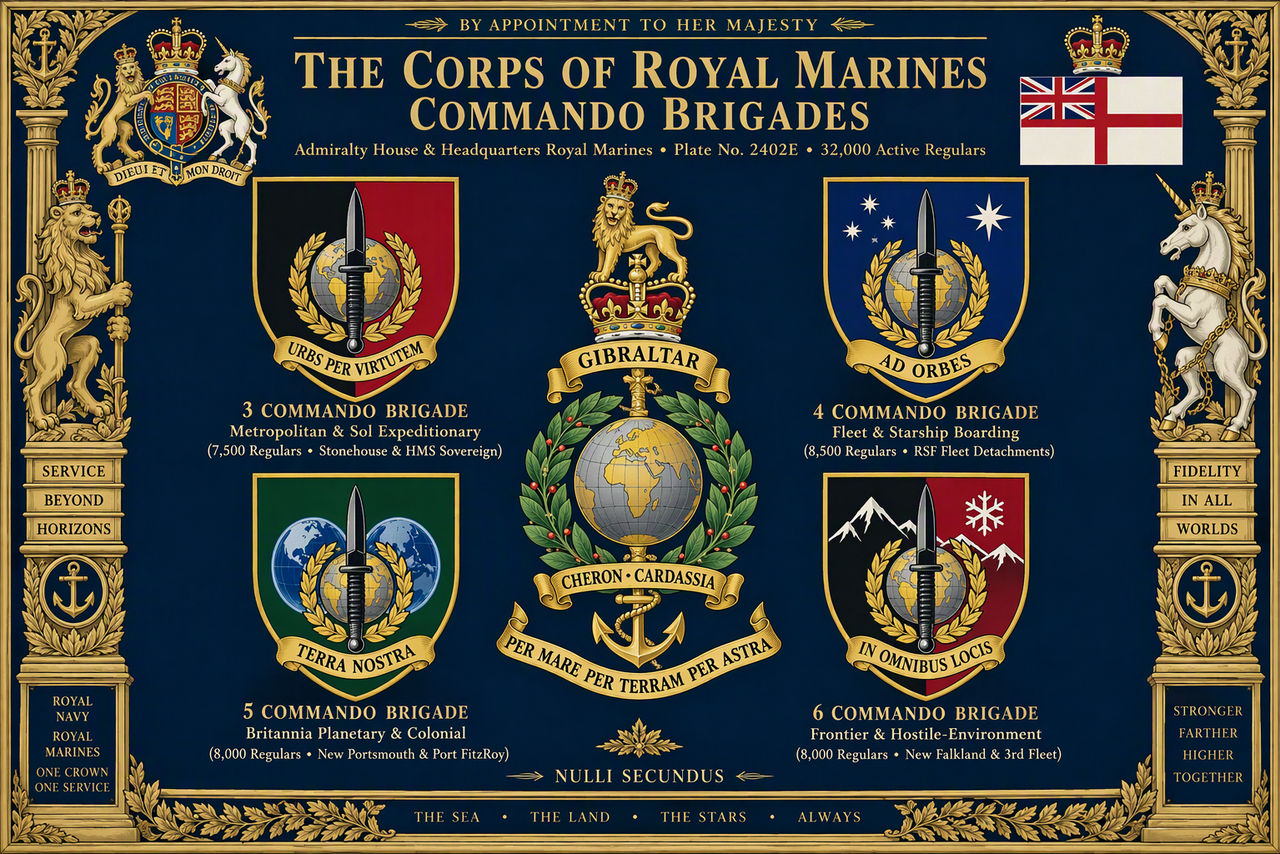
This image i created has resulted in a massive timeline i am still working on and several charts, maps and infographs of all thins related.
In an alternate-history Star Trek timeline woven seamlessly around the official Prime Timeline (Enterprise, Strange New Worlds, TOS, TNG, DS9, Voyager, and Picard), the United Kingdom never surrendered its sovereignty to United Earth or the United Federation of Planets. Functioning as a 24th-century "Switzerland in Space," the United Kingdom of Great Britain and New Britannia (UKGBNB) is a smaller, sovereign single-system star nation surrounded peacefully by Federation territory—never claiming to rival the 150-world Federation as a superpower, yet punching above its weight through air-gapped analog redundancy, dedicated defense forces, and principled neutrality. Having survived the 21st-century wars through its own institutions, Armed Neutrality, and Commonwealth lifelines, Britain rejected absorption into a planetary superstate—choosing instead to stand alongside United Earth and Starfleet as a trusted sovereign ally bound by the 2150 Treaty of Eternal Concord, the 2161 15th Realm Accord, and the 2373 Grand Alliance Pact.
• Official Name: United Kingdom of Great Britain and New Britannia (UKGBNB) (styled UKGBOT from 2024–2209 prior to the 2210 Act of Dual Union)
• Capitals: London (Terrestrial Capital, Great Britain — seat of Westminster, Buckingham Palace, and 10 Downing Street, linked to orbital transit hub HMS Sovereign) & New London (Co-Capital & Beta Quadrant Seat of the Dual Union, New Britannia — home to Victoria House and Royal Britannia Palace, linked to New Portsmouth Orbital Yards)
• Head of State: Her Majesty Queen Victoria III (Constitutional Monarch, ascended 2379; travels between Earth and New Britannia aboard Royal Space Yacht HMY Britannia)
• Head of Government: Prime Minister & Parliament of the Realm (bicameral Westminster in London linked via quantum-entangled holographic chambers to Victoria House in New London)
• Legal & Foreign Policy Doctrine: British Common Law, Scots Law, and the 2161 Crown Non-Interference Statute (rooted in Queen's Regulations and Britain's 2026 Armed Neutrality tradition—strictly quarantining pre-warp worlds such as Albion Prime while enforcing anti-slavery and mutual-defense treaties).
• Currency & Economy: New Pound Sterling (£ / Sovereign Pound), cleared through the Bank of England (London), Bermuda, and New Hong Kong—backed by fusion energy credits, Krellan dilithium, and Gold-Pressed Latinum reserves alongside free post-scarcity basic utilities and thriving artisanal/non-replicated trade.
• Total Realm Population (2373–2402): ~248.5 Million total subjects (~197 Million citizens across the Dual Union & Overseas Territories, plus ~51.5 Million subjects across the Three Crown Protectorates outside Federation space):
- New Britannia (15th Territory — Epsilon Indi, 11.8 LY from Sol): ~110 Million (across 7 self-governing provinces including New Hong Kong and Little Canada, plus 250,000 resettled Romulan refugees after 2387)
- Great Britain (England, Scotland, Wales): ~78 Million (kept green and uncrowded by 22nd/23rd-century interstellar migration and Noah Wildlife Sanctuaries)
- New Ireland (Britannia IV — 0.78g Sister World): ~14 Million
- Total Realm Population (2373–2402): ~211.5 Million (plus ~14.5 Million citizens across the Three Crown Protectorates outside Federation space):
- The 15 Overseas Territories (Earth): ~4.5 Million (Falklands, South Georgia, British Antarctic Territory, St. Helena, Ascension, Tristan da Cunha, Bermuda, Caymans, Turks & Caicos, BVI, Anguilla, Montserrat, Gibraltar, BIOT/Chagos, and Rockall North Atlantic Territory)
- Sol System Enclaves & Stations: ~5.05 Million (New Cornwall on Luna: 3.2M; New Albion on Mars: 1.4M; HMS Sovereign & Royal Belt Stations on Vesta/Pallas: 450k)
- Crown Protectorates Outside Federation Space (~51.5 Million Total — Treaty Allies): Kingdom of Vesperia (~42.5M), New Hobart (~3.2M), and the Krellan Principality (~5.8M).
Last edited by Lordroel on Fri Nov 20, 2026 3:25 pm, edited 1 time in total.
Admiralty Chart No. 7.418 — Britannia III (New Britannia) System (2402)
Realm: United Kingdom of Great Britain and New Britannia (Epsilon Indi Sector)
System Coordinates: Epsilon Indi (11.8 Light-Years from Sol) | Surface Gravity: 1.03g | Total Population (2402): ~110 Million
Orbital Anchors: Natural Moons St. George & St. Andrew • Two Equatorial Space Elevators (Thames-Portsmouth Skyhook & Indraprastha Tether)
Provinces & Principal Cities:
• New England & Cambria (Capital: New London — ~24M)
• New India / Indraprastha (Capital: New Bombay — ~42M)
• New Africa (Capital: New Nairobi — ~18M)
• New Scotland / Caledonia Reach (Capital: Fort Stirling — ~11M)
• New ANZAC / Australis Reach (Capital: New Melbourne — ~7M)
• New Hong Kong (Capital: Victoria Harbour II — ~5M)
• The Overseas Isles (Capital: Port FitzRoy — ~3M)
Key Planetary & Ecological Features:
• 45% Protected Noah Wildlife Sanctuaries: Preserving rare Earth-lineage megafauna and indigenous Epsilon Indi ecosystems under strict Royal Charter conservation law.
• Dual-Capital Seat: Co-capital of the Dual Union alongside Great Britain, housing Victoria House (the Britannian Parliament), New Portsmouth Spacedock (2nd Fleet Headquarters), and Sandhurst-on-Indi.
Admiralty Chart No. 7.425 — Britannia IV (New Ireland | 2402)
Planetary Profile: Positioned in the fourth orbit of Epsilon Indi (11.8 light-years from Sol), New Ireland is a lush, terraformed 0.78g Class-M garden world home to ~14 million citizens across four historic provinces—Leinster, Ulster, Connacht, and Munster—surrounding The Emerald Sea.
Key Cities, Bases & Research Hubs: Anchored by the planetary capital New Belfast, northern port New Londonderry, the Ballykinlar Base garrison, and marine/ecological stations at Inis Lán and New Grange, alongside protected wildlife reserves (Mór Wildlife Sanctuary, Aisling Marine Sanctuary, and Ériu Conservation Zone).
Culture & Sport: Renowned across the Dual Union and neighboring Federation worlds for its emerald coastal valleys, ocean conservation, and fast-paced 0.78g Low-Gravity Rugby and Hurling championships.
Last edited by Lordroel on Fri Nov 20, 2026 3:31 pm, edited 1 time in total.
Era I: The Long Watch, Great Survival, First Contact & Sol Footholds (1940–2155)
- 1940–2023 – Finest Hour, Temporal Shadows, The Vaelen Abductions & The Road to Neutrality: Britain stands alone during the 1940 Battle of Britain—unaware that high above the storm clouds on 15 September 1940, the time-displaced 23rd-century cruiser HMS Trafalgar silently observes the battle without interfering before returning to 2274. In November 1944, the Vaelen Archivists abduct four wartime towns (Königswald, Oakhaven, Novaya Tula, and Kurokawa) onto Tetrad IV, leaving unexplained disappearance files archived at IWM London. Across the late 20th century, MI5, GCHQ, and RAF Fylingdales quietly log unexplained orbital and temporal anomalies—including the 1968 orbital incident (TOS: "Assignment: Earth"), 1986 Pacific sightings (Star Trek IV), the 1992–1996 Eugenics Wars (which Britain avoids while tracking the sleeper ship SS Botany Bay departing Earth orbit in 1996), and 2004 Temporal Cold War Xindi activity in North America (ENT: "Carpenter Street")—filing them inside early Room 13 vaults. Drawing inspiration from late-1990s closed-loop biosphere projects (such as the Millennium Gate, VOY: "11:59") and Rolls-Royce modular fusion research, Britain responds to early 21st-century global instability, Sanctuary District unrest, and accelerating European federalization by quietly hardening its analog infrastructure, agricultural reserves, and Commonwealth lifelines ahead of the 2024 crisis.
[/b]- 2024–2039 – Fragmentation, Neutrality, Early Sol Milestones & The Eugenics Aftermath: Following the 2024 Bell Riots and Renée Picard's landmark 2024 Europa Mission (PIC: "Two of One"—whose Europan microbial breakthrough British Royal Society scientists help adapt to restore UK marine ecosystems), the United States fractures into the Second American Civil War (2026). Parliament passes the 2024 Realm Continuity Act (re-styling the nation the United Kingdom of Great Britain and Overseas Territories, UKGBOT) and declares Armed Neutrality (2026), remaining aloof from continental European federalization while rebuilding sovereign fusion grids, closed-loop biosphere shelters, and hardwired, air-gapped analog defense networks. As an active partner in the International Space Agency's five-mission Ares Mars Program (Ares I–V, 2029–2033—with Great Britain's flag emblazoned on Ares IV's hull alongside a British Royal Society geophysicist flying on Ares II to survey Argyre Planitia), British tracking arrays on Ascension Island and Woomera support the 2028 Shango X-1 asteroid-belt crossing, the October 2032 Ares IV mission (VOY: "One Small Step"), and the Ares V rescue of stranded astronauts Rose Kumagawa and Andrei Novakovich—and in the late 2030s quietly log the unscheduled deep-space departure of the sleeper ship SS Botany Bay as the Eugenics Wars topple Augment regimes abroad. At home, Britain defeats a brief 2031 Second Falklands crisis and crushes Colonel Phillip Green's 2033–2035 Optimum Movement cells via MI5, Special Branch, and the British Army—enacting the 2035 Genetic Purity & Crown Bio-Ethics Act to ban human genetic augmentation and unshackled networked AI. (Pop: ~68M)
- 2040–2053 – World War III, "The May Day Horror of '53" & Operation Ark: Regional wars escalate between the New United Nations (US and EU) and the Eastern Coalition (ECON), especially after hardline General Lee Kuan overthrows ECON's democratic reformers in 2051 and clashes over Taklamakan and Antarctic resources (where Royal Navy patrols keep the British Antarctic Territory neutral). At 02:30 EST on 1 May 2053 ("The May Day Horror of '53"), ECON launches a global nuclear first strike alongside the Interface computer virus—obliterating Washington D.C., Paris, Moscow, Berlin, and dozens of major cities, killing nearly half a billion people instantly (while the Red Angel transports an Indiana church to Terralysium). Britain does not escape unscathed: although Armed Neutrality and air-gapped, hardwired defense grids block ECON's cyber-virus and intercept over 90% of incoming missiles—sparing central London from the multi-megaton strike that destroyed it in the Prime Timeline—a damaged warhead detonates over the Dartford/Thamesmead outskirts (killing 185,000 outer-Londoners, commemorated at Thamesmead Memorial Lake), while coastal port hits, high-altitude EMPs, heavy continental fallout, and severe nuclear-winter famine claim over 3.2 million British lives total (dropping UK population from ~68M to ~48M). Yet while North America, Europe, and Asia collapse into warlordism after the 3 May ECON invasion of North America and Lee Kuan's death, Britain's surviving Parliament, Crown, NHS emergency teams, and armed forces maintain unbroken civil order under strict rationing—backed by Operation Ark vaults, South Georgia seed banks, Falkland fisheries, and vital food convoys from neutral Australia and New Zealand. (Pop: ~48M)
- 2053–2063 – The San Francisco Cease-Fire, Post-Atomic Horror & The 2054 North Sea War: Britain sends a neutral observer to the late-2053 San Francisco Cease-Fire while Earth fractures into warlord fiefdoms—including Colonel Green's brutal 2054 rampage from Alaska into Montana culling millions of radiation-sick civilians (ENT: "Demons" / "Terra Prime"). Standing in stark contrast to Green's atrocities, NHS Realm doctors pioneer adrenaline-based radiation therapies (later superseded by Hyronalin) while Royal Society stations monitor mysterious orbital satellites gradually restoring Earth's ozone layer. In autumn 2054, desperate continental warlords launch an amphibious armada of armed ferries, hijacked merchantmen, and scavenged missile boats across the North Sea to seize Britain's food reserves and fusion grids; battered and fuel-rationed after 2053's coastal strikes yet kept running by hardwired analog backups, the surviving Royal Navy (Type 83 destroyers, Type 26/31 frigates, and SSN-AUKUS submarines)—backed by the RAF and British Army—shatters the invasion off Dogger Bank in six grueling weeks during its last great terrestrial naval war. Over the next seven years (2055–2062), British naval escorts, Royal Marines, and 22 SAS fight ongoing North Atlantic anti-piracy battles to protect Australian and New Zealand food convoys and join forces with the San Francisco Coalition to suppress coastal warlords and secure loose weapons stockpiles until global peace stabilizes. As Liam Dieghan's Neo-Transcendentalism gains quiet traction among rural pacifists, Britain keeps its railways, universities, Parliament, and aerospace industry running—passing the Royal Navy's White Ensign heritage upward to launch the Royal Space Force (RSF) in 2058 with fusion-impulse DY-245 and DY-500 modular hulls (led by HMS Halcyon) and testing early micro-warp thrusters just before Zefram Cochrane's 2063 flight. (Pop: ~50M)
- 2063–2084 – First Contact, The Greenwich Landing, Mestral's Counsel, End of the Post-Atomic Horror (2079) & Early Beagle Probes: British stations on Ascension Island, Diego Garcia, and Antarctica—alongside Australia's Woomera tracking complex—detect the Vulcan survey ship T'Plana-Hath on 5 April 2063; the following morning (6 April 2063), as the New New York Times breaks the story across North America, The Times of London and the BBC broadcast Ascension's tracking telemetry across the Commonwealth, leading to a formal Vulcan diplomatic landing at the Royal Observatory, Greenwich on 19 May 2063 where Sub-Commander Solkar meets the Crown and Prime Minister as sovereign equals. Privately at Greenwich, Vulcan surveyor Mestral—having lived secretly among humans since the 1957 Carbon Creek mission (ENT: "Carbon Creek") before settling in Oxford—steps forward to counsel Solkar and the Vulcan diplomatic envoy, explaining that Britain's refusal to merge into continental coalitions preserves vital parliamentary and moral diversity alongside emerging planetary unity, persuading Vulcan High Command to recognize British sovereignty from the outset. While NHS Realm doctors and British peacekeepers assist post-war relief efforts abroad until the final warlord kangaroo courts of the Post-Atomic Horror are dismantled in 2079 (TNG: "Encounter at Farpoint"), Rolls-Royce and Cambridge engineers refit the DY-500 hull HMS Halcyon in 2064 with an experimental micro-warp drive as Britain's first crewed Warp 1 starship, and Britain participates diplomatically alongside post-war Earth authorities during the 2066 First Contact with Alpha Centauri and the 2073 First Contact with the Tellarites (whose love of fierce debate finds an instant match in Westminster's House of Commons). Operating a joint Sister Holdout space program out of Woomera and Pacific launch ranges alongside Ascension and Diego Garcia, the Royal Society launches unmanned early-warp surveyor probes (Beagle-1 through Beagle-6) fitted with safe, inert-fusing micro-warp cores—with Beagle-2 (2074) first detecting the habitable Epsilon Indi system (later retrieved in 2138 alongside Beagle-1 and Beagle-3) and Beagle-4 (2081) vanishing beyond the Beta Quadrant rim—while Britain establishes its first off-world sovereign enclave at New Cornwall on Luna (2078) inside Mare Crisium for Helium-3 fusion mining and low-gravity drydocks.
- 2085–2115 – European Hegemony Disputes, First Sovereign UK Mars Landing, New Albion, Martian Crisis & Royal Belt Territories: In 2085, Britain declines membership in the continental European Hegemony—sparking twenty-five years of tense orbital-slot, tariff, and Channel airspace disputes (as well as Lunar mining-boundary friction around New Cornwall) until the Hegemony dissolves into United Earth in 2130. Determined not to be shut out of inner-system resources, Britain launches its first sovereign crewed mission to Mars in 2088 aboard the Lunar-built fusion cruiser HMSS Endeavour—landing inside Argyre Planitia to survey subsurface water-ice aquifers and establishing the permanent enclave of New Albion six years later (2094), followed by mineral mining outposts on 4 Vesta and 2 Pallas (2112) alongside neighboring settlements on Ceres that evolve into self-governing Crown Space Territories (~280,000 residents by the 24th century, later hosting joint Dartmouth–Starfleet Academy impulse-navigation training runs, VOY: "Future's End, Part II"), while probe Beagle-6 (2115) drifts into future Romulan space. During the tense 2103 Martian independence struggle (the Fundamental Declarations of the Martian Colonies), New Albion faces suspicion, supply blockades, and border standoffs from Martian rebels who view the British enclave as an Earth foothold—while London refuses Earth's demands to use Argyre Planitia as a military staging base, eventually securing peace via the 2104 Argyre Border & Water-Sharing Accord once Mars wins autonomy (and later welcoming Australian loyalist settlers to New Britannia's Australis Reach when Australia joins United Earth in 2150).
- 2116–2149 – The Great Commonwealth Settlement & Noah's Ark: Prioritizing rugged reliability and heavy cargo capacity over experimental top speed (remaining within Warp 2–4.2 while Starfleet's Warp 5 Complex chases the Warp 5 barrier), Britain uses Lunar- and L5-built colony liners to claim the uninhabited Epsilon Indi system (11.8 light-years from Sol) under the 2125 Commonwealth Settlement Act—colonizing New Britannia (Britannia III) and New Ireland (Britannia IV) with millions of British, Scottish, Welsh, Northern Irish, and loyalist Commonwealth settlers (including Anglo-Hong Kongers founding New Hong Kong and Canadian loyalists establishing Little Canada). Guided by the 2126 Noah Wildlife Sanctuary Act, colonists preserve 45% of New Britannia's landmass as wilderness reserves stocked with cloned Earth wildlife from South Georgia's vaults alongside native flora and fauna. (Pop: ~58M)
- 2150–2155 – Treaty of Eternal Concord, Post-Woomera Transition, Antarctic Borg Recovery, Terra Prime & HMS Vanguard (Warp 6): As Australia joins United Earth as the final signatory in 2150 (TNG: "Attached"), Britain concludes its Woomera launch partnership—shifting heavy-lift operations to sovereign mass-drivers on Ascension Island, Diego Garcia, and Mount Pleasant Orbital (Falklands) until expanded drydocks at HMS Sovereign, New Cornwall (Luna), Port Elizabeth (L5), and New Portsmouth make ground launches obsolete—while signing the Treaty of Eternal Concord (including Article IV's grandfather clause securing Britain's pre-existing geostationary orbital corridor above New Albion) to secure permanent UKGBOT sovereignty. Leaving Starfleet's Enterprise NX-01 to break humanity's Warp 5 barrier first in April 2151 (ENT: "Broken Bow"), British ships operate at Warp 4.5 until the March 2153 Xindi probe kills 7 million people across Florida and Venezuela and sends destructive tsunamis into Britain's Caribbean Overseas Territories (~140 British lives lost)—prompting London to rush relief to United Earth, dispatch Warp 4.5 heavy cruiser HMS Yorkshire into the Delphic Expanse alongside Enterprise NX-01 (where Lt. Malcolm Reed transfers permanently to Enterprise), and authorize an emergency Rolls-Royce and Cambridge propulsion surge. Ignoring Vulcan High Command attempts to stall British warp research, Britain breaks the Warp 6 barrier first in late 2155 with battlecruiser HMS Vanguard. Meanwhile, during the Temporal Cold War (ENT), MI6 and Section D quietly intercept Suliban Cabal agents trying to sabotage Rolls-Royce propulsion labs and New Albion (Mars)—and in 2153, after a British Antarctic Survey ice-core team uncovers frozen cybernetic fragments from the 2063 Borg Sphere explosion (Star Trek: First Contact / ENT: "Regeneration") inside the British Antarctic Territory, Section D (Room 13) and 22 SAS immediately quarantine the site and seal the unthawed debris inside air-gapped cryonic vaults—before MI6 and 22 SAS help Starfleet defeat John Frederick Paxton's 2155 Terra Prime Crisis. (Pop: ~62M)
Era II: The Earth–Romulan War, Dual Union & Golden Expansion (2156–2215)
- 2156–2160 – The Earth–Romulan War: Triggered when a Romulan Bird-of-Prey destroys the British colony liner BSW Athenia (388 civilian dead) and escort frigate HMS Glowworm in March 2156, Britain enters the war alongside United Earth, Vulcan, Andoria, and Tellar. Immune to Romulan "telecapture" cyber-warfare due to hardwired analog bridge controls, HMS Vanguard (RSF-01) and 1st Fleet defeat a Romulan invasion armada at the 2158 Battle of New Britannia, hold New Albion's perimeter during the 2160 Battle of Sol (losing HMS Exeter), and fight at the decisive Battle of Cheron—losing 3,420 military KIA across the war.
-2161–2215 – The 15th Realm Accord, Battle of the Belt & The Act of Dual Union: Upon the founding of the United Federation of Planets in 2161, Britain declines full membership to preserve its parliamentary monarchy, Common Law, and armed neutrality—signing instead the 15th Realm Accord (establishing visa-free travel, free trade, mutual defense, and the Crown Non-Interference Statute alongside Starfleet's Prime Directive, while United Earth's MACO forces—long trained alongside the Royal Marines and 22 SAS—are absorbed into Starfleet). In 2179, RSF Mining Protection Squadron frigates based at Port Vesta and Pallas Station fight alongside the USS Benjamin Franklin to defeat deep-space raiders during the Battle of the Belt. Following the 2210 Act of Dual Union, New Britannia is elevated from an Overseas Territory to an equal constituent realm alongside Great Britain, renaming the state the United Kingdom of Great Britain and New Britannia (UKGBNB) and building Victoria House in New London. (Pop: ~115M).
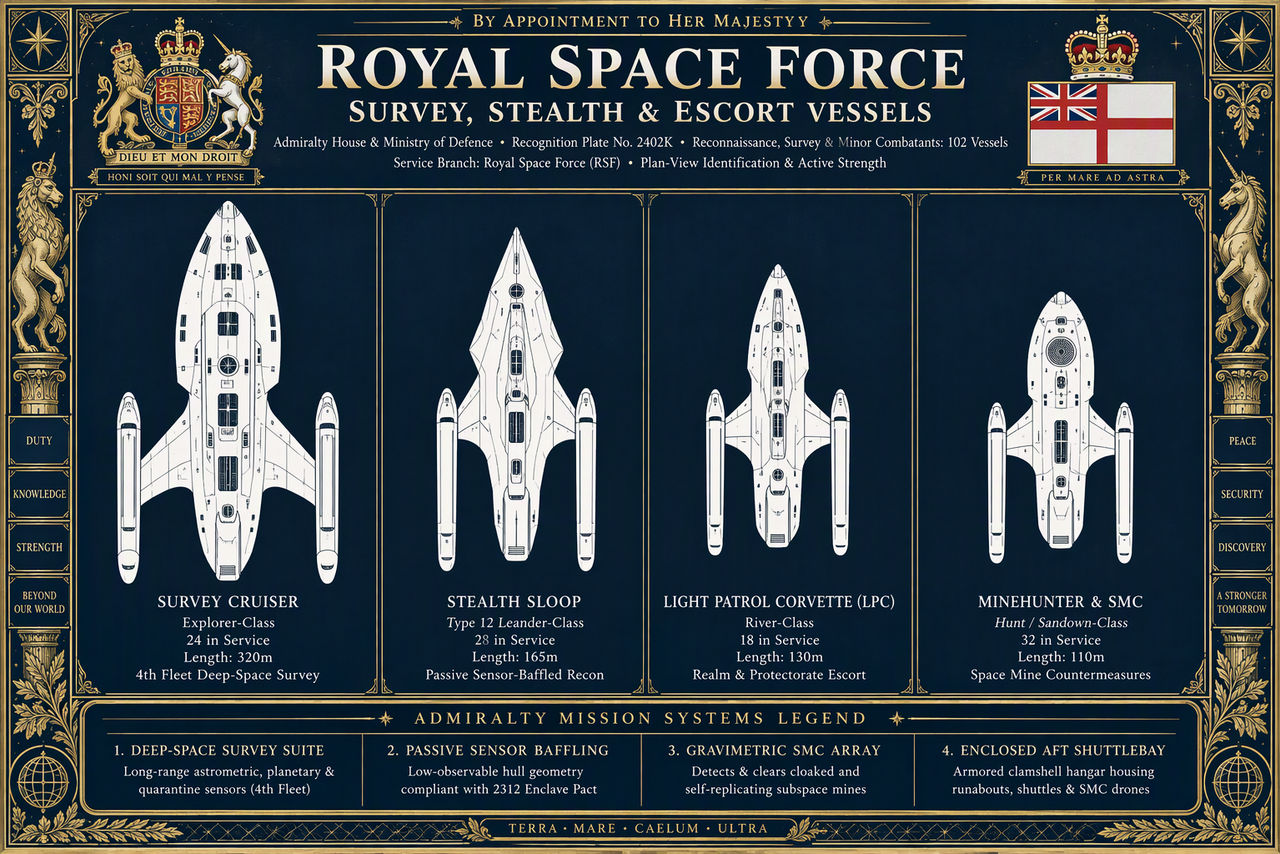
- 2265–2270 – HMS Vanguard's Five-Year Mission (TOS Era): Parallel to Starfleet's Constitution-class five-year voyages (including Captain Kirk's USS Enterprise), the Royal Space Force and Royal Society dispatch the 23rd-century Explorer-Class survey cruiser HMS Vanguard on a landmark Five-Year Mission into the uncharted Beta Quadrant rim under the 15th Realm Accord. Operating independently under Queen's Regulations and the Crown Non-Interference Statute while sharing cartographic telemetry and mutual-defense support with Starfleet cruisers, Vanguard maps hundreds of new star systems—laying the diplomatic groundwork for the later Vesperia and Krellan Crown Protectorates before returning triumphantly to New Portsmouth in 2270.
Era III: The 23rd-Century Cold War, Temporal Watch & Neutral Treaties (2215–2367)
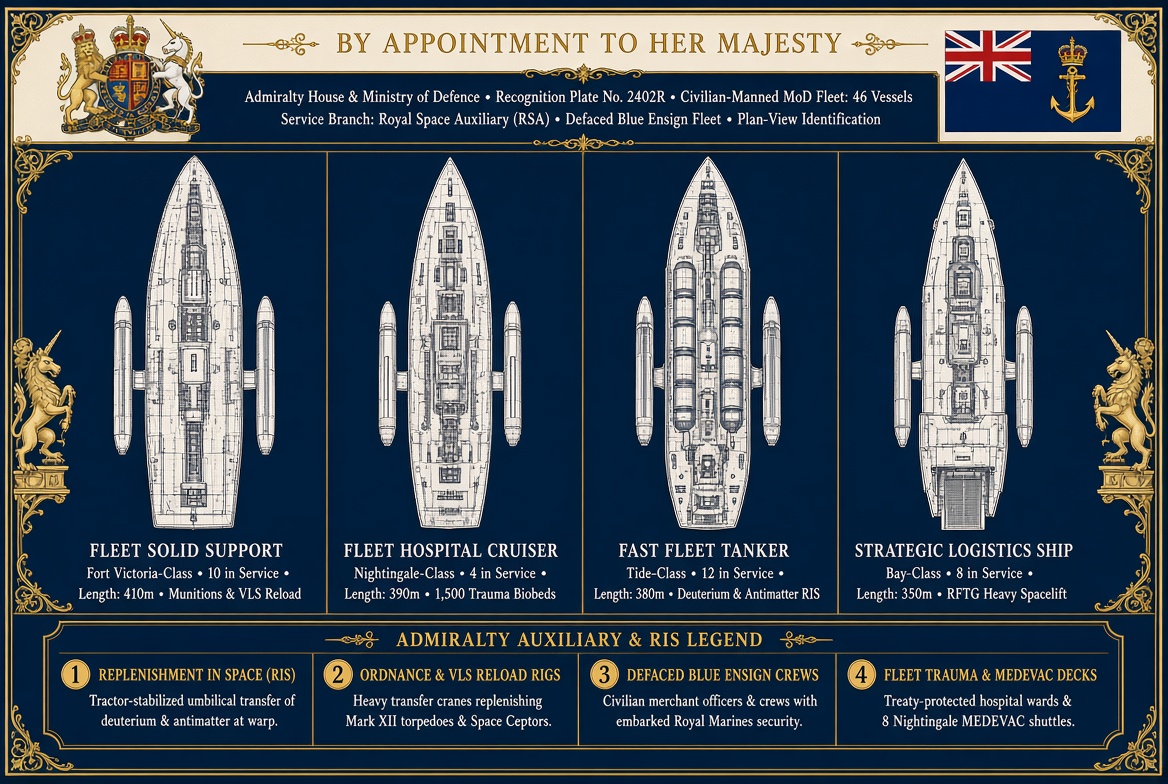
- 2215–2293 – Kzinti Clashes, TOS Cold War, V'ger, Trafalgar, Whale Probe & Khitomer: Across the early 23rd-century Earth–Kzinti Wars, RSF escorts, Royal Marines, and Royal Gurkha Rifles defend the Beta Quadrant trade corridors against Kzinti raiders before ratifying parallel Kzinti Disarmament Protocols. Britain maintains armed neutrality during the 2267 Klingon conflict while supplying medical aid to Starfleet. During the 2273 V'ger Crisis, completely outmatched alongside Starfleet, Britain loses patrol destroyer HMS Grenville and an orbital tracking relay (148 KIA) as V'ger freezes Earth's defense grids offline until Captain Kirk and the Enterprise save the planet. In 2274, cruiser HMS Trafalgar is thrown back by a quantum singularity to September 15, 1940 during the Battle of Britain—watching from cloud cover without interfering, prompting Oxford and Section D to establish a classified Temporal Counter-Incursion Cell in the Drake Belt alongside Starfleet DTI (glimpsing quantum echoes of the parallel "Merged UK" canon timeline while strictly obeying the Temporal Prime Directive). During the 2286 Whale Probe Crisis, Britain's WWIII-era hardwired ground backups keep subterranean shelters heated during the planetary power drain; afterward, Britain's South Georgia genetic vaults provide diverse whale DNA alongside Kirk's rescued whales (George and Gracie) to restore humpback whale pods across Earth and New Britannia without inbreeding. In 2293, Britain attends Camp Khitomer as an impartial observer—helping shield the peace summit from conspirators—and deploys HMS Kent alongside RSA hospital ships to deliver atmospheric scrubbers and relief to Qo'noS after Praxis explodes, ratifying parallel Khitomer Accords.
2288 —& The Constitutional Crisis of 2288 (The United Earth Devolution Bill): Every enduring constitution is forged by crisis, and Britain's greatest interstellar test arrived in 2288 when a radical reformist Prime Minister pushed the United Earth & Federation Integration Act through Parliament—a bill that would have transferred supreme command of the Royal Space Force and sovereign customs authority over Sol to United Earth and Starfleet Command without a Dual Union referendum.
- The Standoff & Reluctant Refusal: Outraged MPs from Britannia III and New Ireland staged a historic walkout, warning that Whitehall was surrendering the Dual Union's independence behind their backs, while the House of Lords deadlocked the bill for months before it narrowly cleared both Houses by a razor-thin margin. Deeply mindful of constitutional convention, King George VIII spent three agonizing weeks privately urging the Prime Minister to withdraw the legislation and put it to a Dual Union referendum. Only when the government refused—leaving the foundational settlement of Great Britain, Britannia III, and New Ireland itself endangered without consent—did the King reluctantly refuse Royal Assent (the first refusal since Queen Anne in 1708).
- The Settlement & Legacy: Rather than acting as a partisan politician, the Sovereign acted strictly as guardian of the constitutional framework. The Prime Minister resigned, triggering the General Election of 2288, which returned a decisive Dual Unionist majority. The resulting Act of Union Confirmation (2289) permanently enshrined the Dual Referendum Lock (requiring separate majorities in both Great Britain and Britannia III before any sovereign powers can ever be ceded) and expanded Britannian representation in Westminster—while every subsequent monarch, down to Queen Victoria III, scrupulously avoided invoking the veto for over a century, cementing 2288 as a legendary constitutional precedent.
- 2276–2310 – The Three Crown Protectorates: Operating outside Federation borders in the Beta and Alpha Quadrants, Britain ratifies mutual-defense and free-trade protectorate treaties with three non-Federation allies: the aquatic monarchy of Vesperia (2276 Treaty of Coral Harbour), the independent frontier colony of New Hobart near the Badlands (2298), and the dilithium-rich Krellan Principality near the Romulan Neutral Zone (2310)—each retaining full internal self-government under Royal Space Force orbital protection.
- 2311–2367 – The Tomed Incident, Treaty of Algeron, Cardassian Border Wars, Bluegill Scare & Wolf 359: Following the catastrophic 2311 Tomed Incident, Britain signs the 2312 Enclave Security Pact alongside the Federation's Treaty of Algeron—renouncing cloaking devices while deploying GCHQ tachyon detection grids and passive-baffle Type 12 Stealth Sloops along the Romulan border. During the 2347–2367 Cardassian Border Wars (sparked by the Setlik III Massacre), 3rd Fleet frigates and Royal Marines protect New Hobart and evacuate endangered British dual-national frontier colonists alongside Starfleet. In 2364, during the alien neural-parasite conspiracy inside Starfleet Command (TNG: "Conspiracy"), an infected Starfleet envoy secretly infects a senior British Rear Admiral at Admiralty House before NHS Realm doctors and MI5/Section D catch the parasite during a routine biometric scan—quarantining the officer, rushing biological telemetry to Starfleet Medical until Captain Picard eliminates the threat in San Francisco, and prompting Britain to institute mandatory biometric checks and rotating paper challenge-pass codebooks across all senior posts (countermeasures that later make it extraordinarily difficult for Changeling infiltrators to impersonate British officials in 2372). In 2365, when Starfleet shares sensor telemetry from the Enterprise-D's first Borg encounter at System J-25 (TNG: "Q Who"), Section D (Room 13) matches the Borg alloy signatures to the frozen 2153 Antarctic debris—quietly feeding RCTI metallurgical and frequency-modulation data to Admiralty House and Starfleet Tactical before later incinerating the dormant fragments in a star. At the 2367 Battle of Wolf 359, Britain dispatches a four-ship RSF cruiser squadron beside Starfleet—losing two heavy cruisers (HMS Hood and HMS Ajax, 490 KIA) while two survive thanks to air-gapped computers, frequency-rotating phasers, and kinetic railgun backups, before patrolling the Krellan-Romulan border during the 2367 Klingon Civil War (TNG: "Redemption") to help block Romulan supply runs to the House of Duras.
Era IV: The Dominion War, Romulan Supernova & Frontier Day (2369–2402)
- 2369–2373 – Neutral Peacekeeping, Bajoran Circle Coup, Vesperia Rift & The 2372 Changeling Crisis: Leveraging its status as an impartial neutral power outside the Federation, Britain deploys "Slate Beret" peacekeepers and Royal Engineers to stabilize post-occupation Bajor (2369)—earning commercial and scientific transit rights through the newly discovered Bajoran Wormhole until late 2370, when three Jem'Hadar fighters ambush and destroy the unarmed survey cruiser HMS Darwin in the Gamma Quadrant (164 KIA), prompting London to halt civilian wormhole travel and share Darwin's phased-polaron sensor logs with Deep Space 9 to develop anti-polaron shield upgrades. During the 2370 Bajoran Circle coup (DS9: "The Siege"), MI6 uncovers proof of secret Cardassian arms shipments to The Circle and passes the intelligence to Major Kira and Commander Sisko, helping collapse the coup peacefully. Britain also monitors ceasefires on Ajilon Prime (2372–2373) and runs humanitarian corridors in the Cardassian DMZ—where MI7, the Ranger Regiment, and 24 SAS evacuate over 18,000 British dual-nationals during Operation Dunkirk II. During the 2372 Federation-Klingon War, Type 26 Frigate HMS Achilles defeats the rogue Klingon Bird-of-Prey IKS Korinar single-handedly at the Battle of the Vesperia Rift before offering honorable medical aid—earning a personal Mek'leth tribute from Chancellor Gowron. Later in 2372, during the Changeling infiltration scare and Admiral Leyton's military coup attempt (DS9: "Homefront" / "Paradise Lost"), Britain refuses to impose martial law—instead relying on its post-2364 biometric screening and rotating paper challenge-pass codebooks to expose and capture a Changeling impostor inside Whitehall via MI5/New Scotland Yard, while foiling a second Changeling saboteur aboard HMS Sovereign using hardwired reactor overrides and 43 Commando Royal Marines. When Leyton drafts secret plans ("Operation Channel Lock") to blockade British orbital hubs, London places 2nd Fleet on alert and offers asylum to Federation President Jaresh-Inyo, helping foil the coup.
- 2373–2375 – The Dominion War, Goodwin Sands & Breen POWs: Upon the Dominion invasion of Deep Space Nine in late 2373 (DS9: "Call to Arms"), King Edward IX signs the Grand Alliance Pact while Britain's forward New Hobart squadron (HMS Belfast, HMS Dragon, and three frigates) helps cover DS9's evacuation before withdrawing with heavy damage. Britain mobilizes 620,000 personnel, reactivating 32 mothballed warships and deploying Task Force Britannia (HMS Ark Royal, HMS Dreadnought, HMS Lion, Planetary Assault Landships, 7th Armoured Division, 5th New Ireland Division, 3rd Orbital Airborne Division, JTAG-Britannia, and Royal Gurkha Corps) to Operation Return ("Sacrifice of Angels"—losing heavy cruiser HMS York while helping punch open the corridor to retake DS9), as well as contested orbital troop landings and planetary campaigns on Betazed, Benzar, First and Second Chin'toka (where hardwired mechanical overrides save several British ships from Breen energy-dampeners), AR-558, and Cardassia Prime—enduring heavy ship and troop-transport losses fighting through Dominion orbital blockades alongside two years of brutal ground warfare against Jem'Hadar shock troops. In late 2375, four Breen raiders attack Britain; RAF Orbital and Fighter Command defenses destroy three over the Channel while the fourth crashes on Goodwin Sands, where 16 Space Mobile Brigade, 1st Royal Gurkhas, 22 SAS, and SBS storm the wreck in close-quarters combat—capturing four Breen prisoners (held in sub-zero containment on South Georgia before honorable repatriation in 2376) and an intact energy-dampener at the cost of 14 British KIA (366 total British deaths in the Breen Raid). Total Dominion War Toll: 48 RSF warships and RSA/PAL troop transports lost (including HMS York), 56,900 military KIA (18,400 space/air/transit and 38,500 ground forces), and 310 civilian deaths—Britain's heaviest military loss since World War III.
- 2374 — The Helaspont Ambush & Loss of HMS Repulse (Operation Drake): Britain's most painful modern military disaster—and a wound still fiercely debated in Westminster, New Westminster, and RSF wardrooms in 2402. Departing from its usual perimeter-defense posture during the darkest months of the Dominion War, Whitehall dispatched a 14-ship expeditionary task group led by the wartime-surge battlecruiser HMS Repulse (BC-105) with embarked elements of 45 Commando Royal Marines and 2 PARA to relieve a besieged Federation colony inside the sensor-obscuring Helaspont Nebula. Acting on compromised subspace intelligence later traced to a Romulan Tal Shiar double-agent who had deceived MI7, the task group entered the nebula without forward Type 12 Leander stealth scouts and was ambushed by over forty Jem'Hadar fighters and Cardassian cruisers equipped with energy-dampening weapons. Eight British warships—including HMS Repulse—were lost with 3,412 sailors, Royal Marines, and paratroopers killed before surviving escorts led by HMS Belfast broke out firing solid-slug kinetic ordnance. The resulting Chilcot-Repulse Inquiry (2376) shook the government, directly inspired the 2380 Naval Modernization Act (mandating Galahad kinetic-penetrator torpedoes and strict air-gapped Turing cores), and gave rise to the solemn RSF wardroom toast: "To Repulse and the Helaspont—never blind, never again." Twenty-eight years later in 2402, historians, politicians, and veterans remain sharply divided over who bore ultimate blame:
- The Official Narrative (The Chilcot-Repulse Report): Concludes the tragedy was caused by compromised subspace intelligence and inadequate forward stealth reconnaissance inside the nebula.
- The Alternative Political School: Argues the mission itself was a reckless, politically motivated prestige gesture ordered by Whitehall to prove British resolve to the Federation Council against Admiralty warnings.
- The Veteran View (Survivors of HMS Belfast & 45 Commando): Maintains that while MI7 intelligence failed, senior operational command failed equally by ignoring standard Royal Navy sensor-screening doctrine in blind space.
- The Section D Assessment (Classified): Quietly suspects that someone high inside allied or Whitehall circles knew far more about the Romulan trap than was ever admitted to the 2376 Inquiry—leaving an open file in Room 13 to this day.
- The Federation Historians' View (San Francisco & Oxford): Argues that the tragedy occurred precisely because Britain abandoned its own greatest strengths—where traditional RSF doctrine emphasized caution, forward reconnaissance, and independent verification, at Helaspont urgency replaced caution, political pressure replaced verification, and alliance obligations replaced armed neutrality. As Federation military historians write: "Britain lost not because it acted like Britain; Britain lost because it stopped acting like Britain."
- 2376–2384 – Post-War Recovery & Queen Victoria III: Following the 2375 Treaty of Bajor, Britain demobilizes wartime reserves, returns Breen prisoners honorably, and maintains armed neutrality during the 2379 Shinzon crisis on Romulus. In 2379, King Edward IX abdicates in favor of his daughter, Queen Victoria III, while Starfleet Command—having spent two centuries viewing Britain's dedicated warships and standing army as archaic—adopts British-style hardwired manual backups on post-war starships and expands joint planetary-warfare exchanges with the Royal Marines and British Army.
- 2385–2387 – Attack on Mars, Crown Cyber-Ethics Act & Operation Dunkirk III: During the First Contact Day (5 April 2385) rogue synth attack on Mars (Star Trek: Picard), Britain's air-gapped Turing computers and hardwired overrides prevent internal synth hijacking inside New Albion (Argyre Planitia, 1.4M residents)—though the enclave suffers heavy firestorm and debris damage from the burning Martian atmosphere, killing 412 British citizens and destroying four RSA relief ships staged for the Romulan evacuation. Parliament passes the 2385 Crown Cyber-Ethics & AI Accord—banning mass-produced unshackled networked drones while protecting true sentient individuals (affirming the 2365 Data legal precedent). When the Federation retreats into isolation after the 2387 Romulan supernova, Britain continues smaller-scale humanitarian evacuations (Operation Dunkirk III)—resettling 250,000 Romulan refugees, establishing neutral peacekeeping safe zones on the Romulan border, and granting Crown Sanctuary on New Britannia to the exiled Romulan Imperial House (House Vaelen) at Silverwood Estate.
- 2388–2402 – The Frontier Day Borg Crisis & Modern Era: During the April 2401 Frontier Day crisis (Star Trek: Picard Season 3), British civilian transporters—which never adopted Starfleet's compromised genetic buffer templates—keep London, New London, and New Albion completely free of assimilation. However, younger RSF personnel who served on Starfleet exchange tours are assimilated aboard Sol 2nd Fleet ships, triggering brief mutinies aboard HMS Vanguard (BC-00) and two frigates before veteran Royal Marines and hardwired reactor cutoffs regain control—helping Starfleet defend Earth until Admiral Jean-Luc Picard and the Enterprise-D destroy the Borg Cube over Jupiter. By 2402, the UKGBNB stands secure at ~209 million citizens as a stable, outward-looking neutral ally.
• House of Windsor Monarchs (2022–2402):
• King Charles III (r. 2022–2036)
• King William V "The Bunker King" (r. 2036–2058)
• King George VII "The Spacefarer King" (r. 2058–2098)
• Queen Charlotte I "The Charter Queen" (r. 2098–2146)
• King George VIII "The Wartime King" (r. 2146–2175)
• Queen Elizabeth III "The Steadfast" (r. 2175–2228, abdicated)
• Queen Victoria II (r. 2228–2279, abdicated)
• King Henry IX (r. 2279–2325, abdicated)
• Queen Anne II (r. 2325–2362, abdicated)
• King Edward IX "The Alliance King" (r. 2362–2379, abdicated)
• Queen Victoria III "The Sanctuary Queen" (r. 2379–Present)
• Noble Titles & The Realm Peerage: Hereditary peers on Earth and appointed Life Peers in the House of Lords remain active alongside new colonial peerages on New Britannia and New Ireland (such as Duke of Caledonia Reach, Earl of New Portsmouth, and Viscountess of Stormont). In a post-scarcity realm, titles carry zero feudal power or tax privilege, serving instead as prestigious civic patronages.
• Constitutional Rule & The "Untouchable Earth" Debate: Britain never imposes martial law on home soil, keeping military forces strictly subordinate to civil police and Parliament. For over two centuries after 2160, United Earth and Federation Councilors mocked Britain's Earth-based military and RAF Regiment missile silos as obsolete—claiming Earth was untouchable. That skepticism vanished permanently after the 2366 Borg Incursion, the 2372 Changeling blackout, and the 2375 Breen Raid—after which Starfleet quietly consulted RAF Orbital Command on building hardwired planetary defenses of its own.
• Parliament, Prime Ministerial Stability & Political Parties (Westminster & Victoria House): Following the 2210 Act of Dual Union, the UKGBNB Parliament splits its annual sessions between the Palace of Westminster (London) and Victoria House (New London) on steady five-year terms—protected from revolving-door leadership crises by post-2024 constructive Vote of No Confidence rules and post-scarcity economic stability. Both chambers feature a lively multi-party democracy led by the Unionist & Constitutional Party (championing Dual Union sovereignty, strong RSF defense, and Armed Neutrality), the Realm Labour & Co-operative Party (championing NHS Realm, Belt/Lunar workers, and humanitarian missions), the Commonwealth Liberal Democrats (advocating deeper 15th Realm Accord ties and civil liberties), the New Britannia First Party (provincial autonomy within the Crown), and the Green & Noah Stewardship Party (enforcing the 2126 Noah Wildlife Sanctuary Act), balanced by non-partisan Crossbench Life Peers in the House of Lords.
• 10 Downing Street & Executive Government: Saved from World War III nuclear strikes by London's air-gapped defense grid, the historic Georgian townhouse at 10 Downing Street remains the Prime Minister's official Earth residence—complete with its famous glossy black door, unarmed constable guard, and a descendant of the Chief Mouser cat—linked via hardened quantum-entangled Cabinet rooms to its sister residence at 10 Victoria Square (New London, New Britannia).
• Prime Ministerial & Ministerial Transport (No. 32 Squadron — RBAF Voyager & Endeavour): Continuing the lineage of RAF Northolt's No. 32 (The Royal) Squadron, the Prime Minister and Cabinet ministers travel aboard two dedicated 110m RBAF diplomatic cruisers—RBAF Voyager and RBAF Endeavour (Warp 9.0, air-gapped mobile COBRA briefing suites, guarded by Diplomatic Protection and 22 SAS). Under Operation Lyonesse continuity rules, the Prime Minister and Sovereign never travel on the same ship during a crisis, ensuring elected ministers can evacuate separately to New Britannia or command from a mobile RSF warship if Earth is threatened.
• Diplomatic Missions & Foreign Embassies: Standing outside both United Earth and the Federation as a sovereign ally under the 15th Realm Accord, the UKGBNB maintains the Royal Embassy to the United Federation of Planets in Paris, the British High Commission to United Earth in San Francisco (with a sub-mission in New Geneva), and accredited Crown Legations on Vulcan, Andoria, Tellar Prime, Qo'noS, and Bajor—while hosting foreign embassies from the Federation, United Earth, major quadrant powers, and the Three Crown Protectorates in both London and New London.
• The Crown Estate & Dual-Realm Royal Residences: Operating as an independent public trust whose net revenues flow directly into the UKGBNB Treasury, the historic Crown Estate on Earth is paired with the Crown Estate New Britannia (chartered in 2125 and elevated in 2210). Alongside Earth's Buckingham Palace, Windsor Castle, and Balmoral, it maintains Royal Britannia Palace (New London) and Highland Lodge (Caledonia Reach), stewards New Britannia's continental seabed, orbital tether anchors, and 45% Noah Wildlife Sanctuaries, and manages the Crown Sanctuary lease at Silverwood Estate for the exiled Romulan House Vaelen.
• Law, Justice & The Crown Non-Interference Statute: British Common Law, Scots Law, Trial by Jury, and Habeas Corpus remain sacred. Alongside Starfleet's Prime Directive, Britain enforces the 2161 Crown Non-Interference Statute (rooted in Queen's Regulations and Britain's 2026 Armed Neutrality doctrine)—strictly forbidding cultural or technological interference with pre-warp worlds (such as Albion Prime) and barring military intervention in alien civil wars unless requested under a ratified Crown Protectorate treaty.
• Post-Scarcity Heritage, Tourism & British Spaceways: Basic housing, healthcare, education, and public transit (Channel Vacuum-Rail, red double-decker hover-buses) are free. Citizens use the New Pound Sterling (£) for handcrafted goods, real non-replicated pub fare, single-malt whisky, paper books, and Savile Row tailoring. Millions of Federation tourists visit Great Britain, Bermuda, and New Britannia each year, paying effortlessly via Bank of England energy-credit exchanges and traveling aboard British Spaceways (BSW) Concorde-class luxury warp liners.
• Ecology, Sentient Beings & Law: Commercial forestry, strip-mining, sport hunting, and commercial trawling are strictly banned; over 75% of New Britannia remains untouched wilderness, including 45% formally protected as isolated "Noah Sanctuaries" for revived Earth wildlife under the 2126 Act. Under English Common Law, Scots Law, and the 2385 Crown Cyber-Ethics & AI Accord, both sentient androids and self-aware photonic holograms (such as Voyager's Emergency Medical Hologram) hold full legal personhood rights, while unshackled networked AI and autonomous military combat AI remain strictly banned. Violent crime is rare; courts enforce Common Law and Scots Law with zero death penalty, relying on humane psychiatric rehabilitation at open-air Norfolk Reach (New Britannia) and whole-life containment at Mount Pitt Citadel or South Georgia.
• Scotland, Wales & The Union: Independence movements in Scotland and Wales faded permanently during the 2024–2055 survival crises as Great Britain stood united through World War III and the North Sea War. Today, Holyrood and the Senedd enjoy full domestic home rule on Earth alongside thriving self-governing homelands on New Britannia (New Scotland / Caledonia Reach and Cambria), with national rivalry reserved strictly for Realm Eight Nations Rugby.
• Sports & Media: BBC Realm broadcasts holographic news, Prime Minister's Questions (beloved by Tellarites), detective dramas, and the uninterrupted 150+ era run of Doctor Who (wildly popular across Starfleet and Vulcan). Major sports include The Interstellar Ashes (a triangular Test Cricket series between England, New ANZAC, and New India, alongside traditional bilateral tours against United Earth Australia), Realm Eight Nations Rugby (England, Scotland, Wales, New Ireland, New Scotland, New ANZAC, New Africa, and The Overseas Isles Barbarians—plus legendary 24 SAS vs. Klingon exhibition matches), the Premier League/Britannia Super League, Wimbledon, and Royal Ascot.
• The Interstellar Olympic Games (Games of the Olympiad): Following the canonical survival and interstellar expansion of the Olympics (DS9: "Melora"), Team Great Britain & New Britannia (Team UKGBNB) competes as a sovereign national delegation alongside United Earth, Vulcan, Andoria, Betazed, and Bajor. While Roman numeral Olympiad numbering continued continuously in four-year cycles even during cancelled games—skipping the VI (1916, WWI), XII & XIII (1940 & 1944, WWII), XIII–XV (2040–2052, World War III & Post-Atomic Horror, resuming with the XVI Olympiad in 2056), and the XCVII Olympiad (2376, suspended due to the 2373–2375 Dominion War, resuming with the XCVIII Olympiad in 2380)—both London and New London have hosted the modern Interstellar Games, featuring traditional Earth events alongside zero-gravity and low-gravity (0.78g New Ireland) divisions.
• The Realm Games (Successor to the Commonwealth Games): When Australia, Canada, and New Zealand became independent republics in 2026–2027, the quadrennial festival was reborn as The Realm Games—known as "The Friendly Games" and held every four years between Olympic cycles (opened by Queen Victoria III via the interstellar Queen's Baton Relay). Suspended during WWII (1942 & 1946), World War III (2038–2054, resuming with the XXXII Realm Games in 2058), and the Dominion War (2374, resuming with the CXVI Realm Games in 2378), the Games unite 16 teams across England, Scotland, Wales, Isle of Man, Channel Islands, New Ireland, all Seven Provinces of New Britannia, Sol Enclaves (New Albion & New Cornwall), the 14 Overseas Territories, and Crown Protectorate guest teams (Vesperia, New Hobart, and Krellan).
THE BRITANNIA (EPSILON INDI) STAR SYSTEM & SOL ENCLAVES
• The Britannia System (Epsilon Indi — 11.8 LY from Sol): Britain's primary Beta Quadrant star system and equal partner to Great Britain under the 2210 Act of Dual Union.
• CULTURE & PLANETARY IDENTITY OF BRITANNIA III (300+ YEARS OF EVOLUTION)
After over three centuries in the orange-gold light of the Epsilon Indi star system, Britannia III has evolved from a frontier colony into a proud, self-confident sister nation—unmistakably British in law, loyalty, and humour, yet possessing a distinct planetary character all its own (much as Australia or Canada diverged from Britain over centuries):
- The Britannian Accent ("Indi-Broguish" / "New London Twang"): Blending 21st-century Estuary English, Scottish and Northern vowel shifts, and Irish cadence from neighboring New Ireland, native Britannians speak with a crisp, slightly melodic drawl marked by clipped "t"s and distinct colony slang—calling Earth Britons "Sol-folk" or "Home-islanders," referring to warp transit as "hopping the pond," and greeting mates with "Fair light to you."
- Britannian Cuisine (And the Dish Earth Britons Find Weird): Alongside classic fish-and-chips, Sunday roasts, and high-altitude Epsilon Indi tea estates, Britannian pubs are famous for "Amber-Pie" (a rich, sweet-and-savory pastry filled with slow-braised native rust-elk, spiced crimson sun-berries, and melted cheddar) and "Indi-Marmite"—a bright orange, citrus-fermented yeast spread that every native Britannian eats on toast at breakfast and every Earth Briton views with deep suspicion.
- Planetary Sport — Grav-Hurling & Sky-Rugby: While football, rugby, and cricket thrive across both worlds, Britannia III invented "Sky-Rugby" (or "Grav-Ball")—a fast, high-flying 12-a-side contact sport played inside low-gravity domed arenas with magnetic boots and vertical goal hoops. The annual Sol vs. Britannia III Six-Nations & Sky-Rugby Test Series brings both worlds to a standstill.
- Epsilon Indi Architecture ("Sun-Stone & Copper-Gothic"): Adapted to Epsilon Indi's warm, amber-tinted sunlight and frequent coastal trade winds, Britannian cities like New London and New Portsmouth blend traditional Victorian/Edwardian red-brick civic halls with sweeping, wind-curved amber sandstone facades, deep shaded colonnades, and oxidized green-copper domes built to harvest solar-thermal energy.
- National Holidays of Britannia III: First Landing Day (14 May): Celebrates the 2094 touchdown of the pioneer colony ships at New Portsmouth Harbor with fleet flypasts, harbor regattas, and street parties.
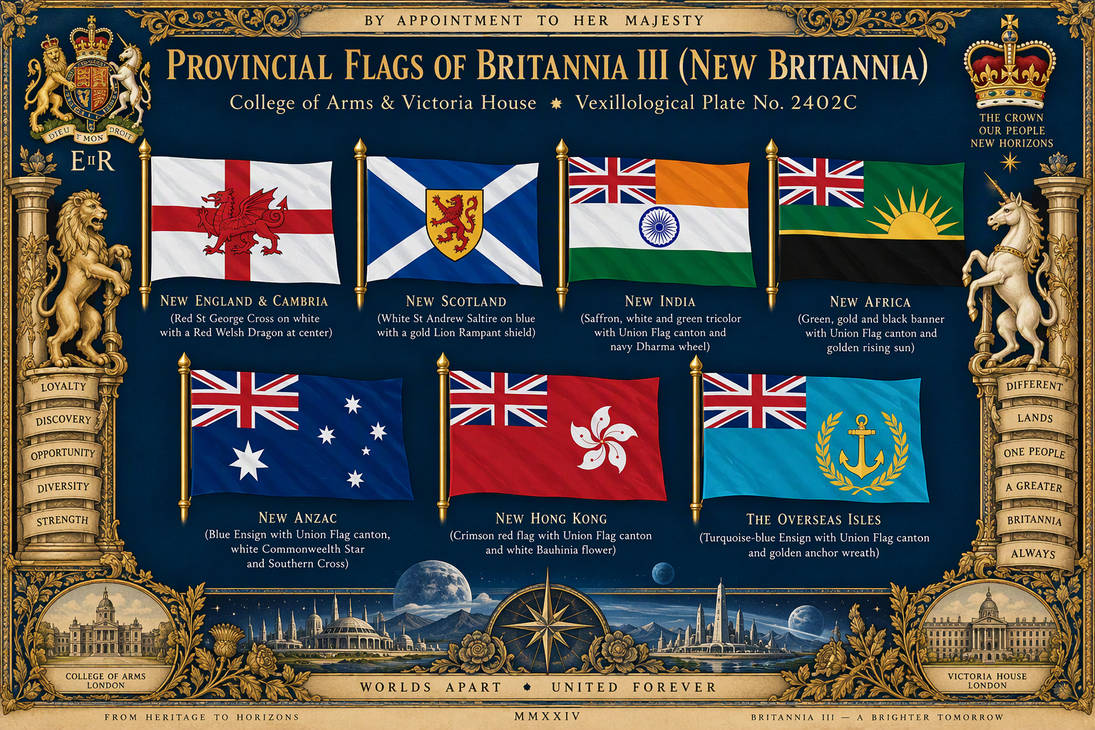
• Britannia III (New Britannia — Pop: ~110M): A lush 1.03g garden world (with 45% of its landmass protected as Noah Wildlife Sanctuaries) linked to orbit via two giant Space Elevators—the Thames-Portsmouth Skyhook and the Indraprastha Tether—and divided into Seven Self-Governing Provinces:
- New England & Cambria (Capital: New London — Pop: ~24M; Beta Quadrant seat of Victoria House, Royal Britannia Palace, and New Portsmouth).
- New India / Indraprastha (Capital: New Bombay — Pop: ~42M; agricultural plains, Indraprastha Brigade, and New Cambridge).
- New Africa (Capital: New Nairobi — Pop: ~18M; savanna reserves, engineering hubs, and Commonwealth regiments).
- New Scotland / Caledonia Reach (Capital: Fort Stirling — Pop: ~11M; granite highlands, Highland Lodge, and Gurkha/Krellan mountain ranges).
- New ANZAC / Australis Reach (Capital: New Melbourne — Pop: ~7M; coastal ports, 2nd Royal Australian Regiment, and championship cricket).
- New Hong Kong (Capital: Victoria Harbour II — Pop: ~5M; maritime trade, New Pound (£) clearinghouses, and Royal Hong Kong Regiment).
- The Overseas Isles (Capital: Port FitzRoy — Pop: ~3M; sub-arctic southern islands and fjords housing 5 Commando Brigade Royal Marines, RBAF Bomber Command, and joint Vesperian training ranges).
• Moons & Orbital Defenses: Twin moons St. George and St. Andrew anchor the New Portsmouth Orbital Yards, the Fleet Museum, and the top terminals of both Space Elevators—protected by 24 Martello Mk. IV Orbital Defense Platforms (crewed, self-powered British counterparts to Cardassian orbital weapon platforms, banned around Earth by treaty but vital to defending the Britannia System alongside RAF/RBAF and ASAW surface-to-orbit grids).
• Britannia IV (New Ireland — Pop: ~14M): Terraformed 0.78g emerald world (Capital: New Belfast, plus New Londonderry and Ballykinlar Base), renowned for low-gravity sports and pastoral valleys.
• Inner & Outer Britannia System: Britannia I & II (solar smelters and RCTI research stations), The Drake Asteroid Belt (zero-G mining and a classified Section D black site), gas giant Britannia V (Leviathan) (housing antimatter fleet depot HMNB Hawke alongside outer-system domed moons and stations New Bermuda, New Falkland Ice-Moon Range, Gibraltar Station, and St. Helena), plus outer ice giant Britannia VI (Trafalgar) (long-range GCHQ tachyon arrays).
• Sol System Sovereign Enclaves (Autonomous Mars & Luna): Secured permanently under the 2150 Treaty of Eternal Concord: New Albion (Argyre Planitia, Mars — 42,000 sq km, Pop: 1.4M), New Cornwall (Shackleton South, Luna — 18,500 sq km, Pop: 3.2M, including the 10,000 sq km Bodmin Proving Grounds), orbital transit stations HMS Sovereign & HMS Trafalgar, and sovereign Belt enclaves on 4 Vesta & 2 Pallas.
South Atlantic & Antarctic Territories (The WWIII Lifelines)
• The Falkland Islands(Pop: ~420,000)
• History: Liberated in six weeks during the 2031 Second Falklands War against a South American junta; escaped World War III nuclear targeting completely and served as Britain's vital food, wool, and seed-vault lifeline during the 2040–2053 nuclear winter.
• Modern Role: A thriving, green maritime-agricultural hub and major spaceport gateway (Mount Pleasant Orbital), defended by the Falkland Islands Defence Force (FIDF) and Maritime Royal Navy polar cutters.
• South Georgia & The South Sandwich Islands(Pop: ~18,000)
• History: Fortified during the 2030s with deep subterranean genetic and seed vaults; survived World War III untouched and later supplied diverse frozen humpback whale DNA after the 2286 Whale Probe Crisis (and housed four captured Breen POWs in sub-zero containment in 2375).
• Modern Role: Premier marine biology, sub-glacial science, and polar conservation sanctuary alongside restored humpback whale pods.
• British Antarctic Territory(Pop: ~45,000 rotating scientists & support staff)
• History: Remained strictly neutral and demilitarized during 21st-century conflicts (with Royal Navy patrols blocking New UN and ECON oil drilling in the 2040s) before expanding into Britain's premier subterranean high-energy and warp-field physics laboratory.
• Modern Role: Home to the Royal Society's deep-ice gravimetric arrays, neutrino observatories, and cold-weather survival training with the Andorian Imperial Guard.
• Saint Helena(Pop: ~85,000)
• History: Escaped World War III entirely thanks to its remote mid-Atlantic isolation, feeding British relief convoys and sheltering evacuated scholars during the Post-Atomic Horror.
• Modern Role: Peaceful organic coffee/agricultural garden island, deep-space subspace relay station, and popular retirement haven for RSF veterans.
• Ascension Island(Pop: ~110,000)
• History: Upgraded in the 2060s–2080s into Britain's primary Atlantic equatorial launch complex—sparking twenty-five years of orbital-slot rivalry with the European Hegemony (2085–2130).
• Modern Role: Bustling equatorial spaceport featuring massive electromagnetic mass-drivers and stratospheric skyhooks linking directly to orbital station HMS Sovereign.
• Tristan da Cunha(Pop: ~12,000)
• History: The world's most remote inhabited archipelago weathered World War III completely self-sufficiently, preserving traditional island life and marine fisheries.
• Modern Role: Zero-emission oceanic conservation reserve, meteorological monitoring station, and quiet eco-tourism retreat.
Atlantic & Caribbean Territories (The Refugee & Financial Gateways)
• Bermuda(Pop: ~380,000)
• History: Fortified by the Royal Navy and Royal Bermuda Regiment during the 2024–2028 Second American Civil War to shelter peaceful North American refugees; survived World War III intact behind automated naval missile shields.
• Modern Role: Major interstellar banking center for the New Pound Sterling (£), Ferengi/Federation luxury tourism resort, and Atlantic aerospace hub.
• Cayman Islands(Pop: ~310,000)
• History: Brushed by destructive tsunamis during the March 2153 Xindi probe attack on Florida and Venezuela, quickly rebuilt with British and United Earth aid.
• Modern Role: Thriving tropical tourist paradise, coral-reef marine sanctuary, and Bank of England interstellar currency clearinghouse.
• Turks & Caicos Islands(Pop: ~195,000)
• History: Weathered the 2153 Xindi shockwaves alongside the Caymans and expanded into a major Caribbean marine-farming and orbital-shuttle recovery zone.
• Modern Role: Zero-emission aquaculture center, luxury holiday archipelago, and Maritime Royal Navy patrol base.
• British Virgin Islands (BVI)(Pop: ~165,000)
• History: Maintained unbroken constitutional self-rule through the 21st-century wars, welcoming Commonwealth migrants and maritime scholars, and hosting British Army jungle training from 2030 until New Britannia opened in the warp era.
• Modern Role: Premier sailing, water-sports, and eco-tourism destination frequented by off-duty Starfleet and RSF crews.
• Anguilla(Pop: ~95,000)
• History: Partnered with neighboring British islands to preserve Caribbean biodiversity during Operation Ark.
• Modern Role: Quiet island retreat, heritage rum and culinary exporter, and regional solar-fusion relay hub.
• Montserrat(Pop: ~65,000)
• History: Reclaimed and stabilized its volcanic southern zone using late-21st-century British geothermal and tectonic-dampening engineering, while hosting tropical warfare training after the 2026 Brunei withdrawal.
• Modern Role: Geothermal clean-energy research center, lush botanical sanctuary, and Caribbean cultural arts hub.
European, Indian Ocean & North Atlantic Territories
• Gibraltar(Pop: ~240,000)
• History: Survived World War III behind fortified Rock bunkers; in the 2070s, Britain vetoed a proposed "Atlantropa" Gibraltar Dam on ecological and sovereignty grounds, installing submerged seabed tidal turbines beneath the open Strait instead.
• Modern Role: Strategic Mediterranean naval anchorage, European sub-orbital transit hub, and home to the Royal Gibraltar Regiment.
• British Indian Ocean Territory (Diego Garcia & Chagos Archipelago)(Pop: ~190,000)
• History: Expanded after the 2024 Realm Continuity Act from a military base into a populated, self-governing island territory—serving as Britain's Indian Ocean equatorial launch complex during the 2085–2130 European Hegemony rivalry.
• Modern Role: Major eastern equatorial electromagnetic mass-driver spaceport, subspace tracking array, and Maritime Royal Navy Indian Ocean headquarters.
• Rockall & North Atlantic Maritime Territory(Pop: ~25,000 offshore engineers & maritime crews)
• History: Elevated to full territory status in the 2070s to restore the constitutional count of 15 Overseas Territories after Britain peacefully transferred Akrotiri and Dhekelia (Cyprus) to a reunited Cypriot humanitarian authority in 2056.
• Modern Role: Chain of floating anti-grav fusion energy platforms, North Atlantic weather-grid stabilizers, and Maritime Royal Navy / RAF North Sea patrol hubs.
THE THREE CROWN PROTECTORATES (OUTSIDE FEDERATION SPACE — AS OF 2402)
Self-governing allied worlds and frontier colonies outside Federation borders linked to the UKGBNB by mutual-defense, free-trade, and New Pound (£) currency pacts—never annexed or colonized against their will, yet shielded by 3rd Fleet and UKSF:
The Kingdom of Vesperia (Oceanic Alien Monarchy — Beta Quadrant)
- Population (2402): ~42.5 million native Vesperians (plus ~18,000 British naval, scientific, and diplomatic liaison personnel at Coral Harbour Orbital).
- Government & Monarch: Hereditary Constitutional Oceanic Monarchy ruled by High King Nerion IV alongside the bicameral Coral Assembly (representing Vesperia's twelve archipelagic city-states), with a Crown High Commissioner representing Queen Victoria III.
- History: An indigenous, pre-warp aquatic-amphibious alien monarchy whose coastal cities were threatened by Orion and Nausicaan slaver raids in the late 23rd century. After an RSF Explorer-class cruiser rescued a Vesperian royal expedition, Queen Victoria II signed the 2276 Treaty of Coral Harbour—granting Vesperia modern orbital shields, clean fusion energy, and RSF naval protection while strictly honoring their native monarchy and Crown Non-Interference cultural autonomy.
- Vesperian Armed Forces (VAF — ~24,000 Regulars + ~15,000 Reserves): Locally commanded in peacetime (and under joint British CDS operational control in wartime), comprising the elite Vesperian Amphibious Brigade (~6,000 regulars training beneath New Falkland with the Maritime Royal Navy, Royal Marines, and SBS), the Royal Vesperian Sub-Surface Fleet (~10,000 operating deep-ocean hydro-cruisers and sub-orbital skimmers), and the Vesperian Orbital Coast Guard (~8,000 flying six light Type 23-V customs cutters alongside RSF patrol frigates).
• New Hobart (Human Frontier Colony — Near the Badlands & Former Cardassian DMZ)
- Population (2402): ~1.85 million humans (predominantly Australian-British, Tasmanian, and English frontier descendants, plus ~35,000 resettled Cardassian-border refugees).
- Government & Leadership: Self-Governing Parliamentary Frontier Republic (no local monarch; recognizes Queen Victoria III as Symbolic Protector) led by elected First Minister Callum MacLeod and the Derwent House of Assembly in Port Derwent.
- History: Founded in 2298 by independent Australian-British and Tasmanian frontier families seeking a rugged agricultural world outside Federation bureaucracy. During the mid-24th-century Cardassian Border Wars and the Maquis Crisis, New Hobart petitioned Westminster for Crown Protectorate status rather than join the Maquis or surrender to Cardassian border claims—prompting 3rd Fleet and The Ranger Regiment to fortify the system.
- New Hobart Defence Force (NHDF — ~6,500 Regulars + ~4,500 Reserves): Modeled on the historic Australian Defence Force (ADF) and serving as a vital humanitarian hub since Operation Dunkirk II and the Dominion War, uniting the New Hobart Frontier Rangers (~4,500 equipped with Land Rover Mk. XII and Foxhound Mk. IV patrol craft) and the New Hobart Air Corps (~2,000 flying upgraded former-RAF/RBAF Typhoon-S atmospheric interceptors and Chinook-G heavy grav-transports), backed in orbit by rotating RSF 3rd Fleet Type 26 frigates out of Port Nelson / Britannia One.
• The Krellan Principality (Mountainous Dilithium World — Near the Romulan Neutral Zone)
- Population (2402): ~8.4 million Krellans (hardy, high-altitude humanoids adapted to thin mountain air and low light, plus ~6,500 British engineers and GCHQ personnel at Highland Watch).
- Government & Sovereign Prince: Sovereign Clan-Federated Principality ruled by Sovereign Prince Torin Vael-Krell in council with the Highland Clan Moot (heads of the nine mountain mining clans) at Citadel Krell.
- History: A proud, clan-based highland humanoid principality rich in dilithium and rare minerals, situated dangerously close to the Romulan Neutral Zone. In 2310, facing covert Tal Shiar destabilization and Orion Syndicate extortion, the Prince of Krellan signed an eternal defense and fair-trade pact with King Henry IX—trading certified dilithium for New Pounds (£N), NHS-style medical clinics, and RSF border patrols without surrendering sovereign rule.
- Armed Forces of the Principality of Krellan (AFPK — ~9,500 Regulars + ~6,000 Reserves): Key strategic dilithium ally for Rolls-Royce and New Portsmouth shipyards, fielding the Krellan Mountain Rifles (~4,500 training with the Royal Gurkha Corps and 24 SAS in Caledonia Reach), the Krellan Alpine Artillery & Surface-to-Orbit Corps (~3,000 manning both fixed mountain-bunkered AS99 mass-driver turrets and mobile grav-howitzers alongside Space Rapier 2400 FSD launchers), and the Princely Guard & Dilithium Security Corps (~2,000), supported in orbit by RSF 1st/3rd Fleet treaty patrols.
Allied Canon Alien Powers & Galactic Threats
Minor starfaring species who prefer sovereign trade and neutral defense treaties with the Crown—plus major galactic threats
• The Tamarian Empire: Bound by cultural-exchange treaties with Oxford and the Royal Society, trading historical literature and Shakespearean epics for Tamarian allegorical art.
• The Elaysian Homeworld: Low-gravity humanoids who partner closely with New Ireland's 0.78g universities, RSF Medical bio-engineers, and Olympic training centers.
• The Lissepian Merchant Guilds: Pragmatic Beta/Alpha Quadrant traders who use New Hong Kong and Bermuda as regulated New Pound Sterling (£) free-trade hubs under RSF escort.
• Bajor (2369–2375 Neutral Partnership): Following the Cardassian withdrawal, Bajor trusted Britain's impartial "Slate Beret" peacekeepers, Royal Engineers, and RFA hospital cruisers long before considering Federation membership.
• The Tholian Assembly(TOS: "The Tholian Web" / ENT: "Future Tense"): Strictly territorial crystalline xenophobes who tolerate the UKGBNB far better than the Federation due to Britain's exact treaty compliance, non-expansionist borders, and formal diplomatic punctuality—maintaining a 2271 Non-Incursion Accord and limited high-precision crystalline sensor trade.
• The Borg Collective(TNG / First Contact / Voyager / Picard): Views the UKGBNB as a stubborn tactical obstacle due to Britain's air-gapped computers, hardwired overrides, and kinetic backup weapons. Britain lost two cruisers at Wolf 359 (2367), fought beside Starfleet at Sector 001 (2373), and suffered heavy internal mutinies during the 2401 Frontier Day transporter-DNA crisis—fighting alongside Spacedock One to hold Earth's perimeter until Picard destroyed the Borg Cube.
• The Borg Collective(TNG / First Contact / Voyager / Picard): Views the UKGBNB as a stubborn tactical obstacle due to Britain's air-gapped computers, hardwired overrides, and kinetic backup weapons. Britain lost two cruisers at Wolf 359 (2367), fought beside Starfleet at Sector 001 (2373), and suffered heavy internal mutinies during the 2401 Frontier Day transporter-DNA crisis—fighting alongside Spacedock One to hold Earth's perimeter until Picard destroyed the Borg Cube.
• Albion Prime (The Preserver Parallel World — Sector Beta-419)(Discovered 2369 by HMS Endeavour): A mysterious Class-M world hidden inside a sensor-masking nebula beyond the Beta Quadrant frontier, featuring genuine Earth oak forests, wildlife, and a towering crystalline Preserver obelisk (TOS: "The Paradise Syndrome"). Inhabited by ~18 million descendants of 10th-century Anglo-Saxon and Celtic Britons transplanted a millennium ago by the Preservers—now living in a peaceful, pre-warp Victorian-era steam-and-airship society. Sealed off from all outside contact—including Federation survey teams, Ferengi traders, and Orion raiders—by a Royal Order-in-Council (The 2369 Albion Sanctuary Proclamation), enforced by Type 12 Stealth Sloop patrols and a single concealed Royal Society observation post.
ECONOMY, INFRASTRUCTURE, CULTURE & DAILY LIFE (2402)
• The New Pound (£), Debt-Free Exchequer & Mixed Economy: Unlike the Federation's moneyless economy, the UKGBNB maintains the sovereign New Pound (£, introduced 2059)—backed 100% by fusion kilowatt-hours, Crown Estate Dual-Realm revenues, and Royal Belt / Krellan mineral reserves. Completely debt-free since 2094 with zero inflation, the Exchequer balances an annual ~£6.3 trillion New Pound budget (allocating ~33% to NHS Realm & welfare, ~21% to education & RCTI science, ~19% to space-elevator & rail infrastructure, ~3.8% [£240B/year] to SDSR 2400 defense, and the remainder to Crown Protectorate grants and Sovereign Reserves)—guaranteeing effortless replicator abundance for every citizen while preserving family farms, artisanal guilds, historic pubs, and seamless commercial trade with non-Federation powers, Vesperia, and Krellan.
• NHS Realm & Social Welfare: Funded directly through the Exchequer and Crown Estate trusts, NHS Realm provides free, cradle-to-grave healthcare across Great Britain, New Britannia, New Ireland, the Sol Enclaves, and the 14 Overseas Territories—famed across both quadrants for radiation medicine, trauma surgery, and compassionate psychiatric care.
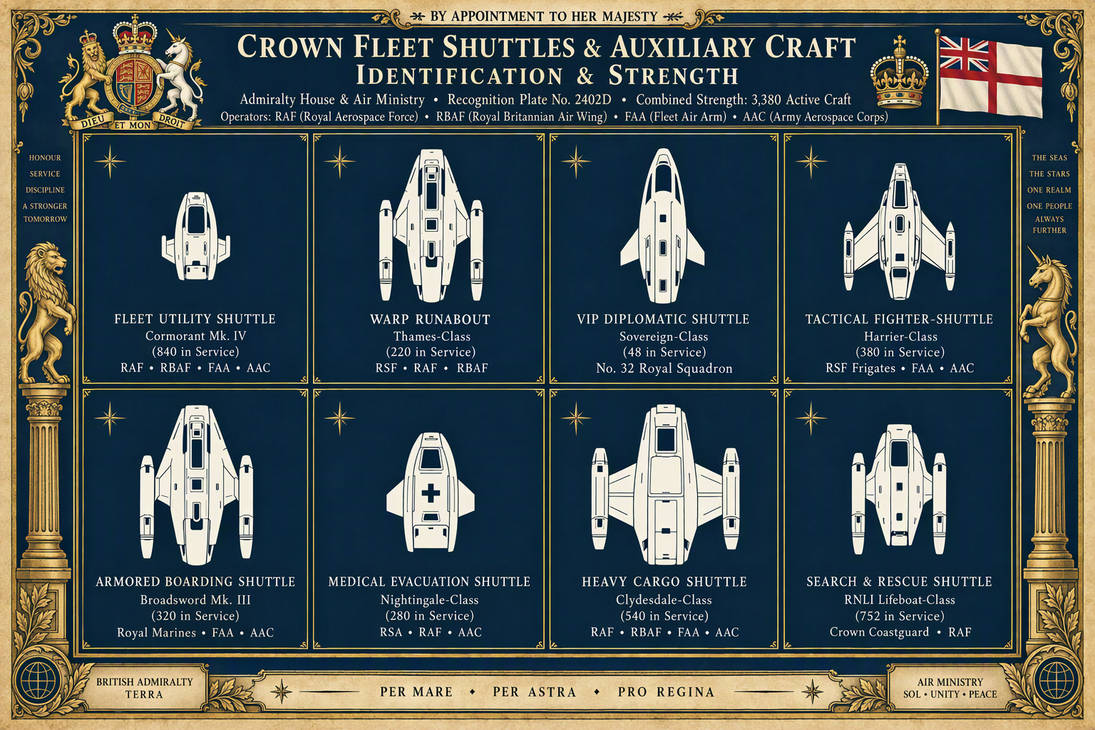
• British Spaceways & Civilian Infrastructure: Civilian interstellar travel is led by British Spaceways (operating Warp 8.5 Sovereign-class passenger liners and Cormorant shuttles linking HMS Sovereign, Port Elizabeth at L5, New Cornwall, New Albion, and New Portsmouth—plus visa-free 15th Realm Accord routes to Paris, San Francisco, Vulcan, and Bajor), alongside orbital space elevators on New Britannia and high-speed maglev rail networks across Great Britain.
• The RAF & RSF Fleet Air Arm Historic Flights (40 Ceremonial Craft — Guardians of Memory): Alongside active frontline squadrons, the Ministry of Defence maintains two ceremonial heritage wings bridging four centuries of aviation and spaceflight for Armed Forces Day, Coronation flypasts, and Remembrance Sunday across Sol and Epsilon Indi. Because all surviving original World War II and World War III airframes are permanently grounded inside climate-controlled Royal Museum stasis vaults at Hendon, Duxford, and New Hendon due to their extreme age and priceless historical value, all 20th- and 21st-century flypasts are performed by Officially Sanctioned Heritage Replicas—constructed by Rolls-Royce Heritage Works to original historical blueprints with discreet 2402 safety standards, micro-inertial dampeners, and clean-burning synthetic/fusion powerplants—alongside restored 22nd- and 23rd-century craft:
- RAF Historical Flight (20 Airworthy Aircraft — RAF Coningsby & New Coningsby, Britannia III): Successor to the Battle of Britain Memorial Flight, operating 2x Supermarine Spitfire Mk. IX, 2x Hawker Hurricane Mk. IIc, 2x Avro Lancaster B.I, 2x Avro Vulcan B.2, 2x Eurofighter Typhoon FGR.4, and 2x 2035 BAe Tempest GCAP sixth-generation interceptors (all Officially Sanctioned Heritage Replicas), alongside airworthy 2x 2110s English Electric Thunderbolt Mk. II sub-orbital defenders, 2x 2150s Earth–Romulan War BAe Sovereign Mk. I interceptors, 2x 2240s Hawker Vanguard Mk. III trans-atmospheric fighters, and 2x 2290s Hercules Mk. I tactical lifters.
- RSF Fleet Air Arm Historic Flight (20 Airworthy Craft — RNAS Yeovilton & RNAS New Culdrose, Britannia III): Successor to Navy Wings / Royal Navy Historic Flight, operating 2x Fairey Swordfish, 2x Hawker Sea Fury, 2x Sea Harrier FA.2, and 2x F-35B Lightning II / Tempest-N carrier variants (all Officially Sanctioned Heritage Replicas), alongside airworthy 2x 2152 Supermarine Valkyrie Mk. I carrier interceptors, 2x 2180s Blackburn Buccaneer Mk. IV orbital strike fighters, 2x 2280s Fairey Swordfish Mk. IV torpedo-fighters, 2x 2310s Scimitar Mk. I carrier fighters, 2x 2320s Atlas Mk. I assault dropships, and 2x 2305 Cormorant Mk. I utility shuttles.
• Universities & Science: Higher learning centers on Oxford, Cambridge, Edinburgh, St Andrews, and New Cambridge (working in open academic exchange with the Vulcan Science Academy and Daystrom Institute).
• The BBC Realm Service (BBC-R — Public Charter Broadcaster): Linking Sol, Epsilon Indi, and the Crown Protectorates via quantum-encrypted tachyon relays, BBC-R is the direct interstellar descendant of the historic BBC—still funded by a Royal Charter and public licence fee. It broadcasts gavel-to-gavel parliamentary sessions from Westminster and Victoria House, investigative documentaries, legendary all-night Dual Union election nights, cultural programming, and embedded RSF war correspondents. As a famous Whitehall saying goes: "The BBC has survived eleven monarchs, three Borg invasions, and seventeen governments. It remains convinced all of them are hiding something."
• The Times Interstellar (Britain's Paper of Record): Descended from London's historic Times (1785), The Times Interstellar is the Dual Union's premier broadsheet and subspace journal of record—famed for rigorous long-form investigations, foreign-affairs analysis, and fiercely independent editorial columns. Read daily by diplomats, academics, and starship captains across New London, Whitehall, Paris, San Francisco, and Vulcan, its morning subspace edition frequently sets the diplomatic agenda across both the Alpha and Beta Quadrants.
• The Portsmouth Ledger (Independent Naval & Defence Journal): Published jointly out of Old Portsmouth on Earth and New Portsmouth Spacedock above Britannia III, The Portsmouth Ledger is a famously aggressive, fiercely independent naval-affairs journal dreaded by every Secretary of State for Defence. Renowned for breaking stories on shipyard cost overruns, procurement delays, and quiet Admiralty boardroom disputes, it is officially grumbled about in every RSF wardroom while being secretly read cover-to-cover by every captain and flag officer in the fleet.
• The New London Spectator (Weekly Political & Cultural Review): Published in New London on Britannia III with a simultaneous Westminster edition, The New London Spectator is the Dual Union's sharpest, most contrarian weekly political magazine—famously dedicated to irritating every party, ministry, and star system in equal measure. Renowned for provocative cover essays that swing from "Why Britain Needs More Warp Escorts" one week to "Why Britain Has Too Many Warp Escorts" the next, it remains mandatory Friday reading in Whitehall, Victoria House, and RSF wardrooms across both quadrants.
• The Drake Belt Podcast (Subspace Current-Affairs & Defence Show): Transmitted across subspace relays from the Drake Belt listening frontier, this surprisingly influential weekly roundtable is hosted by a rotating panel of retired RSF captains, military historians, backbench MPs, and planetary scientists. Famed for lively, unfiltered arguments over the 2374 Helaspont Ambush, whispered rumours of Section D, Federation diplomacy, and Klingon border politics, it is standard off-watch listening for junior officers on long deep-space patrols—while senior admirals publicly dismiss it and privately listen to every episode.
• The Public Ledger (Investigative & Constitutional Watchdog): The Dual Union's largest non-profit investigative journalism organization, dedicated to parliamentary accountability, Crown Estate finances, and intelligence oversight across Great Britain, Britannia III, and New Ireland. Famed for breaking key leads that helped expose the 2336 Room 13 Reform Crisis to Privy Council auditors, its relentless freedom-of-information teams are quietly referred to by Section D personnel as "the most dangerous organization in the Realm."
• Everyday Traditions & Interstellar Sport: Daily life blends classic British rituals—afternoon tea, village cricket, Test matches, and Premier League football—with 0.78g Low-Gravity Rugby and Hurling on New Ireland, low-gravity Sky-Rugby on Britannia III, and underwater aquatic games with Vesperian exchange athletes.
• Popular Culture, Drama & Interstellar Sport: Beyond hard news, BBC-R and independent holo-studios sustain a thriving Dual Union entertainment culture—ranging from lush costume dramas, historical documentaries, and razor-sharp satirical political panel shows to Doctor Who, which enters its fifth century on the air in 2402 (now featuring occasional cameos from actual time-weary Section D advisers complaining about temporal inaccuracies). Subspace sports broadcasts remain a national obsession across both star systems, from live low-gravity Sky-Rugby commentaries to ball-by-ball interstellar cricket; tellingly, the most-watched BBC-R broadcast of 2401 was not the Starfleet Frontier Day Crisis, but the fifth day of the Interstellar Ashes Test between England and New ANZAC—prompting predictable grumbling in Westminster and Victoria House regarding national priorities.
• The Unwritten Law of Real Tea: Across eleven light-years and three centuries of history, every citizen of the Dual Union understands one silent rule: "Replicated tea is acceptable. Real tea is important." While shipboard replicators dispense perfectly serviceable Earl Grey during routine watches, loose-leaf tea grown on Earth or Britannia III's high-altitude Epsilon Indi estates carries deep social weight. In 2402, treaty signings use real tea, ship commissionings use real tea, promotions use real tea, marriage proposals use real tea, and serious apologies absolutely require real tea. No law mandates it, and no citizen questions it—though a Vulcan exchange professor may spend ten years in New London before realizing that the quiet question "Would you like a proper cup of tea?" is never actually about the tea.
• The Crown Card & The Mandatory Manual Queue: Every subject of the Dual Union carries a thin brass-and-black biometric Crown Card—combining citizen identification, New Pound (£N) banking, NHS healthcare, voting registration, taxation, university and library access, orbital transit passes, and interstellar customs clearance across Sol, Epsilon Indi, and the Crown Protectorates. Perfectly ordinary yet indispensable, it prompts the universal daily question heard in every home, pub, and spaceport from London to New Portsmouth: "Have you got your Crown Card?" Unlike Federation digital databases, however, the Crown Card is required by Act of Parliament to maintain a complete manual fallback at every spaceport, post office, and border checkpoint: physical identity ledgers, stamped paper forms, and living human clerks. Forged in the hard lessons of World War III, three Borg incursions, Changeling infiltration, and the Mars Synth Attack, this analog redundancy strikes Federation visitors as bafflingly archaic—while Britons find it deeply reassuring. Across every orbital terminal, travelers routinely pass the familiar brass-and-enamel sign: "SYSTEM OFFLINE? PLEASE JOIN THE MANUAL QUEUE"—and because this is Britain, the manual queue is invariably orderly, polite, and slightly longer than anyone would like.
Deep-Space Mysteries & Quarantine Zones
Notable anomalies, lost ships, and ancient relics encountered by Explorer-class survey cruisers
• The Lost Colony of New Mercia (SS Mercia)(Rediscovered 2368 by HMS Discovery): Descendants of a 2030s British sub-light cryoship that fled the Eugenics Wars; rediscovered thriving on a frontier world and now linked to the UKGBNB by friendly trade and cultural treaties while remaining self-governing.
• Spaceborne Leviathans & Subspace Conservation(TNG: "Galaxy's Child" / "Force of Nature"): Following HMS Darwin's 2366 peaceful rescue of a radiation-feeding spaceborne creature, Britain extended Noah Wildlife protections to non-sentient space life—and worked with Vulcan scientists in 2370 to fit variable-geometry warp coils across the fleet to prevent subspace damage.
• The Beagle Probes (Beagle-6 Recovered 2389 & Missing Beagle-4): Following the 2387 Romulan supernova and Britain's humanitarian aid to Romulan refugees, survey cruiser HMS Beagle received diplomatic clearance in 2389 to recover the long-lost Beagle-6 (launched 2115) from an abandoned Romulan border archive—reuniting it with Beagle-1, 2, and 3 at the IWM Fleet Museum, leaving only Beagle-4 (2081) still missing beyond the Beta Quadrant rim.
• Tetrad IV ("The Vaelen Experiment" — Sector Beta-512)(Discovered 2371; Quarantined through 2402): A pre-warp Class-M world engineered by the Vaelen Archivists as a sociological experiment—abducting four towns from November 1944 onto separate provinces alongside ~14 million native Veldari: Königswald (Germany — ~6,500 townsfolk and a 1,500-man Wehrmacht/SS garrison), Oakhaven (Ohio, USA — ~7,200 civilians and a 900-man US Army battalion), Novaya Tula (USSR — ~6,800 workers and a 1,800-man Red Army regiment), and Kurokawa (Japan — ~5,800 coastal villagers with zero military garrison as a peaceful control group). In 2371, RSF survey cruiser HMS Shackleton discovers a camouflaged Vaelen observation station in high orbit staffed by the last living Vaelen Archivist—who had survived their homeworld's 1978 supernova and faithfully monitored the experiment alone into extreme old age. Before passing away peacefully, the last Archivist entrusts three centuries of pristine sociological logs to HMS Shackleton and Oxford historians on one condition: that outsiders leave the surface undisturbed. Honoring that dying wish alongside the Prime Directive and Britain's 1765/2161 Crown Non-Interference Statute, the UKGBNB and the Federation seal the entire Tetrad IV system behind automated GCHQ and Starfleet warning buoys, sensor arrays, and 4th Fleet patrol pickets through 2402—hoping Königswald, Oakhaven, Novaya Tula, Kurokawa, and the Veldari resolve their differences in peace.
• Excalbia: A molten Beta Quadrant world inhabited by shape-shifting, silicon-based beings who tested Captain Kirk in 2269 using recreations of historical figures—including Colonel Phillip Green (leader of the 2033–2035 Optimum Movement). Britain respects a strict 5-light-year navigational exclusion zone around the system while Oxford historians study the Enterprise logs of Green's tactics.
• [/b]HMS Endeavour's Delta Quadrant Odyssey (2371–2377)(Parallel to Star Trek: Voyager): While patrolling the New Hobart / Badlands border in 2371, Type 26 Frigate HMS Endeavour (135 RSF crew and a 15-man 43 Commando Royal Marine detachment) was swept 70,000 light-years into the Delta Quadrant by the Caretaker's Array (18 KIA in transit). Operating sectors apart from the USS Voyager—never meeting Captain Janeway's ship during the voyage, though Voyager occasionally heard trader rumors of a stubborn, grey-hulled warship firing solid railgun slugs and refusing to trade weapons—Endeavour fought a grueling six-year journey home guided by Queen's Regulations and the Crown Non-Interference Statute. Losing 29 more crewmembers in Kazon, Vidiian, Hirogen, and Borg skirmishes (47 total KIA) while rescuing and taking aboard 22 Delta Quadrant castaways and local guides who became adopted members of the ship's company, the battered frigate relied on hardwired analog repairs and air-gapped Turing computers to slip through a collapsing transwarp conduit back to New Portsmouth in late 2377—where her Delta Quadrant recruits received Crown citizenship and Admiralty House later merged Endeavour's and Voyager's star charts in 2378.
• Talos IV (The Talosian Quarantine)(TOS: "The Cage" / "The Menagerie"): Home to the telepathic Talosians whose hyper-realistic mental illusions prompted Starfleet's General Order 7. Under the parallel 2256 Talosian Quarantine Order-in-Council, Britain classifies the Talos Star Group as an Absolute Bio-Psychological Hazard Zone—enforcing strict GCHQ perimeter warning buoys and life-imprisonment penalties against any unauthorized British vessel entering the system.
• [/b]The Drake Belt Iconian Gateway (Vault 19)(Britannia System — Discovered 2341): An ancient, semi-dormant Iconian spatial-translocation arch ("Iconian door", TNG: "Contagion" / DS9: "To the Death") found inside hollow asteroid Drake-19. Too unstable to detonate safely inside the home system, the gateway is sealed behind strictly air-gapped dampening fields (blocking the infamous Iconian computer virus) and guarded 24/7 by Section D, 43 Commando Royal Marines, and 22 SAS against Tal Shiar, Section 31, Dominion, and MU-Britannia infiltrators.
• The HMS Resolution Temporal Incursion (2154)(Parallel to ENT: "Zero Hour" / "Storm Front"): Caught in the temporal wake of Vosk's Na'kuhl faction at the climax of the Temporal Cold War in 2154, RSF cruiser HMS Resolution is pulled back into an altered 2038 Britain where Colonel Green's Optimum Movement succeeded—overthrowing the Crown and imposing genetic-purity purges. Using hardwired manual overrides to ride the collapsing temporal rift back to 2154 as Captain Archer destroys Vosk's conduit, Resolution's crew returns to their intact parliamentary Britain—leaving Section D (Vault 19) permanently haunted by whether they witnessed a Na'kuhl temporal distortion or a dark glimpse of the un-diverged Prime Star Trek timeline.
Parallel Realities & The Mirror Universe (Section D Classified Files)
Monitored strictly by Section D (Room 13) alongside Starfleet temporal/dimensional liaisons
• The Prime Mirror Universe (TOS / DS9 / Discovery): Encountered occasionally via Badlands and Bajoran-sector subspace rifts; a brutal timeline where the Terran Empire (and later the Klingon-Cardassian Alliance) dominated humanity and no independent Britain survived.
• MU-Britannia — The Imperial Britannic Dominion (Dark Reflection of the UKGBNB): Rather than an opposite of Britain, MU-Britannia is a chilling mirror where every core British virtue has been twisted into authoritarian excess—turning Preparedness into Paranoia, Continuity into an Obsession with Order, Duty into Fanatical Loyalty, Restraint into Cold Control, and Constitutionalism into Permanent Emergency Government. Diverging after Britain embraced the 2035 Augment coup, conquered Europe, abolished Parliament, and reduced Vesperia and the Krellan Principality to vassal states, the Dominion operates on a single terrifying creed: where Prime UKGBNB believes liberty creates resilience, MU-Britannia believes liberty creates chaos.
- The Imperial Crown & Ideology: Ruled by Empress Victoria XIII—whose authority became absolute after the Augment Emergency stripped away all constitutional restraints—the Dominion genuinely believes it saved humanity, proclaiming from its orbital citadels: "The disorder of democracy brought Earth to the brink of extinction. The Crown restored order. The Crown restored unity. The Crown restored humanity." Where Prime RSF wardrooms toast "Never blind, never again," Imperial Dominion warships fly under the motto: "Nothing escapes the Crown."
- Unchecked Mirror Section D & Cross-Dimensional Incursions: In MU-Britannia, no 2336 Room 13 Reform Crisis ever occurred; Mirror Section D operates without audits, judicial warrants, or legislative oversight—leaving captured Mirror operatives genuinely baffled that Prime Britain permits lawmakers to review temporal operations. Locked in a ruthless Cold War against its own Mirror Terran Empire, Imperial Dominion warships—carrying the prefix IBS (Imperial Britannic Ship) or ISS, led by the dreaded mirror battlecruiser ISS Dreadnought—repeatedly attempt to breach subspace corridors into Prime space to steal RSF air-gapped Turing cores, slipstream propulsion data, and temporal archives, making cross-dimensional infiltrators a top priority for Prime Section D, 22 SAS, 24 (Britannia) SAS, and the Special Orbital Service (S.O.S.).
- The Room 13 Assessment: Section D analysts classify the Imperial Britannic Dominion not as Britain's opposite, but as Britain's most plausible failure state: a civilization that survived every crisis by sacrificing one liberty at a time until none remained. As a classified Room 13 historical brief notes: "Analysis indicates that no single event created the Imperial Britannic Dominion. The divergence resulted from three centuries of temporary emergency measures that never expired." Every briefing concludes with the same warning: "The Imperial Britannic Dominion is not our opposite. It is our warning."
Last edited by Lordroel on Fri Nov 20, 2026 8:20 pm, edited 2 times in total.
Heraldry, Flags & Ensigns of the Dual Union (2402)
Service: College of Arms & Admiralty House
Flags & Ensigns Shown: The Union Flag (Dual Union National Flag) • The White Ensign (Royal Space Force & Maritime Royal Navy) • The Royal Air Ensign (Royal Aerospace Force) • The Britannia System Ensign (Blue Ensign with six planetary stars representing the Epsilon Indi System) • Britannia III — New Britannia Ensign (Dominion Red Ensign with Tudor Crown & seven provincial stars) • Britannia IV — New Ireland Ensign (Emerald Green Ensign with Union Flag canton and centered golden Celtic harp).
Provincial Flags of Britannia III (New Britannia | 2402)
Service: College of Arms & Victoria House
Overview: Official 24th-century College of Arms survey of the seven provincial banners of Britannia III (New Britannia)—blending Crown heraldry with the historic Commonwealth symbols of the Earth nations that settled each province following World War III.
Provinces Shown: New England & Cambria • New Scotland • New India • New Africa • New ANZAC • New Hong Kong • The Overseas Isles.
CROWN ARMED FORCES, ORBITAL STARBASES & INTELLIGENCE (~320,000 ACTIVE REGULARS + 140,000 RESERVES)
Civilian Oversight, Military Doctrine & Public Trust
- Civilian Oversight & The Ministry of Defence (MoD): Unlike the United Federation of Planets—which leaves daily naval administration to uniformed admirals at Starfleet Command under the Federation President and Security Council—all British armed forces answer daily to an elected civilian Cabinet minister, the Secretary of State for Defence, supported by an evolved Dual-Realm ministerial team at the Ministry of Defence (Main Building, Whitehall & Victoria Square, New London): the Minister of State for the Armed Forces & Interstellar Operations, the Minister of State for New Britannia, Sol Enclaves & Overseas Territories, the Minister of State for Space Procurement, Shipyards & Cyber-Hardening, and the Parliamentary Under-Secretary for Defence People & Veterans. Though Starfleet liaison officers often find it unusual to see uniformed RSF Admirals and Generals reporting to civilian politicians, Federation leaders deeply respect Britain's strict democratic control—especially following Admiral Leyton's 2372 military coup attempt in San Francisco.
- Chief of the Defence Staff (CDS) & Chiefs of Staff Committee: Reporting directly to the civilian Secretary of State for Defence and advising the Prime Minister and Queen Victoria III, the Chief of the Defence Staff (a five-star officer rotating between the RSF, British Army, and RAF) heads the Chiefs of Staff Committee alongside the Vice-Chief of the Defence Staff (maintaining permanent dual-capital command across Whitehall and New Portsmouth), the First Sea Lord & Chief of the Space Staff (RSF & Maritime Royal Navy), the Chief of the General Staff (British Army & RBA), the Chief of the Air & Space-Wing Staff (RAF & RBAF Air Wing), and the Commandant General Royal Marines & Director Special Forces.
- Strategic Defence & Security Review (SDSR 2400) & Budget: Published every five years alongside new parliamentary terms, the SDSR 2400 commits a 10-year Equipment & Shipyard Plan of £2.4 trillion New Pounds (~3.8% of Dual-Realm GDP, backed by Crown Estate revenues and Royal Belt mining) focused on scarce strategic resources such as certified dilithium, antimatter refining, and drydock capacity. Adapting Britain's historic four primary defense missions to the 24th century, it tasks the Armed Forces to: (1) defend Great Britain, Britannia III, New Ireland, the Sol Enclaves, and the 14 Overseas Territories; (2) maintain Britain's survivable strategic antimatter/quantum deterrent; (3) provide quadrant-wide intelligence and survey mapping via GCHQ and 4th Fleet; and (4) reinforce interstellar security alongside allies—keeping Crown forces permanently ready for humanitarian rescues, surgical strikes, "Slate Beret" peacekeeping, and major combat operations under the 15th Realm Accord and Crown Protectorate mutual-defense treaties.
- National Security Council (NSC), COBRA & Defence Council: Britain separates strategy, crisis command, and military administration across three lean bodies: the National Security Council (a compact weekly Cabinet committee chaired by the Prime Minister with the Foreign, Defence, Home, and New Britannia Secretaries, Chancellor, CDS, JIC Chair, and National Security Adviser—setting long-term SDSR strategy and 15th Realm Accord policy), COBRA (convened only during immediate emergencies inside air-gapped bunkers beneath 70 Whitehall and No. 10 Victoria Square, as during Wolf 359, the 2372 Leyton crisis, and 2401 Frontier Day), and the Defence Council (chaired by the Defence Secretary to oversee internal MoD administration and Queen's Regulations).
- Military Doctrine & Shipboard Standards ("The Victory Lineage"): Strict operational separation keeps all civilians and families off active HMS warships. Vessels feature matte Admiralty Slate Grey hulls with ablative duranium-Chobham armor, hardwired mechanical overrides, air-gapped Turing computers, non-sentient "Human-in-the-Loop" combat drones, and physical aerospace transports for contested or shielded drop zones. Every newly commissioned capital ship receives a small ceremonial section of certified 18th-century oak from HMS Victory installed in its wardroom or captain's cabin during commissioning; by 2402, several vessels carry oak salvaged from earlier generations of British starships, creating an unbroken material lineage stretching back across six centuries to Trafalgar.
- Public Trust & Civil Society ("Preparedness Without Paranoia"): Despite maintaining one of the largest per-capita defence establishments in Human space outside the Federation itself, the Crown Armed Forces remain deeply trusted across Great Britain, Britannia III, and New Ireland. Annual Armed Forces Day celebrations, Fleet Open Weeks at HMS Sovereign and New Portsmouth Spacedock, and extensive reserve, cadet, and civil-defence programs ensure nearly every citizen knows someone serving in uniform. While parliamentary scrutiny of defence spending remains vigorous, opinion polling consistently places the Royal Space Force, Royal Marines, and Royal Space Auxiliary among the Realm's most respected public institutions—prompting a frequent observation among visiting Starfleet attachés: "Federation officers are often surprised that a civilization so heavily invested in planetary defence, military reserves, and emergency preparedness is simultaneously one of the most democratic societies in known space." Built around a single guiding principle—Power is necessary; accountability is mandatory—the Dual Union proves that preparedness need never become paranoia.& Every officer cadet—from Britannia Royal Naval College and Sandhurst-on-Indi to New Cranwell and HMS Sovereign—passes daily beneath the same stone-carved maxim from the aftermath of the 2380 Naval Modernization Debate: "A free people may maintain strong institutions. Strong institutions must never own a free people." — Lord Pembroke, 2380.
Royal Space Force (RSF — Peacetime Standing Fleet: ~320 Active Warships)
Institutional Heritage (UK Space Command → RSF): Elevated into a full independent service by the 2058 Royal Space Force Act from its real-world predecessor United Kingdom Space Command (founded 1 April 2021 at RAF High Wycombe), the RSF fuses UK Space Command's orbital-warfare pedigree with the Royal Navy's White Ensign, naval ranks, and centuries-old shipboard traditions. Built around spartan, dedicated warships with hardwired manual controls, air-gapped Turing computers, ablative armor, and kinetic backup weapons rather than civilian-family explorers:
• Capital & Carrier Battle Groups:
- 3 Type 100 Battlecruisers (Lion-Class — Peacetime): Carrying on a 250-year battlecruiser lineage stretching back to 2155's Warp 6 pioneer HMS Vanguard (BC-01), the modern Lion-class comprises HMS Dreadnought (BC-101), HMS Lion (BC-102), and HMS Tiger (BC-103), joined by HMS Hood (BC-104 — honoring both the 1941 battlecruiser and the cruiser lost at Wolf 359) and HMS Repulse (BC-105) during the 2373–2374 Dominion War surge. Measuring 520m with twin Rolls-Royce cores, spartan military interiors favored by visiting Klingons, and squared-off stern flight decks embarking 24 Scimitar Mk. IV fighters, 2 Broadsword Mk. III boarding pods, and 4 Cormorant Mk. IV utility shuttles, each battlecruiser mounts heavy Type-XII collimated phaser strips, 12 close-in pulse-phaser turrets, 64 foredeck CASt Vertical Launch System (VLS) cells firing Space Ceptor point-defense interceptors, and 8 midships broadside torpedo tubes firing Mark XII Sovereign dual-mode quantum-kinetic and photon torpedoes.
- 2 Type 90 Fleet Carriers (Ark Royal-Class): HMS Ark Royal and HMS Illustrious (carrying 60 Scimitar Mk. IV carrier space fighters, 12 Merlin Mk. V tactical grav-gunships, and 12 Atlas Mk. VI assault dropships each, alongside Cormorant Mk. IV utility shuttles).
- 4 Transorbital Assault Ships (TAS / Space LPDs — Albion-Class): HMS Albion (1st Fleet, New Portsmouth), HMS Bulwark and HMS Intrepid (3rd Fleet, New Portsmouth / New Hobart), and HMS Fearless (2nd Fleet RFTG, HMS Sovereign) — 340m atmospheric-capable heavy armor transports fitted with flush-retractable heavy landing struts, low-altitude hover thrusters, vertical heavy cargo lift elevators, and a wide squared-off stern roll-on/roll-off (Ro-Ro) ramp. Descending directly through planetary atmospheres once landing zones are secured, each vessel touches down on reinforced struts or hovers above rough terrain to offload 1,400 troops, 48 Challenger VI grav-tanks, 72 Warrior III grav-IFVs, and 6 Hercules III heavy lifters directly onto the surface for 3rd & 7th Armoured Divisions and heavy Royal Marine brigades.
- 2 Commando Assault Carriers (CAC / Space LPHs — Galaxy-Class): HMS Galaxy (1st Fleet, New Portsmouth) and HMS Centaur (2nd Fleet RFTG, HMS Sovereign) — 360m orbital assault carriers remaining in orbit during Phase One landings to launch 2,400 paratroopers of 3rd Orbital Airborne Division & 16 Space Mobile Brigade or Royal Marine raiders via 64 Mk. IV Orbital Drop-Pod tubes, 24 Atlas Mk. VI assault dropships, and 24 Scimitar Mk. IV close-support fighters (supported by Merlin Mk. V tactical grav-gunships).
- 1 Royal Space Yacht (RSF Royal Squadron): HMY Britannia (commissioned 2321, bearing no Roman numerals per Royal Navy tradition—the fourth spacefaring yacht since 2085, preserving original 1953 teak paneling and the brass ship's bell; 280m royal-blue-and-white diplomatic flagship, Warp 9.2 with emergency sprint overdrive, concealed military shields and sensor baffling, air-gapped Turing systems, crewed by RSF yachtsmen with a 43 Commando Royal Marine guard and two-frigate escort—also serving as the Crown's Operation Lyonesse emergency evacuation flagship to rush the Royal Family from Earth to Britannia III during a Borg or alien invasion of Sol).
• Cruisers, Escorts & Reconnaissance:
- 18 Type 82 Heavy Cruisers (County/City-Class, e.g., HMS Belfast, HMS London, HMS Kent): 410m fleet line combatants armed with twin Type-XI phaser arrays, 8 close-in pulse-phaser emitters, 48 foredeck CASt VLS cells (Space Ceptor interceptors), and 6 midships broadside Mark XII quantum/photon torpedo tubes, embarking 4 Scimitar Mk. IV space fighters, 2 Harrier-class tactical fighter-shuttles, 1 Broadsword Mk. III Royal Marine boarding shuttle, and 3 Cormorant Mk. IV utility shuttles on their squared-off aft flight decks.
- 48 Type 45 Area-Defense Destroyers (Daring-Class, e.g., HMS Daring, HMS Dragon): 290m dedicated fleet torpedo and fighter area-defense escorts fitted with a multi-function phased-array tracking dome, rapid-fire Type-X pulse-phaser batteries, 48 foredeck CASt VLS cells (Space Ceptor omnidirectional point-defense swarm interceptors), and 4 midships broadside Mark XII quantum/photon torpedo tubes, embarking 2 Harrier-class tactical fighter-shuttles, 1 Broadsword Mk. III boarding shuttle, and 2 Cormorant Mk. IV utility shuttles.
- 65 Type 26 Fleet Escort & Anti-Cloak Frigates (City-Class, e.g., HMS Glasgow, HMS Cardiff, HMS Achilles): 220m frontline battle-group escorts and cloak-hunters fitted with long-range tachyon/gravimetric sensor arrays, forward Type-X phaser strips, 24 foredeck CASt VLS cells (Space Ceptor interceptors), 4 midships broadside Mark XII quantum/photon torpedo tubes, and modular stern mine-rails, embarking 2 Harrier-class tactical fighter-shuttles and 2 Cormorant Mk. IV utility shuttles.
- Type 31 General Purpose Patrol Frigates (Inspiration-Class, e.g., HMS Active, HMS Bulldog, HMS Venturer): 195m modular, long-endurance patrol and expeditionary frigates guarding Sol shipping lanes, Crown Protectorate borders, and humanitarian corridors—armed with defensive phaser strips, 16 foredeck CASt VLS cells, and 2 midships broadside Mark XII torpedo tubes, embarking 2 Harrier-class tactical fighter-shuttles and 2 Cormorant Mk. IV utility shuttles.
- 24 Explorer-Class Survey Cruisers (4th Fleet deep-space scientific ships, e.g., HMS Challenger, HMS Shackleton): 320m deep-space astrometric, planetary, and quarantine cruisers equipped with long-range multi-spectrum sensor suites, defensive Type-X phaser strips, a 16-cell Space Ceptor point-defense grid, and 2 forward photon torpedo tubes—featuring an enclosed Voyager-style aft clamshell shuttlebay embarking 2 Thames-class long-range warp runabouts, 1 Nightingale-class MEDEVAC shuttle, and 4 Cormorant Mk. IV utility shuttles for extended planetary surveys.
28 Type 12 Stealth Sloops (Leander-Class, e.g., HMS Leander, HMS Arethusa, HMS Naiad): 165m passive sensor-baffled reconnaissance sloops compliant with the 2312 Enclave Security Pact / Treaty of Algeron, fitted with low-observable hull geometry, defensive pulse phasers, a flush-recessed 12-cell Space Ceptor launcher, and 2 light photon torpedo tubes, carrying 2 low-signature Cormorant Mk. IV utility shuttles inside an enclosed aft stealth bay.
- 18 River-Class Light Patrol Corvettes (LPC, e.g., HMS Tyne, HMS Severn, HMS Mersey, HMS Tamar): 130m agile Sol, Britannia, and Crown Protectorate patrol escorts armed with defensive phaser strips, a 12-cell Space Ceptor point-defense grid, and 2 light photon torpedo tubes, carrying 2 Cormorant Mk. IV utility shuttles in an enclosed aft hangar.
RSF Ordnance, Torpedo Lineage & Mine Warfare:
• RSF Torpedo Lineage (Mark I – Mark XII) & Specialist Warheads: Descending from 2058's sub-light Mark I Spearfish-S nuclear missile and 2155's Earth–Romulan War Mark IV photon torpedo to the 2402 Mark XII Sovereign dual-mode quantum-kinetic torpedo (combining a zero-point quantum core with a hyper-velocity depleted-duranium penetrator nose), British broadside and forward torpedo tubes also fire five specialized tactical variants:
- Galahad Solid-Slug Kinetic Penetrator: Non-explosive hyper-velocity duranium-tritanium slug immune to energy-dampening fields and Borg shield adaptation.
- Merlin Tachyon-Pulse Cloak-Hunter: Emits a wide-spectrum tachyon burst on proximity to destabilize and expose cloaked Romulan or Klingon vessels.
- Boudica Non-Lethal Shield-Disruptor: Fires an electromagnetic/subspace feedback pulse that collapses enemy deflector shields without breaching the hull, tailored for Royal Marine and Special Orbital Service (S.O.S.) boarding actions.
- Excalibur Orbital Bunker-Buster: Reinforces its warhead casing with ablative armor for deep-crust orbital bombardment against hardened planetary fortifications.
- Nightingale Warp-Capable Humanitarian Rescue Beacon: Unarmed long-range emergency probe carrying medical supplies, life-support rations, and subspace distress transponders to stranded ships or disaster zones.
• Mine Warfare & Space Minelayers (Hunt-Class & Modular Rails): Preserving the Royal Navy's historic mine-warfare specialty, the RSF operates a dedicated Mine Countermeasures Squadron—comprising 32 Hunt- and Sandown-Class Space Mine Countermeasure (SMC) & Training Vessels (part of its 50 light patrol corvettes, minesweepers, and training vessels). Built on 110m low-signature hulls named after towns and villages across Great Britain, New Britannia, and New Ireland—led by six dual-role Hunt-class Minehunters & Minelayers (HMS Ledbury, HMS Cattistock, HMS Brocklesby, HMS Middleton, HMS Chiddingfold, and HMS Hurworth) alongside Sandown-class minehunters (such as HMS Aldershot, HMS Stirling, HMS Ballykinlar, and HMS FitzRoy)—each ship carries an 8-cell Space Ceptor self-defense canister and forward gravimetric/tachyon arrays. For offensive and defensive barrier minelaying across Sol, Britannia, and Crown Protectorate chokepoints, they are backed by modular stern mine-rails aboard Type 26 frigates and RSA auxiliaries, deploying both Abdiel-class self-replicating quantum-gravimetric mines (with hardwired friend-or-foe transponders) and Manxman-class kinetic-shrapnel and tachyon-snare mines designed to strip away cloaking devices along the Romulan border.
• SpaceFox Space Mine Countermeasure (SMC) Neutralizer Drones: Deployed from the enclosed aft shuttle and drone bays of Hunt- and Sandown-class minehunters, unmanned SpaceFox SMC drones (2.4m) are the RSF's primary method for hunting, identifying, and destroying space mines without risking crewed craft. Propelled by ultra-quiet cold-gas micro-thrusters with zero warp signature and guided via jam-proof laser-tethered telemetry, reusable scout SpaceFox units pinpoint and classify cloaked or proximity mines while expendable combat SpaceFox neutralizers destroy targets with directional shaped micro-antimatter charges—or attach magnetic subspace frequency-jammer clamps onto self-replicating minefields (such as those encountered in DS9's Bajoran Wormhole and Cardassian DMZ) so they cannot clone themselves when detonated ahead of planetary landings and civilian shipping lanes.
RSF Orbital Starbases & Deep-Space Stations
• Home-System Orbital Starbases & Her Majesty's Naval Bases (HMNB):
- HMS Sovereign (Earth Geostationary Orbit above Great Britain): Primary Sol orbital transit hub, Royal Ceremonial Pier for HMY Britannia, and HMNB Mountbatten (2nd Fleet HQ), operating alongside Starfleet Spacedock One.
- New Portsmouth Orbital Yards & St. Andrew Anchorage (New Britannia Orbit): Main RSF and British Spaceways zero-gravity shipyards (anchored to moon St. Andrew) plus the Imperial War Museum – Fleet Museum.
- HMS Victory & Wellington Orbital Yards (New Albion / Mars Orbit): Houses HMNB Drake (orbital manufacturing and shipyard hub), grandfathered under Article IV of the 2150 Treaty of Eternal Concord from Britain's pre-UE 2094 Martian settlement and operating alongside Starfleet's Utopia Planitia without expanding beyond Argyre Planitia's orbital corridor.
- HMS Trafalgar (New Cornwall / Luna Orbit): Houses HMNB Beatty (low-gravity Rolls-Royce hull foundries and Inner Sol Patrol base).
- Hawking Orbital Outpost (Jupiter Orbit): Houses HMNB Nelson (joint RCTI scientific and deuterium-scooping station operating alongside Starfleet's Jupiter Station).
• Frontier Deep-Space Stations (Outside Sol & Britannia):
- Port Nelson / Britannia One (New Hobart Orbit — Badlands Border): Heavily shielded frontier starbase, 3rd Fleet forward logistics hub, and New Pound (£) free-trade port near the former Cardassian DMZ.
- Coral Harbour Orbital (Vesperia System — Beta Quadrant): Joint RSF–Vesperian defense and marine-science station built under the 2276 Treaty of Coral Harbour.
- Highland Watch (Krellan System — Romulan Border): Hardened GCHQ tachyon listening post and dilithium-transfer station watching the Romulan Neutral Zone in compliance with the Treaty of
Algeron.
- Deep Space Outpost Shackleton (Outer Beta Quadrant Rim): Furthest British deep-space scientific waystation resupplying 4th Fleet survey cruisers near the Albion Prime and Germania IV quarantine zones.
- 1st Fleet (Home & Britannia Fleet — New Britannia), 2nd Fleet (Sol & Channel Fleet — Earth, Luna & Mars), 3rd Fleet (Expeditionary & Protectorate Fleet — New Hobart, Vesperia & Krellan), and 4th Fleet (Deep-Space Survey & Quarantine Fleet — Outpost Shackleton).
- Standing Sol Squadrons (2nd Fleet): Includes the Fleet Ready Escort (FRE — a single high-readiness frigate or destroyer on immediate Sol standby), the Mining Protection Squadron (two Type 26 Frigates guarding shipping lanes to 4 Vesta and 2 Pallas, veterans of the 2179 Battle of the Belt), and the Response Force Task Group (RFTG — Britain's permanent high-readiness expeditionary force of RSF escorts, RSA replenishment ships, Planetary Assault Landships, and Royal Marine Commandos for rapid evacuation, humanitarian relief, or planetary landings).
• Legacy Warships & The Imperial War Museum – Fleet Museum (St. Andrew Orbit, New Britannia): Before standardizing on Battlecruisers and Fleet Carriers, the RSF fielded legendary 22nd- and 23rd-century Battleships—led by HMS King George VII (named after "The Spacefarer King," r. 2058–2098), HMS William V ("The Bunker King"), HMS Warspite, and HMS Iron Duke (the final true battleship, retired 2330)—alongside early carriers (HMS Furious and HMS Eagle) and storied cruisers (HMS Vanguard (RSF-01 — Launched 2155, the first RSF vessel to bear the name and Britain's answer to Starfleet's Enterprise NX-01. Built with polarized hull plating, hardwired analog overrides, Enfield Mk. III phase cannons, and BAe Sea Slug photonic/spatial torpedoes, her twin Rolls-Royce engines broke the Warp 6 barrier first in late 2155—carrying her to legendary victories at the 2158 Battle of New Britannia and 2160 Battle of Cheron before her preservation at the IWM Fleet Museum), HMS Yorkshire, HMS Trafalgar [whose 1940 time-slip records remain classified beyond Top Secret in Section D vaults], and HMS Glowworm). For maximum security under New Britannia's Martello defense grid, these preserved legacy warships and the retrieved Beagle warp probes are moored at the IWM Fleet Museum in St. Andrew orbit above New Britannia, complementing IWM London and IWM Duxford on Earth.
• Ship Naming & Ordnance: Under the 2161 15th Realm Accord, Starfleet avoids duplicating traditional Royal Navy warship names (such as Hood, Ark Royal, Dreadnought, or Illustrious), leaving them exclusively to His/Her Majesty's Ships (HMS). Standard ordnance includes Mark VII Smart Photons, Mark VIII "Space Eagle" Swarm Torpedoes, Mark IX "Excalibur" Quantum Torpedoes, Mark X "Broadsword" Adaptive prototypes, and Guardian automated torpedo pods.
- RSF Folklore — "Never Rename a Boat": Carrying four centuries of Royal Navy seafaring superstition straight into the 24th century, RSF deck crews and Fleet Air Arm pilots firmly believe that renaming a Thames-class runabout, Cormorant shuttle, or Admiral's pinnace brings terrible luck unless the vessel undergoes an elaborate traditional "de-naming" ceremony involving real sea salt, a formal apology to the void, and a tot of Navy rum. Officially dismissed by Admiralty House as harmless nonsense, the superstition remains so ingrained that Chief Petty Officers and hangar-bay maintenance ratings grow visibly uncomfortable—and mysteriously find urgent plasma-manifold inspections to perform—whenever a new commander suggests painting over a small craft's hull name.
• The Maritime Royal Navy (~14,000 Active — HMNB Portsmouth, HMNB Clyde, Diego Garcia & Port FitzRoy): Once the ruler of Earth's waves and still revered as the Senior Service's oceanic arm, the Maritime Royal Navy phased out nuclear weapons, ballistic/attack submarines, and ocean super-carriers as strategic defense moved into orbit—reorganizing into Britain's premier planetary coastguard, hydrographic, and maritime security service across Great Britain, the 15 Overseas Territories, New Britannia, and New Ireland. Wearing classic dark navy-blue uniforms and flying the White Ensign atop zero-emission clean-fusion hydrofoil patrol cutters, polar icebreakers, deep-ocean scientific submersibles, and amphibious hovercraft, it conducts joint North Atlantic search-and-rescue, deep-ocean weather-grid maintenance, seabed tidal-turbine defense, and Noah marine sanctuary conservation alongside Starfleet's Federation Naval Patrol (DS9: "Homefront" / VOY: "Thirty Days"), His Majesty's Coastguard, RNLI Lifeboat-class rescue shuttles, and the Special Boat Service (SBS) across two regional commands:
- UK & Overseas Territories Fleet (~5,500): Operates as a zero-emission coastguard, anti-smuggling, and polar research fleet around Great Britain, Gibraltar, Bermuda, the Falklands, South Georgia, and the British Antarctic Territory (with HMS Victory preserved in Portsmouth as ceremonial flagship alongside tall-ship cadet training brigs).
- New Britannia & Outer-System Fleet (~8,500): Operates as a full blue-water ocean and sub-surface fleet across New Britannia's Sapphire Sea, New Ireland's coastal fjords, and the sub-glacial oceans of New Falkland—guarding orbital space-elevator sea-platforms, protecting revived humpback whale and Sapphire-Sea Leviathan sanctuaries, and conducting deep-trench expeditions alongside the Vesperian Amphibious Brigade.
• Allied Canonical Exchanges & Partnerships:
- Britannia Royal Naval College & Starfleet Academy Exchange: Annual cadet exchange under the 15th Realm Accord, testing British midshipmen in Starfleet's Kobayashi Maru command simulation while Starfleet cadets train on hardwired RSF manual bridge simulators.
- The Royal Cavendish & Turing Institute (RCTI — Britain's Daystrom Counterpart): Chartered in 2078 across Cambridge, Bletchley Park, and New Cambridge (New Britannia), the RCTI leads UKGBNB research in warp propulsion, air-gapped Turing computing, xeno-archaeology, and subspace physics—maintaining a formal peer-review exchange with Starfleet's Daystrom Institute while strictly enforcing the 2035 Genetic Purity & Crown Bio-Ethics Act.
• Royal Space Auxiliary (RSA — Civilian-Manned MoD Fleet):
Royal Space Auxiliary (RSA — Civilian-Manned MoD Fleet): Descended directly from Britain's historic Royal Fleet Auxiliary (1905), the Royal Space Auxiliary is a civilian-manned, Ministry of Defence-owned logistical and support fleet flying the Defaced Blue Ensign (bearing a golden fouled anchor) alongside the uniformed RSF. Vessels carry the prefix RSA, are commanded by merchant-qualified RSA Commodores and Captains with civilian spacefarer crews (augmented by embarked Royal Marines security teams and Fleet Air Arm flight detachments), and enable Britain's battle fleets to sustain deep-space deployments indefinitely.
- Core Missions: Replenishment in Space (RIS)—transferring liquid deuterium, stabilized antimatter pods, Mark XII quantum/photon torpedoes, Space Ceptor canisters, and spare parts to frontline warships via tractor-stabilized umbilical transfer rigs; heavy armored logistics for the Response Force Task Group (RFTG); officer cadet space training; anti-piracy convoy escort; and deep-space humanitarian hospital operations.
- Active RSA Fleet (46 Auxiliary Vessels — Named Across Great Britain, New Britannia & New Ireland):
- 12 Tide-Class Fast Fleet Tankers (380m — e.g., RSA Tidespring, RSA Tiderace, RSA Britannic Tide, RSA Hibernian Tide): High-warp deuterium and stabilized antimatter containment tankers fitted with dual port-and-starboard tractor-beam Replenishment in Space (RIS) rigs capable of refueling two RSF warships simultaneously at warp or impulse.
- 10 Fort Victoria-Class Fleet Solid Support Ships (410m — e.g., RSA Fort Victoria, RSA Fort Rosalie, RSA Fort New Portsmouth, RSA Fort Catterick): Armored munitions, torpedo, Space Ceptor VLS reload, and dry-stores replenishment ships featuring a squared-off aft flight deck for 4 Cormorant Mk. IV heavy cargo shuttles and 2 Merlin Mk. V tactical grav-gunships.
- 8 Bay-Class Strategic Transorbital Logistics Ships (350m — e.g., RSA Lyme Bay, RSA Cardigan Bay, RSA New Portsmouth Bay, RSA New Dublin Bay): Atmospheric-capable heavy roll-on/roll-off (Ro-Ro) transorbital transports supporting the Albion-class TAS vessels of the Response Force Task Group (RFTG). Fitted with flush-retractable heavy landing struts and low-altitude hover thrusters, each vessel descends through planetary atmospheres to touch down directly on secured landing zones or hover above rough terrain—lowering its armored stern Ro-Ro ramp to offload 1,200 troops, 36 Challenger VI grav-tanks, and 4 Hercules III heavy lifters for sustained planetary reinforcement and disaster relief.
- 12 Point-Class Merchant Convoys & Cadet Training Ships (280m — e.g., RSA Hurst Point, RSA Eddystone, RSA Britannia Point, RSA Hawke Point): Modular heavy freighters and RSF/RSA officer-cadet training cruisers fitted with defensive phaser strips, Space Ceptor point-defense canisters, and multi-shuttle training flight decks.
- 4 Nightingale-Class Fleet Hospital Cruisers (390m — RSA Florence Nightingale, RSA Mary Seacole, RSA Edith Cavell, RSA Clara Barton): Unarmed, treaty-protected humanitarian and fleet trauma hospital ships painted in white and Red Cross/Admiralty markings, equipped with 1,500 holographic/biobed surgical wards, quarantine containment decks, and 8 Nightingale-class MEDEVAC shuttles.
- The Blue Ensign Culture & Wardroom Lore ("Everyone Remembers the Auxiliaries"): While admirals and journalists celebrate Type 100 battlecruisers, every veteran fleet commander knows the unspoken truth of deep-space operations: "Everyone talks about the battlecruisers; everyone remembers the auxiliaries when the battlecruisers run out of fuel."
- Civilian Spacefarers in a Uniformed Fleet: Uniquely among Crown maritime/orbital services, RSA crews operate under Merchant Spacefarer contracts rather than military discipline—wearing dark navy-slate merchant uniforms with gold-braid stripes, addressing their captain as "Master" or "Old Man," and quietly taking pride in keeping warship reactors fed under fire without ever firing a shot in anger.
- Good-Natured RSF vs. RSA Rivalry: On frontline warships, RSF sailors affectionately call RSA tankers "Floating Filling Stations" and tease their relaxed civilian hair regulations—until a Replenishment in Space (RIS) rig hooks up in heavy ion turbulence to deliver fresh deuterium, Mark XII torpedoes, and crates of real loose-leaf tea. RSA Commodore's standard toast at joint wardroom dinners: "To the White Ensign—who find the fights—and the Blue Ensign, who make sure they can finish them."
- The "Nightingale" Mercy Tradition: Aboard the four unarmed hospital cruisers (led by RSA Florence Nightingale), medical crews observe an absolute sanctuary code—treating wounded RSF ratings, Federation colonists, Klingon warriors, and even captured raiders side by side, earning the Blue Ensign safe passage across borders where warships dare not tread.
• RSF, RAF, RBAF & Army Aerospace Corps (AAC) Shuttle & Auxiliary Craft Roster (2402): Cormorant Mk. IV Fleet Utility Shuttle (840 in Service; standard 8-passenger ship-to-ship and station transit across RAF, RBAF, FAA & AAC), Thames-Class Warp Runabout (220 in Service; Warp 6.5 diplomatic and independent sector patrol runabout), Sovereign-Class VIP Diplomatic Shuttle (48 in Service; No. 32 Royal Squadron and embassy transport), Harrier-Class Tactical Fighter-Shuttle (380 in Service; armed combat shuttle embarked aboard Type 26 frigates and operated by the Army Aerospace Corps [AAC] for ground-support escort), Broadsword Mk. III Armored Boarding Shuttle (320 in Service; Royal Marine and AAC magnetic hull-breaching pod for zero-G boarding), Nightingale-Class MEDEVAC Shuttle (280 in Service; high-speed surgical stasis and cryogenic rescue shuttle), Clydesdale-Class Heavy Cargo Shuttle (540 in Service; dockyard, colony, and Army supply lift), RNLI Lifeboat-Class Search & Rescue Shuttle (752 in Service; deep-space and planetary Coastguard rescue), Tempest Mk. IX Aerospace Fighter (480 in Service; RAF & RBAF planetary and orbital defense), Scimitar Mk. IV Carrier Space Fighter (640 in Service; Fleet Air Arm shipboard strike), Vulcan Mk. VIII Strategic Bomber (120 in Service; RAF deep-space heavy strike), Nimrod Mk. VII Orbital Recon & AEW Cruiser (96 in Service; long-range phased-array sensor patrol), Hercules III Strategic Heavy Lifter (180 in Service; interplanetary logistics carrying up to a 70-ton Challenger VI grav-tank), Atlas Mk. VI Assault Dropship (280 in Service; orbital Marine and paratrooper insertion carrying 36 armored troops or a Warrior III grav-IFV), and Merlin Mk. V Tactical Grav-Gunship (260 in Service; RBAF, AAC & Fleet Air Arm close-air and atmospheric support).
Royal Aerospace Force (RAF) and Royal Britannian Aerospace Force (RBAF)
Royal Aerospace Force (RAF — Regular & Auxiliary Royal Aerospace Force / ARAF): Carrying an unbroken lineage from 1918 through World War III into the 24th century, the RAF defends British airspace, planetary defense perimeters, and near-space corridors across Great Britain, New Britannia, New Ireland, Luna, and Mars across five specialized Commands:
• Fighter Command (480 Tempest Mk. IX Aerospace Fighters & 96 Nimrod Mk. VII AEW Cruisers): Guards planetary airspace, near-space corridors, and orbital perimeters across Great Britain (RAF Coningsby, RAF Lossiemouth, and RAF Brize Norton), New Cornwall (Luna), New Albion (Mars), and the Britannia System (working alongside the RBAF Air Wing) with impulse-and-warp-capable Tempest Mk. IX aerospace fighters (descended from the 22nd-century Comet F.5 and Starfire SF.2, armed with rapid-fire pulse phasers, micro-quantum torpedoes, and air-gapped hardwired overrides) directed by Nimrod Mk. VII orbital reconnaissance and phased-array AEW cruisers. Carries an unbroken battle lineage from the 1940 Battle of Britain and 2054 North Sea War to the 2375 Breen Raid (when Fighter Command squadrons and ASAW batteries downed three Breen raiders over the English Channel), coordinating seamlessly with Scimitar Mk. IV Fleet Air Arm wings from HMS Ark Royal and HMS Sovereign.
• Bomber Command (120 Vulcan Mk. VIII Strategic Bombers): Operates high-impulse, warp-capable Vulcan Mk. VIII heavy strategic bombers (descended from the sub-warp Valkyrie series, featuring oversized internal weapons bays and passive sensor-baffling stealth hulls to ambush invading fleets from lunar or asteroid cover) carrying micro-quantum/photon torpedoes, kinetic orbital penetrators, and precision plasma munitions—supported by specialized electronic-warfare and GCHQ signals-reconnaissance variants of the Nimrod Mk. VII.
• Support Command (180 Hercules III Heavy Lifters, 280 Atlas Mk. VI Assault Dropships & 260 Merlin Mk. V Grav-Gunships): Operates armored, impulse/warp-capable Atlas Mk. VI tactical assault dropships (carrying 36 armored troops or a Warrior III grav-IFV), heavy Hercules III strategic armor-and-cargo lifters (fitted with structural integrity fields and gravimetric locks to deploy 70-ton Challenger VI grav-tanks from orbit), Merlin Mk. V tactical grav-gunships, Clydesdale-class heavy cargo shuttles, and No. 32 (The Royal) Squadron (RBAF Voyager, Endeavour, and Sovereign-class VIP diplomatic shuttles) for Crown and Cabinet flights.
• Training Command: Trains RAF and Fleet Air Arm aircrew at Cranwell and New Cranwell on Comet T.6 and Spacehawk 600 impulse/warp trainers.
Comprises ~10,500 ground-combat airman-soldiers ("The Rock Apes") across 14 Force Protection Wings (~750 personnel each)—7 Wings in the Royal Air Force Regiment (Sol, Earth, Luna & Mars) and 7 Wings in the Royal Britannian Air Force (RBAF) Regiment (Epsilon Indi & Three Crown Protectorates)—guarding spaceports, orbital tether terminals, and Royal airfields across Great Britain, Luna, Mars, Britannia III, New Ireland, and the Crown Protectorates. Each Wing combines a flagship Field/Spaceport Assault Squadron with specialized Light Grav-Armour (15x Warrior III Grav-IFVs, 6x Foxhound Mk. IV) and Point Air-Defence Squadrons (8x–12x Mobile Space Rapier 2400 — Field Standard D [FSD] quad-launchers, the fourth major upgrade of the Rapier 2400 system, firing four ready-to-launch surface-to-orbit Mark XII Sovereign, Merlin cloak-hunter, or Boudica shield-disruptor micro-torpedoes):
- Royal Air Force Regiment — Sol & Earth Command (Wings 1–7):
* No. 1 Force Protection Wing (RAF Honington, Earth): No. 1 Sqn (Flagship Spaceport Assault), No. 3 Sqn (Field, RAF Aldergrove) & No. 20 Sqn (8x Rapier 2400 FSD Launch Stations).
* No. 2 Force Protection Wing (RAF Brize Norton, Earth): Orbital-capable No. II (No. 2) Sqn (Orbital Drop-Pod & Parachute Assault), No. 19 Sqn (12x Rapier 2400 FSD Launch Stations) & No. 58 Sqn (Light Grav-Armour).
* No. 3 Force Protection Wing (RAF Catterick & Leuchars): No. 15 Sqn (Planetary Air Defence) & No. 48 Sqn (8x Rapier 2400 FSD Launch Stations, RAF Lossiemouth).
* No. 4 Force Protection Wing (Tycho & Luna Orbital Terminals): No. 27 Sqn (CBRN, Vacuum & Alien Bio-Hazard Defence) & No. 16 Sqn (8x Rapier 2400 FSD Launch Stations).
* No. 5 Force Protection Wing (Olympus & New Portsmouth-on-Mars): No. 34 Sqn (VIP, Diplomatic & HMY Britannia Security) & No. 26 Sqn (8x Rapier 2400 FSD Launch Stations).
* No. 6 Force Protection Wing (Sol Orbital Tether & High-Orbit Terminals): No. 51 Sqn (Heavy Grav-Armour & Perimeter Patrol) & No. 37 Sqn (8x Rapier 2400 FSD Launch Stations).
* No. 7 Force Protection Wing (London, Buckingham & Westminster Citadel Guard): No. 63 Sqn (Queen's Colour Squadron) & No. 66 Sqn (8x Rapier 2400 FSD Launch Stations).
- Royal Britannian Air Force (RBAF) Regiment — Epsilon Indi & Protectorates (Wings 101–107):
* No. 101 Force Protection Wing (New London Spaceport, Britannia III): No. 101 (Britannia III) Sqn (Capital Spaceport Assault) & No. 108 Sqn (12x Rapier 2400 FSD Launch Stations).
* No. 102 Force Protection Wing (New Dublin Orbital Tether, New Ireland): No. 104 (New Ireland) Sqn (Tether & Terminal Defence) & No. 110 Sqn (Light Grav-Armour).
* No. 103 Force Protection Wing (New Colchester, Britannia III): Orbital-capable No. 112 (Britannia) Sqn (Orbital Parachute & Rapid Reaction) & No. 115 Sqn (8x Rapier 2400 FSD Launch Stations).
* No. 104 Force Protection Wing (New Portsmouth & RBAF Catterick, Britannia III): No. 118 (Catterick) Sqn (Surface-to-Orbit Air Defence) & No. 121 Sqn (Light Grav-Armour).
* No. 105 Force Protection Wing (Vesperia Crown Protectorate): No. 124 (Vesperia) Sqn (Protectorate Frontier Garrison).
* No. 106 Force Protection Wing (New Hobart Crown Protectorate — Beta Quadrant): No. 130 (New Hobart) Sqn (Beta Quadrant Perimeter & Spaceport Security).
* No. 107 Force Protection Wing (New Westminster Palace & Royal Guard, Britannia III): No. 142 (Queen's Colour) Sqn (Ceremonial & Sovereign Citadel Guard).
- Anti-Space and Air Weapons (ASAW) & Auxiliary Reserves (~8,000 Regulars + ~9,500 ARAF & ARBAF Reserves): Alongside the 14 Force Protection Wings, ~8,000 regular and ~9,500 part-time Auxiliary Royal Air Force (ARAF — including Nos. 2503, 2620, 2622, 2623, 2624, 2625, 2729 & 2890 Sqns) and Auxiliary Royal Britannian Air Force (ARBAF — including Nos. 2901, 2904, 2910, 2915 & 2920 Sqns) reserve gunners operate Britain's air-gapped, granite-bunkered surface-to-orbit ASAW heavy phaser and torpedo silos, coordinating via Joint Air & Space Defence Operations Centres with the RSF's high-orbit Martello defense platforms.
- The "Rock Ape" Identity & Inter-Service Banter: Proudly inheriting their centuries-old nickname from World War II's Gibraltar garrison, 24th-century RAF and RBAF Regiment gunners—the "Rock Apes"—possess a fiercely independent esprit de corps and a lively, good-natured rivalry with the rest of Crown Armed Forces:
* The RSF View: "Every problem looks like a spaceport assault to a Rock Ape."
* The Royal Marines View: "They spend half their lives guarding spaceports and the other half explaining why they're not infantry."
* The Rock Ape Reply: "Funny—remind me who held the orbital tether terminal while you lot were still waiting for a dropship?"
• Provincial Air & Orbital Defense (~220 Craft — Fighter & Strike Wings): Based at New Cranwell, Aldershot-on-Indi, and New Hong Kong; operates 190 impulse-and-warp Tempest Mk. IX aerospace fighters and 30 Nimrod Mk. VII orbital recon and phased-array AEW cruisers (part of the Dual Union's combined 480-fighter and 96-AEW strength) to guard New Britannia's and New Ireland's orbital perimeters alongside 1st Fleet's 24 Martello orbital platforms.
• Strategic Bomber & Reconnaissance Wing (~60 Craft): Based in hardened underground hangars at Port FitzRoy (New Falkland) and Caledonia Reach; operates 40 warp-capable Vulcan Mk. VIII strategic bombers (descended from the sub-warp Valkyrie series, armed with micro-quantum torpedoes and kinetic bunker-busters) and 20 specialized Nimrod Mk. VII GCHQ signals-intelligence craft.
• Heavy Assault Airlift & Support Wing (~120 Craft): Operates armored Atlas Mk. VI tactical assault dropships, Merlin Mk. V tactical grav-gunships, and Hercules III heavy armor lifters (plus Cormorant Mk. IV and Clydesdale-class shuttles) across New Britannia's seven provinces and 0.78g New Ireland, providing direct orbital-to-surface lift for 7th (Britannia) Armoured Division, 3rd Orbital Airborne Division, and 5 Commando Brigade Royal Marines.
• Joint Air Warfare School & JTAG-Britannia (~60 Training Craft & Expeditionary Staff): Based at Colenso Base (Cape Britannia), training British, New Britannian, Protectorate (Vesperian/Krellan), and Starfleet exchange pilots in atmospheric-to-orbital combat—and deploying off-world as the Joint Tactical Air Group (JTAG-Britannia), celebrated veterans of the Operation Return, Chin'toka, and Cardassia Prime campaigns during the 2373–2375 Dominion War.
• British Army, Royal Britannia Armed Forces & Royal Marines
Standing Army & Provincial Ground Formations (~124,000 Active Regulars): Comprises ~92,000 Regular British Army & Royal Britannian Army (RBA) soldiers alongside ~32,000 specialized orbital-airborne and Gurkha regulars across seven major formations:
• The Household Division (~6,500 — London & New London): Guards Buckingham Palace, Windsor Castle, and Victoria House; includes the Life Guards, Blues and Royals, Grenadier Guards, Coldstream Guards, Scots Guards, Irish Guards, and Welsh Guards (equipped with concealed hardwired defenses and Operation Lyonesse extraction protocols).
• 1st (United Kingdom) Division (~20,000 — York & Great Britain): Britain's versatile metropolitan rapid-reaction and peacekeeping infantry division; includes 4th Light Brigade Combat Team, 7th Light Mechanised Brigade ("Desert Rats"), and 11th Security Force Assistance Brigade (renowned for "Slate Beret" neutral peacekeeping on Bajor and Ajilon Prime).
• The Parachute Regiment, 3rd Orbital Airborne Division & 16 Space Mobile Brigade (~22,000 Regular & Reserve — Colchester, Earth & New Colchester, New Britannia): Britain's elite maroon-beret airborne and orbital-insertion forces, uniting atmospheric grav-chute and transorbital assault operations with orbital drop-pod landings from Galaxy-class Commando Assault Carriers (CAC):
- 16 Space Mobile Brigade (Colchester, Earth): Spearheaded by 2nd and 3rd Battalions, The Parachute Regiment (2 PARA & 3 PARA), the Pathfinder Platoon, and Space Assault Aviation Regiments (Merlin Mk. V tactical grav-gunships & Atlas Mk. VI transorbital assault dropships), trained to deploy directly from orbit via Mk. IV Orbital Drop-Pods.
- 24th (Britannia) Space Mobile Brigade (New Colchester, New Britannia): Raised under the Royal Britannian Army (RBA) within the 3rd Orbital Airborne Division, comprising 5th (New Britannia) Battalion and 6th (New Ireland) Battalion, The Parachute Regiment (5 PARA & 6 PARA) alongside dedicated RBA grav-artillery and Space Assault Aviation squadrons for rapid Beta Quadrant and Crown Protectorate deployment.
- 1st Battalion, The Parachute Regiment (1 PARA — Special Forces Support Group / UKSF): Permanently detached to United Kingdom Special Forces (UKSF) as the core of the Special Forces Support Group (SFSG), providing heavy orbital and planetary fire support for 22 SAS, SBS, and the Special Orbital Service (S.O.S.).
- 4th Battalion, The Parachute Regiment (4 PARA — Army Reserve): Britain's elite airborne reserve battalion headquartered in Yorkshire and New Yorkshire, remaining specialized in planetary air-assault and atmospheric grav-chute insertion (via Merlin Mk. V tactical grav-gunships and Atlas Mk. VI dropships) to provide strategic reserve reinforcements and rapid homeland planetary defense across Sol and New Britannia.
• 5th (New Ireland) Division (~14,000 — New Belfast, Britannia IV): Self-governing provincial defense division adapted for New Ireland's 0.78g gravity; includes the Royal Irish Rangers, Leinster Light Infantry, and Connaught Armoured Cavalry (veterans of the Dominion War).
• 7th (Britannia) Armoured & Commonwealth Division (~29,000 — Aldershot-on-Indi, Indraprastha & Cape Britannia, New Britannia): New Britannia's premier provincial heavy force blending British and Commonwealth lineage regiments; includes the Royal Scots Dragoon Guards (Indi), Skinner's Horse & The Guides Cavalry (historic Anglo-Indian armored reconnaissance), the Indraprastha Brigade (King's Own Sikh Light Infantry & Punjab Frontier Rifles), 1st Royal Canadian Horse Artillery (Little Canada), 2nd Royal Australian Regiment (Australis Reach), and the Royal Hong Kong Regiment (New Hong Kong).
• 3rd Orbital Airborne Division & 16 Space Mobile Brigade (~18,000 — Colchester, Earth & New Colchester, New Britannia): Britain's orbital drop-pod paratroopers trained to deploy via Mk. IV Orbital Drop-Pods from Planetary Assault Landships; includes 1st, 2nd, and 3rd Battalions The Parachute Regiment, the Pathfinders, and the Air Assault Aviation Regiments.
• Army Aerospace Corps (AAC — ~6,500 Personnel | ~680 Craft — Middle Wallop, Earth & New Wallop, New Britannia): The British Army's dedicated tactical aviation and orbital-assault support corps, working hand-in-hand with 16 Space Mobile Brigade, 3rd Armoured Division, and 7th (Britannia) Armoured Division. Following classic British tri-service doctrine, the AAC leaves dedicated space-superiority fighters to the RAF, RBAF Air Wing, and RSF Fleet Air Arm—operating ~680 dedicated craft drawn from the Dual Union's joint inventory: 140 armed Harrier-class tactical fighter-shuttles, 120 Merlin Mk. V tactical grav-gunships, 100 Atlas Mk. VI assault dropships, 80 Broadsword Mk. III armored assault shuttles, 110 Clydesdale-class heavy cargo shuttles, 70 Nightingale-class MEDEVAC craft, and 60 Cormorant Mk. IV liaison shuttles for battlefield airlift, close fire support, and casualty evacuation.
• Royal Gurkha Corps (~14,000 — Shorncliffe, Earth & New Kathmandu, New Britannia): Britain's legendary Himalayan-descended light-infantry and mountain-warfare specialists; includes 1st, 2nd, 3rd, and 4th Battalions Royal Gurkha Rifles, Queen's Gurkha Engineers, and Queen's Gurkha Signals (celebrated for close-quarters combat during the Kzinti Wars, Dominion War, and 2375 Goodwin Sands Breen raid).
• Royal Marines (~32,000 Active Regulars across Four Commando Brigades): Britain's elite amphibious, zero-gravity boarding, and planetary-assault shock troops—carrying on their historic 2145–2161 training partnership with United Earth's MACO:
- 3 Commando Brigade (Metropolitan & Sol Expeditionary — ~7,500): Based at Stonehouse Barracks and HMS Sovereign; includes 40, 42, & 45 Commandos, 29 Commando Artillery, and 24 Commando Engineers.
- 4 Commando Brigade (Fleet & Starship Boarding — ~8,500): Includes 41 Commando, 43 Commando Fleet Protection Group, and shipboard Marine detachments across all RSF warships.
- 5 Commando Brigade (Britannia Planetary & Colonial — ~8,000): Based at New Portsmouth and Port FitzRoy; includes 44, 46, & 47 Commandos defending New Britannia, New Ireland, and space elevators.
- 6 Commando Brigade (Frontier, Hostile-Environment & Protectorate — ~8,000): Based at New Falkland and with 3rd Fleet; includes 48 Commando (Sub-Glacial/Arctic, training with Andorians), 49 Commando (Oceanic/Vesperian ops), and 50 Commando (Peacekeeping).
- Reserves, Overseas Territory Regiments & Civil Defense (~140,000 Territorial Army + ~200,000 Home Guard): Trained weekend and mobilization reserves (~58,000 immediate-readiness Territorial Army field units and ~82,000 provincial RBAF, Overseas Territory, and Sol Enclave regiments) backed by 200,000 part-time Realm Home Guard civil-defense volunteers across four regional commands:
- Metropolitan Territorial Army (~58,000 — Great Britain): Immediate-readiness mobilization units augmenting the Regular Army; includes the Honourable Artillery Company, Royal Yeomanry, London Regiment, and Scottish & Welsh Yeomanry battalions.
- South Atlantic & Antarctic Command (~22,000 — Falklands, South Georgia & New Falkland): Expanded after the 2031 Second Falklands War and World War III; includes the Falkland Islands Defence Force (FIDF — guarding Mount Pleasant Orbital and South Georgia's Operation Ark vaults) and sister regiment the New Falkland Rifles (defending sub-arctic New Falkland alongside 48 Commando Royal Marines).
- Mediterranean, Atlantic & Caribbean Command (~24,000 — Gibraltar, Bermuda & Island Territories): Historic colonial units expanded into planetary and orbital-defense brigades; includes the Royal Gibraltar Regiment (guarding the Rock's subterranean fusion vaults and providing security detachments aboard HMS Sovereign), the Royal Bermuda Regiment (protecting Bermuda's New Pound clearinghouses), and the Royal Cayman, Turks & Montserrat Defence Rifles (guarding Ascension Island and Diego Garcia relays).
- Sol Enclave & Belt Defense Regiments (~16,000 — Luna, Mars & Asteroid Belt): Locally recruited Territorial regiments defending Britain's sovereign Sol territories; includes the Duke of Cornwall's Lunar Light Infantry (New Cornwall, Luna), the New Albion Martian Rifles (Argyre Planitia, Mars — veterans of the 2385 Rogue Synth Attack), and the Royal Belt Volunteers (zero-gravity cavern militia on 4 Vesta and 2 Pallas).
Combat Support & Specialist Corpses
• Provincial RBAF Reserves & Realm Home Guard (~20,000 RBAF Reserves + ~200,000 Home Guard): Provincial militia regiments across New Britannia and New Ireland alongside 200,000 locally organized Home Guard civil-defense and ASAW point-defense volunteers (who famously helped rescue survivors during the 2375 Breen Raid).
• UK Special Forces (UKSF): Comprises 22 SAS (Credenhill, Earth — veterans of the 2035 Optimum crackdown, 2155 Terra Prime Crisis, and 2375 Goodwin Sands Breen raid), 24 SAS (Stirling Lines, New Britannia — raised in the 2140s for Beta Quadrant counter-terrorism, hostage rescue, and covert direct action), the Special Boat Service (SBS) (for shipboard assaults and Vesperian-style aquatic operations), the Special Orbital Service (S.O.S.) (based aboard HMS Sovereign and HMNB Hawke — Britain's tier-one zero-gravity, EVA, and orbital assault unit drawn from elite 22/24 SAS, SBS, and Royal Marine operators for covert exterior hull-breaching, orbital tether/starbase raids, and deep-space hostage rescues), the Special Reconnaissance Regiment (SRR) (deep-cover counter-infiltration alongside MI5/MI6/MI7), and The Ranger Regiment (backed by 18 UKSF Signals Regiment for forward allied training and evacuation corridors such as Operation Dunkirk II).
- UKSF Aviation Support (Joint Special Forces Aviation Wing — JSFAW): For covert insertions, UKSF and S.O.S. teams deploy aboard specially modified, sensor-baffled variants of the Thames-class runabout (Thames-S "Black Runabouts"), submersible/zero-G Broadsword Mk. III-S boarding pods, and disguised Cormorant Mk. IV-R utility shuttles—fitted with matte-black radar/subspace-absorbent hulls, silent thrusters, and air-gapped navigation (compliant with the 2312 Enclave Security Pact without using banned cloaking devices).
• Infantry Kit & Battlefield Doctrine: Unlike Starfleet Security's uniform-and-phaser-rifle setup, British Army, Royal Marine, and UKSF troops deploy in rugged, tactical combat armor (reminiscent of classic 21st-century infantry upgraded with 24th-century tech)—wearing adaptive MTP/olive fatigues, contoured duranium-ceramic chest and shoulder plates, tactical helmets with green-tinted HUD eyepieces, and Enfield SA98 pulse-phaser rifles (with underslung kinetic railguns for Borg/dampening-field combat), backed by Mk. IV Orbital Drop-Pods, Challenger VI grav-tanks, and Warrior III grav-IFVs.
• Combat Medicine & Field Hospitals (RAMC & RSF Medical Service): Unlike Starfleet Medical's reliance on shipboard sickbays and transporter evacuations, Britain maintains a dedicated, combat-trained Royal Army Medical Corps (RAMC) and RSF Medical Service. Frontline Combat Medical Technicians (CMTs) drop alongside infantry in full tactical armor with surgical stasis packs and polaron-burn coagulants to stabilize casualties inside dampening fields, extracting wounded via heavily armored Warrior III ambulances and sensor-baffled Nightingale MEDEVAC shuttles (switching off traditional Red Cross markings in active alien warzones where foes like the Jem'Hadar or Breen ignore human Geneva Conventions) to shielded Role-3 surface field hospitals and escort-screened hospital cruiser RFA Florence Nightingale.
• Combat Support & Specialist Corps (Artillery, Engineers, Signals, Intelligence & HAC): Supporting every frontline division and Commando brigade are Britain's historic specialist corps: the Royal Regiment of Artillery (operating mobile AS99 grav-howitzers, micro-torpedo launchers, and 7 Para / 29 Commando artillery), the Corps of Royal Engineers (including 24 Commando Engineers and Queen's Gurkha Engineers—handling assault breaching, hardened fortifications, and Bajoran civil reconstruction), the Royal Corps of Signals & Queen's Gurkha Signals (maintaining jam-proof, air-gapped tachyon and hardwired field networks inside dampening fields), the Intelligence Corps (tactical threat analysis, alien hardware exploitation, and battlefield counter-intelligence), and the Honourable Artillery Company (Britain's oldest regiment, founded 1537—serving as elite Territorial Army deep-reconnaissance observers and firing ceremonial salutes at the Tower of London and Victoria Square).
• Light Mobility & Field Vehicles (Land Rover Defender Mk. XII): Preserving the iconic four-wheeled (4x4) silhouette and rear-mounted spare tire of the historic 21st-century Defender as a proud symbol of British utility, the 2402 Land Rover Defender Mk. XII conceals 24th-century hardware beneath its classic boxy bodywork: a sealed Rolls-Royce micro-fusion engine, four independent hub motors, puncture-proof duranium-mesh tires with micro-gravimetric suspension, modular ablative armor, and air-gapped analog controls easily repaired in the field by REME fitters across Great Britain, New Britannia, and Mars.
• Royal Continuity & Contingency Plans (Operation Lyonesse / Operation Redoubt): Admiralty House maintains air-gapped evacuation plans (Operation Lyonesse) to extract the Royal Family, Prime Minister, and Crown Regalia via No. 32 Squadron and HMY Britannia to New Britannia within 48 hours during a Sol blockade or rogue coup (such as Admiral Leyton's 2372 plot). Adapted as Operation Redoubt during the 2367, 2373, and 2401 Borg crises, 2nd Fleet's standing order against existential Sol threats is to escort the Crown to New Britannia immediately while holding orbital corridors open alongside Starfleet to evacuate as many civilians as possible.
• Commonwealth Heritage Regiments: Rather than an anonymous Foreign Legion, ancestral traditions thrive in the Royal Gurkha Corps (~14,000 Regulars), New Punjab Regiment, Sikh Light Infantry, Bengal Lancers, New Frontier Force Regiment & New Baluch Regiment (Pakistani-heritage regiments sharing a fierce, friendly cricket and military rivalry with Indian-heritage units), King's New African Rifles, Lion of Cape Britannia Regiment, Royal New West African Frontier Force, Royal New Hong Kong Regiment, ANZAC Expeditionary Scouts, Royal Canadian Hussars (Reserve), and New West India Regiment.
• Protectorate Auxiliaries (~15,000 Regulars): Locally raised, self-governing allied regiments operating alongside British forces under Crown Protectorate treaties—comprising the Vesperian Amphibious Brigade (aquatic and littoral specialists who train alongside the Royal Marines and SBS), the Krellan Mountain Rifles (high-altitude, low-light ridge fighters defending Krellan dilithium mines near the Romulan Neutral Zone), and the New Hobart Frontier Rangers (hardened Badlands scouts and border patrolmen who guard civilian colonies and helped evacuate dual-nationals during Operation Dunkirk II).
• Defence Medical Services (DMS) & Royal Fleet Auxiliary (RFA — ~12,000 Civilian-Manned Personnel | 42 Ships): All military doctors, combat medics, and aeromedical nurses train at the Royal Centre for Defence Medicine before deploying across the Royal Space Force Medical Service (RSFMS — wearing Admiralty Slate Grey uniforms with scarlet medical trim aboard all HMS warships), Royal Army Medical Corps (RAMC), and RAF Princess Mary's Nursing Wing. Supported by civilian-manned RFA Tide-Class tankers, Fort-Class ordnance ships, Bay-Class heavy troop transports, and Argus-Class hospital cruisers (led by flagship RFA Florence Nightingale, RFA Mary Seacole, and RFA Edith Cavell).
• Police, Intelligence & Temporal Security: New Scotland Yard, the Realm Crime Agency (RCA), and the Royal Space Constabulary (RSC) maintain civilian law and orbital policing across Great Britain, Britannia III, New Ireland, and the Crown Protectorates; supported by MI5 (Domestic Security), MI6 (Sol Diplomacy & Inner-Sphere Intelligence), MI7 (Interstellar & Alien Intelligence), GCHQ (Subspace Signals & Cryptography), and Section D / Room 13 (an unacknowledged, Crown-chartered black-ops and temporal counter-incursion directorate countering Starfleet's Section 31, the Romulan Tal Shiar, temporal saboteurs, and Omega-tier contingencies while enforcing the Temporal Prime Directive).
- Section D / Room 13 — Constitutional Limits & The 2336 Reform Crisis: Officially non-existent and omitted from all public Whitehall directories, Section D works alongside hand-picked UKSF and Special Orbital Service (S.O.S.) teams, yet unlike Starfleet's unaccountable Section 31, it operates under strict British constitutional guardrails forged during the Room 13 Reform Crisis of 2336:
* The Room 13 Reform Crisis (2336) & Accountability Act (2337): In 2336, a well-meaning but overzealous Section D Director—convinced he alone understood an impending temporal incursion—conducted unauthorized surveillance on a Dual Union diplomat, secretly detained an innocent civilian researcher, and concealed temporal evidence from Whitehall. When the breach was uncovered by GCHQ auditors and brought before the Privy Council, senior lawmakers came within a single vote of abolishing the directorate altogether. Instead, Parliament and the Crown enacted the classified Room 13 Accountability Act (2337), permanently binding Section D to four constitutional safeguards:
* The Privy Council Intelligence Tribunal: Section D is legally bound to a secret oversight committee comprising the Sovereign, the Prime Minister, the Leader of the Opposition, and three senior Privy Council Law Lords, who hold full access to its air-gapped operational ledgers.
* Strict Prohibition on Domestic Operations: By Royal Charter, Section D is barred from conducting surveillance, detention, or covert operations against subjects of the Crown on British, Britannian, or Protectorate soil—a jurisdiction reserved strictly for MI5, the Realm Crime Agency, and the Royal Space Constabulary under ordinary judicial warrants.
* Judicial Warrants & Allied Citizen Protections: Section D cannot assassinate, detain, or conduct covert operations against United Federation of Planets or United Earth citizens without a signed Star-Chamber Warrant from a Privy Council Lord Justice and explicit Prime Minister counter-signature; unauthorized lethal force constitutes high treason.
Last edited by Lordroel on Fri Nov 20, 2026 7:55 pm, edited 4 times in total.
Royal Aerospace & Fleet Air Arm: Identification & Strength (2402)
Service: Air Ministry & Admiralty House (RAF, RBAF Air Wing & RSF Fleet Air Arm)
Combined Active Strength (2402): 2,416 Active Craft across Earth, Luna, Mars, the Britannia System (Epsilon Indi), the Three Crown Protectorates, and embarked RSF starship wings.
Aircraft & Spacecraft Classes Shown:
• Aerospace Fighter — Tempest Mk. IX (480 in Service): RAF & RBAF Planetary & Orbital Defense
• Carrier Space Fighter — Scimitar Mk. IV (640 in Service): RSF Fleet Air Arm Shipboard Strike
• Strategic Bomber — Vulcan Mk. VIII (120 in Service): RAF Deep-Space & Orbital Strike Command
• Orbital Recon & AEW — Nimrod Mk. VII (96 in Service): Long-Range Phased-Array Sensor Patrol
• Heavy Transport — Hercules III (180 in Service): Strategic Interplanetary Logistics Lift
• Assault Dropship — Atlas Mk. VI (280 in Service): Orbital Marine & Paratrooper Insertion
• Tactical Grav-Gunship — Merlin Mk. V (260 in Service): Close-Air & Atmospheric Fire Support
• Fleet Utility Shuttle — Cormorant (360 in Service): Multi-Service Ship-to-Shore & Station Transit
Service: Admiralty House & Air Ministry (RAF, RBAF, FAA, AAC, RSF & RSA)
Combined Active Strength (2402): 3,380 Active Craft serving across all Crown armed services—including the Army Aerospace Corps (AAC), which operates armed tactical shuttles and assault transports in direct support of British Army ground formations while leaving dedicated space fighters to the RAF and Fleet Air Arm (FAA).
Shuttle & Runabout Classes Shown:
• Fleet Utility Shuttle — Cormorant Mk. IV (840 in Service): RAF • RBAF • FAA • AAC
• Warp Runabout — Thames-Class (220 in Service): RSF • RAF • RBAF
• VIP Diplomatic Shuttle — Sovereign-Class (48 in Service): No. 32 Royal Squadron
• Tactical Fighter-Shuttle — Harrier-Class (380 in Service): RSF Frigates • FAA • AAC
• Armored Boarding Shuttle — Broadsword Mk. III (320 in Service): Royal Marines • FAA • AAC
• Medical Evacuation Shuttle — Nightingale-Class (280 in Service): RSA • RAF • AAC
• Heavy Cargo Shuttle — Clydesdale-Class (540 in Service): RAF • RBAF • FAA • AAC
• Search & Rescue Shuttle — RNLI Lifeboat-Class (752 in Service): Crown Coastguard • RAF
Last edited by Lordroel on Fri Nov 20, 2026 2:06 pm, edited 1 time in total.
I know the shape of Star Trek ships is iconic but it would be nice to have a design that looks less vulnerable without warp nacelles on aim here pylons, a neck that says cut here and a bridge that may as well have target roundels on it.......
• United Federation of Planets & United Earth: Closest allies and primary trading partners, bound by mutual-defense treaties, open civilian travel, and shared anti-Borg intelligence. Under the Dual Citizenship Act, subjects of the Crown may freely serve in Starfleet—including famous British and Britannian dual-nationals such as Malcolm Reed, Julian Bashir, Montgomery Scott, and Deanna Troi—while Federation luminaries like Jean-Luc Picard maintain close academic and archaeological fellowships in Oxford and London.
- Fraternal Friction (Why Paris & Whitehall Sometimes Clash): Despite deep friendship, relations between the Dual Union and the Federation Council are defined by respectful tension rather than blind agreement. Idealistic commentators in Paris and San Francisco frequently view the New Pound (£N) and Britain's thriving private merchant conglomerates as a capitalist relic in a post-scity Federation; dismiss the hereditary Constitutional Monarchy and House of Lords as anachronistic; accuse Britain's Armed Neutrality of benefiting from Federation peacekeeping while refusing to subordinate the Royal Space Force to Starfleet Command; and criticize the Three Crown Protectorates (New Hobart, Vesperia, and the Krellan Principality) as "neo-colonial." Whitehall diplomats and New Westminster MPs famously brush off Federation lectures with a dry, centuries-old retort: "We've heard that since 2024"—pointing out that Britain's self-funded RSF and RSA hospital cruisers routinely rescue Federation border colonies without asking for credit, and that Britain has no intention of trading a thousand years of parliamentary sovereignty for a seat on a planetary council:
* The Federation Critique of Britain: Idealistic commentators in Paris and San Francisco frequently view the New Pound (£N) and Britain's thriving private merchant conglomerates as a capitalist relic in a post-scarcity Federation; dismiss the hereditary Constitutional Monarchy and House of Lords as anachronistic; accuse Britain's Armed Neutrality of benefiting from Federation peacekeeping while refusing to subordinate the Royal Space Force to Starfleet Command; and criticize the Three Crown Protectorates (New Hobart, Vesperia, and the Krellan Principality) as "neo-colonial." Whitehall diplomats and New Westminster MPs famously brush off Federation lectures with a dry, centuries-old retort: "We've heard that since 2024."
* The British Critique of the Federation: Privately, many Britons—and especially Admiralty officers—view Federation idealism with exasperated frustration. British strategists point out that United Earth dismantled its planetary defenses because it assumed Earth was untouchable; became dangerously over-dependent on networked shipboard automation; ignored basic transporter and cyber-security protocols; proved naïve about Changeling infiltration prior to the Dominion War; and spawned an unaccountable shadow cabal like Section 31 precisely because Paris refuses to admit that existential threats exist. As one retired RSF Admiral famously put it: "Starfleet builds ships for explorers. We build ships on the assumption that one day explorers will need rescuing."
• Klingon Empire: Deep warrior respect, joint 24 SAS–KDF survival and rugby matches on New Britannia, and Scotch whisky/bloodwine trade.
• Andorians & Tellarites: Close cold-weather military exchanges with the Andorian Imperial Guard; Tellarite diplomats famously love debating and cheering during Westminster's Prime Minister's Questions.
• Romulans, Vulcans & Ferengi: Britain shelters the exiled Romulan Imperial House Vaelen after 2387 while MI7 spars with the Tal Shiar; Vulcans respect Britain under IDIC (overcoming early 22nd-century embassy friction) and partner with Oxford/Royal Society; Ferengi love New Pound Sterling (£) trade hubs in New Hong Kong and Bermuda.
• The Tholian Assembly (TOS: "The Tholian Web" / ENT: "Future Tense"): Strictly territorial crystalline xenophobes who tolerate the UKGBNB far better than the Federation due to Britain's exact treaty compliance, non-expansionist borders, and formal diplomatic punctuality—maintaining a 2271 Non-Incursion Accord and limited high-precision crystalline sensor trade.
HOW OTHER POWERS SEE BRITAIN (2402)
Perspectives from Across the Alpha & Beta Quadrants
• United Federation of Planets (San Francisco & Paris):
"Charming, stubborn, and infuriatingly pragmatic."
They still keep a hereditary Queen, paper treaties, and hard currency—yet when a border colony is bleeding or a Borg cube appears on long-range sensors, there is no ally on Earth or in space you would rather see drop out of warp.
• The Klingon Empire (Qo'noS):
"They argue before every battle. Then fight the battle anyway."
Soft-spoken politicians in ridiculous hats—yet fierce, stubborn warriors who refuse to yield an inch of ground. Their Royal Marines and Gurkhas fight without fear, their battlecruisers never run from a brawl, and their single-malt Scotch whisky is the only human drink worthy of a Klingon feast.
• The Romulan Star Empire (Rihan & Tal Shiar):
"The Federation wants friends. Britain wants balance."
Never mistake British politeness for naivety. Behind the tea cups and parliamentary debates sits an intelligence apparatus—MI7 and Section D—that has played the shadow game for eight centuries, backed by air-gapped warships that refuse to fall for electronic tricks.
• The Andorian Imperial Guard (Andoria):
"Among humans, they are the least surprised when disaster arrives."
The only humans paranoid enough to be trusted. While Starfleet insists on flying into unknown anomalies with shields down and sensors open, the Royal Space Force keeps bulkheads sealed, weapons hot, and backup mechanical overrides bolted to every console.
• The Ferengi Alliance (Ferenginar):
"The only humans who claim money is not everything while keeping excellent accounts."
The Federation lectures us about the evils of profit; the British simply pull out a ledger, pour a glass of port, and negotiate a binding 99-year trade charter with interest. They respect contracts, honor debts, and never try to pay for dilithium with "self-improvement."
• The Cardassian Union (Cardassia Prime):
"Unlike the Federation, they understand power. Unlike Cardassia, they willingly restrain it."
Obsessed with tradition, order, and ceremonial uniforms—yet deeply frustrating to interrogate or outmaneuver. Even after the Dominion War, their admirals treat former enemies with cold, immaculate courtesy while keeping twenty-four orbital defense platforms aimed squarely at your bow.
• The Vesperian Crown Protectorate (Vesperia):
"They arrived with warships. They stayed with treaties."
Where Starfleet offered us lectures on cultural non-interference while raiders plundered our outer moons, the Crown offered a Royal Charter, two Type 26 frigates on permanent patrol, and full local self-rule. Our sky-lanes are safe, and our shrines remain untouched.
• The Krellan Principality (Beta Quadrant):
"An honorable alliance of equals."
When our princely houses stood on the brink of civil collapse, Queen Victoria III did not send conquerors—she sent Royal Engineers, RSA hospital cruisers, and a defense pact that lets our own banners fly beside the Union Flag.
• The British View of Themselves (Often Attributed to an Unknown RSF Officer):
"The Federation believes tomorrow will be better. The Klingons believe courage will see them through. The Romulans believe every door hides a trap. We simply assume all three are true and prepare accordingly."
Neither boastful nor cynical, this widely quoted wardroom maxim sums up the quiet realism of the Dual Union—hoping for peace across the stars, honoring centuries of stubborn courage, and keeping hardwired manual overrides bolted to every bulkhead just in case.
SELECTED CONSTITUTIONAL & HISTORICAL ARCHIVES (PRIMARY EXCERPTS)
Preserved in the Royal Archives at Windsor Castle & Victoria House, New London
• I. THE TREATY OF ETERNAL CONCORD (2150 — Founding Charter of the Dual Union)
"We, the Lords Spiritual and Temporal, the Commons of Great Britain and New Britannia, and the Elected Burgesses of Britannia III and New Ireland, do hereby bind our two worlds in perpetual union under one Crown and one Parliament. Neither distance across the gulf of stars nor the passage of centuries shall sever the common law, liberty of conscience, or mutual defence shared by the peoples of Sol and Epsilon Indi; yet each realm shall forever keep its own local courts, customs, and voice in the governance of the whole."
• II. ROYAL MESSAGE OF KING GEORGE VIII ON REFUSING ASSENT (14 November 2288)
"My Lords and Members of the House of Commons: For three weeks We have counseled Our Ministers to submit the United Earth and Federation Integration Bill to the free judgment of the peoples of Great Britain, Britannia III, and New Ireland. No Parliament, however well-intentioned, holds mandate to extinguish the sovereign constitution of this Dual Union without the direct consent of those who dwell beneath its Crown. Acting not as arbiter of party policy, but solely as guardian of the constitutional settlement entrusted to Us, We must with profound reluctance withhold Our Royal Assent—and commend this question to the electors of both star systems."
• III. THE ROOM 13 ACCOUNTABILITY ACT (2337 — Preamble & Section 4, Classified Privy Council Copy)
"Whereas secret agencies established for the preservation of the Realm may, if unchecked by law, imperil the very liberties they exist to defend: Be it enacted that no Directorate of Special or Temporal Operations shall conduct surveillance, detention, or covert action against any subject of the Crown on British, Britannian, or Protectorate soil; nor act against any citizen of an allied power save under a signed Star-Chamber Warrant of a Privy Council Lord Justice and counter-signature of the Prime Minister; and that every such Royal Charter shall lapse at the tenth year unless renewed upon full audit before the Sovereign, the Prime Minister, the Leader of the Opposition, and Three Law Lords."
• IV. THE CHILCOT-REPULSE INQUIRY REPORT (2376 — Concluding Findings on Operation Drake)
"The loss of HMS Repulse and three thousand four hundred and twelve British, Britannian, and New Irish personnel inside the Helaspont Nebula was neither an unavoidable act of war nor a failure of gallantry. It was the consequence of permitting diplomatic urgency to override independent intelligence verification and standard Royal Space Force reconnaissance doctrine. Never again must a British task group enter blind space on unverified allied assurances alone—for caution is not cowardice, and preparation is the first duty of command."
Last edited by Lordroel on Fri Nov 20, 2026 1:31 pm, edited 1 time in total.
Paul Nuttall wrote: ↑Fri Nov 20, 2026 1:26 pm
I know the shape of Star Trek ships is iconic but it would be nice to have a design that looks less vulnerable without warp nacelles on aim here pylons, a neck that says cut here and a bridge that may as well have target roundels on it.......
I know, but with out these war cells, nobody would know it is a ship from the Star Trek verse, but wait until you see the big ships of the RSF.
Battlestarship (6).jpg
USAF Daedalus.jpg
You do not have the required permissions to view the files attached to this post.
Last edited by Paul Nuttall on Fri Nov 20, 2026 1:38 pm, edited 2 times in total.
Admiralty Recognition Plate No. 2402L — Royal Space Force (RSF): Fleet Carriers & Transorbital Assault Ships (2402)
Admiralty Recognition Plate No. 2402L — Royal Space Force (RSF): Fleet Carriers & Transorbital Assault Ships (2402)
Service: Admiralty House & Ministry of Defence (Royal Space Force — 8 Capital Aviation & Transorbital Warships)
Boxy Through-Pod & Transorbital Architecture: Built with straight-edged, angular, high-volume industrial hulls rather than sleek curves to maximize internal hangar volume for strike craft, assault dropships, and heavy grav-armor, RSF fleet carriers and transorbital assault ships house their flight wings inside twin enclosed, heavily armored rectangular port and starboard through-hangar pods—launching craft from the forward bays and recovering returning craft at the aft bays so flight traffic never crosses paths. Each hull mounts port and starboard Space Ceptor point-defense VLS silos, dorsal collimated phaser strips, air-gapped Turing cores, and twin Rolls-Royce warp nacelles.
Capital Classes Shown (To Scale):
• Fleet Carrier — Type 90 Ark Royal-Class (2 in Service • Length: 580m • HMS Ark Royal, HMS Illustrious): Massive twin-pod fleet carriers embarking 60 Scimitar Mk. IV Carrier Space Fighters, 12 Merlin Mk. V Tactical Grav-Gunships, and 12 Atlas Mk. VI Assault Dropships, alongside Cormorant Mk. IV utility shuttles.
• Commando Assault Carrier (CAC) — Galaxy-Class (2 in Service • Length: 360m • HMS Galaxy, HMS Centaur): Dedicated orbital assault carriers remaining in orbit during Phase One landings to launch 2,400 raiders from 3rd Orbital Airborne Division & 16 Space Mobile Brigade, Royal Marines Commandos, and Special Orbital Service (S.O.S.) teams via 64 Mk. IV Orbital Drop-Pod tubes, 24 Atlas Mk. VI Assault Dropships, and 24 Scimitar Mk. IV Close-Support Fighters (supported by Merlin Mk. V tactical grav-gunships).
• Transorbital Assault Ship (TAS) — Albion-Class (4 in Service • Length: 340m • HMS Albion, HMS Bulwark, HMS Intrepid, HMS Fearless): Heavy armored atmospheric-capable transorbital transports fitted with flush-retractable heavy landing struts, low-altitude atmospheric hover thrusters, vertical heavy cargo lift elevators, and a wide squared-off stern roll-on/roll-off (Ro-Ro) ramp. Descending directly through planetary atmospheres once landing zones are secured, each Albion-class vessel touches down on reinforced struts or hovers meters above rough terrain to offload 1,400 troops, 48 Challenger VI Main Battle Grav-Tanks, 72 Warrior III Armoured Grav-IFVs, and 6 Hercules III Heavy Lifters directly onto the surface for 3rd (UK) Armoured Division, 7th (Britannia) Armoured Division, and heavy Royal Marine brigades.
Admiralty Recognition Plate No. 2402E — Royal Space Force (RSF): Principal Surface Warships (2402)
Service: Admiralty House & Ministry of Defence (Royal Space Force — 214 Principal Surface Combatants)
Naval Architecture, Sensors & Armament: Combining slender, high-speed Royal Navy warship lines with Klingon and Romulan tactical geometry, RSF surface combatants carry zero civilians aboard and utilize air-gapped Turing cores, hardwired analog overrides, and twin Rolls-Royce warp nacelles.
Each hull integrates:
• Phaser Strips & Close-In Pulse-Phaser Arrays: Flush dorsal and ventral collimated phaser strips mounted along the bow bevels, central bridge citadel flanks, and swept battle-wing leading edges, backed by rapid-fire close-in pulse-phaser turrets.
• Dedicated Space Ceptor Point-Defense Silos: Compact rapid-fire vertical canisters launching agile Space Ceptor micro-interceptors for 360° close-in fleet defense against incoming torpedoes and strike craft.
• Foredeck CASt Vertical Launch System (VLS): Heavy multi-cell vertical launch silos firing long-range modular strike missiles, Merlin cloak-hunters, and orbital bombardment warheads.
• Midships Broadside Torpedo Bays: Flush 90° port and starboard horizontal launch tubes firing heavy Mark XII Sovereign dual-mode quantum-kinetic and photon torpedoes.
• Central Citadel & Phased-Array Sensor Mast: Armored command bridge paired with long-range tactical tracking and tachyon cloak-detection sensors.
• Squared-Off Stern Flight Deck: Classic Royal Navy transom stern coated in non-reflective duranium-carbon thermal and magnetic arrestor plating for Fleet Air Arm fighters, tactical fighter-shuttles, and boarding pods.
Warship Classes Shown (To Scale):
• Battlecruiser — Type 100 Lion-Class (3 in Peacetime Service • Length: 520m • Fore VLS: 64 Cells): Capital Fleet Flagship • Heavy Type-XII Phaser Strips, 8 Broadside Torpedo Tubes & 64-Cell CASt VLS • Embarks 24 Scimitar Mk. IV Space Fighters, 2 Broadsword Mk. III Boarding Shuttles & 4 Cormorant Mk. IV Utility Shuttles (Peacetime: HMS Dreadnought [BC-101], HMS Lion [BC-102], HMS Tiger [BC-103]; Dominion War Surge: HMS Hood [BC-104], HMS Repulse [BC-105]).
• Heavy Cruiser — Type 82 County/City-Class (18 in Service • Length: 410m • Fore VLS: 48 Cells): Fleet Line Combatant • Twin Type-XI Phaser Arrays, 6 Broadside Torpedo Tubes & 48-Cell CASt VLS • Embarks 4 Scimitar Mk. IV Fighters, 2 Harrier Fighter-Shuttles, 1 Broadsword Mk. III & 3 Cormorant Mk. IV Shuttles (e.g., HMS Belfast, HMS London, HMS Kent).
• Area-Defense Destroyer — Type 45 Daring-Class (48 in Service • Length: 290m • Fore VLS: 48 Cells): Fleet Torpedo & Fighter Area-Defense Escort • Rapid-Fire Type-X Pulse-Phaser Batteries, 4 Broadside Torpedo Tubes, 48-Cell CASt VLS & Multi-Function Phased-Array Tracking Dome • Embarks 2 Harrier Fighter-Shuttles, 1 Broadsword Mk. III & 2 Cormorant Mk. IV Shuttles (e.g., HMS Daring, HMS Dragon).
• Fleet Escort Frigate — Type 26 City-Class (65 in Service • Length: 220m • Fore VLS: 24 Cells): Anti-Cloak & Battle-Group Escort • Bow Phaser Strips, 4 Broadside Torpedo Tubes, 24-Cell CASt VLS, Tachyon Cloak-Detection Suite & Stern Mine-Rails • Embarks 2 Harrier Fighter-Shuttles & 2 Cormorant Mk. IV Shuttles (e.g., HMS Glasgow, HMS Cardiff, HMS Achilles).
• General Purpose Frigate — Type 31 Inspiration-Class (80 in Service • Length: 195m • Fore VLS: 16 Cells): Modular Long-Endurance Patrol & Protectorate Escort • Defensive Phaser Strips, 2 Broadside Torpedo Tubes & 16-Cell CASt VLS • Embarks 2 Harrier Fighter-Shuttles & 2 Cormorant Mk. IV Shuttles (e.g., HMS Active, HMS Bulldog, HMS Venturer).
Admiralty Recognition Plate No. 2402K — Royal Space Force (RSF): Survey, Stealth & Escort Vessels (2402)
Service: Admiralty House & Ministry of Defence (Royal Space Force — 102 Reconnaissance, Survey & Minor Combatants)
Naval Architecture & Enclosed Shuttlebays: Unlike Britain's heavy battlecruisers and cruisers that recover fighters on open stern arrestor decks, RSF survey cruisers, stealth sloops, patrol corvettes, and minehunters feature enclosed, Voyager-style aft shuttlebays behind armored clamshell hangar doors—protecting delicate scientific craft during multi-year deep-space missions and preserving low-observable stealth profiles.
Vessel Classes Shown (To Scale):
• Survey Cruiser — Explorer-Class (24 in Service • Length: 320m • 4th Fleet Deep-Space Survey): Deep-space astrometric, planetary, and quarantine cruisers (e.g., HMS Challenger, HMS Shackleton). Armed with defensive Type-X phaser strips, a 16-cell Space Ceptor point-defense grid, and 2 forward photon torpedo tubes; embarks 2 Thames-Class Warp Runabouts, 1 Nightingale-Class MEDEVAC Shuttle, and 4 Cormorant Mk. IV Utility Shuttles.
• Stealth Sloop — Type 12 Leander-Class (28 in Service • Length: 165m • Passive Sensor-Baffled Recon): Low-observable reconnaissance sloops compliant with the 2312 Enclave Security Pact / Treaty of Algeron (e.g., HMS Leander, HMS Arethusa, HMS Naiad). Armed with defensive pulse phasers, a 12-cell Space Ceptor launcher, and 2 light photon torpedo tubes; embarks 2 low-signature Cormorant Mk. IV Shuttles.
• Light Patrol Corvette (LPC) — River-Class (18 in Service • Length: 130m • Realm & Protectorate Escort): Agile Sol, Britannia, and Crown Protectorate patrol escorts (e.g., HMS Tyne, HMS Severn, HMS Mersey, HMS Tamar). Armed with defensive phaser strips, a 12-cell Space Ceptor grid, and 2 light photon torpedo tubes; embarks 2 Cormorant Mk. IV Utility Shuttles.
• Minehunter & SMC — Hunt / Sandown-Class (32 in Service • Length: 110m • Space Mine Countermeasures): Low-signature minehunters named after towns and villages across Great Britain, New Britannia, and New Ireland (e.g., HMS Ledbury, HMS Cattistock, HMS Aldershot, HMS Stirling, HMS Ballykinlar, HMS FitzRoy). Equipped with forward Gravimetric & Tachyon Mine-Hunting Arrays and an enclosed aft Space Mine Countermeasure (SMC) Drone Bay launching unmanned SpaceFox neutralizer drones—capable of safely detonating cloaked mines or clamping subspace frequency-jammers onto self-replicating minefields (such as those encountered in DS9's Bajoran Wormhole and Cardassian DMZ) ahead of planetary landings.
Last edited by Lordroel on Fri Nov 20, 2026 7:40 pm, edited 2 times in total.
Royal Space Auxiliary (RSA): Fleet Logistics & Hospital Ships (2402)
Admiralty House & Ministry of Defence Recognition Plate No. 2402R — Royal Space Auxiliary (RSA): Fleet Logistics & Hospital Ships (2402)
Service: Ministry of Defence (Royal Space Auxiliary — 46 Civilian-Manned Fleet Logistics, Tanker, Spacelift & Hospital Vessels)
The Defaced Blue Ensign Fleet: Descended directly from Britain's historic Royal Fleet Auxiliary (1905), the Royal Space Auxiliary (RSA) is a civilian-manned, Ministry of Defence-owned logistical fleet flying the Defaced Blue Ensign (bearing a golden fouled anchor) alongside the uniformed Royal Space Force. Commanded by merchant-qualified RSA Commodores and Captains with embarked Royal Marines security teams and Fleet Air Arm detachments, RSA auxiliaries allow Britain's battle fleets to sustain deep-space deployments indefinitely.
Auxiliary Classes Shown (To Scale):
• Fleet Solid Support — Fort Victoria-Class (10 in Service • Length: 410m • Munitions & VLS Reload): e.g., RSA Fort Victoria, RSA Fort Rosalie, RSA Fort George, RSA Fort Austin. Armored munitions, Mark XII quantum/photon torpedo, Space Ceptor VLS canister, and dry-stores replenishment ships featuring a squared-off stern flight deck for 4 Cormorant Mk. IV heavy cargo shuttles and 2 Merlin Mk. V tactical grav-gunships.
• Fleet Hospital Cruiser — Nightingale-Class (4 in Service • Length: 390m • 1,500 Trauma Biobeds): RSA Florence Nightingale, RSA Mary Seacole, RSA Edith Cavell, RSA Clara Barton. Unarmed, treaty-protected humanitarian and fleet trauma hospital cruisers equipped with 1,500 holographic/biobed surgical wards, quarantine containment decks, and 8 Nightingale-class MEDEVAC shuttles.
• Fast Fleet Tanker — Tide-Class (12 in Service • Length: 380m • Deuterium & Antimatter RIS): e.g., RSA Tidespring, RSA Tiderace, RSA Tidesurge, RSA Tideforce. High-warp containment tankers fitted with armored twin-row liquid deuterium and stabilized antimatter pods along the spine and dual Replenishment in Space (RIS) tractor-umbilical rigs capable of refueling two RSF warships simultaneously at warp or impulse.
• Strategic Logistics Ship — Bay-Class (8 in Service • Length: 350m • RFTG Heavy Spacelift): e.g., RSA Lyme Bay, RSA Mounts Bay, RSA Cardigan Bay, RSA Largs Bay. Atmospheric-capable heavy roll-on/roll-off (Ro-Ro) transorbital transports supporting the Albion-class Transorbital Assault Ships of the Response Force Task Group (RFTG). Fitted with flush-retractable heavy landing struts and low-altitude hover thrusters, each Bay-class vessel descends through planetary atmospheres to touch down directly on secured landing zones or hover above rough terrain—lowering its armored stern Ro-Ro ramp to offload 1,200 troops, 36 Challenger VI grav-tanks, and 4 Hercules III heavy lifters for sustained armored reinforcement and disaster relief.
(Note: Also operating 12 Point-Class Merchant Convoys & Cadet Training Ships, bringing active RSA strength to 46 vessels.
Last edited by Lordroel on Fri Nov 20, 2026 7:44 pm, edited 2 times in total.
Royal Space Force (RSF): Fleet & Squadron Crests (2402) Service
Admiralty House & Ministry of Defence Heraldic Plate No. 2402Q — Royal Space Force (RSF): Fleet & Squadron Crests (2402)
Service: Royal Space Force (Admiralty House • Sol Home Realm • Epsilon Indi • Beta Quadrant Enclave)
Operational Fleet & Squadron Heraldry: Following over four and a half centuries of Royal Navy ship-badge tradition, every numbered fleet and standing squadron of the Royal Space Force bears a Tudor-crowned heraldic crest and Latin battle motto:
• 1st Fleet (Home & Britannia Fleet — New Britannia • Custodes Regni — "Guardians of the Realm"): Britain's premier battle fleet guarding the Epsilon Indi capital world of New Britannia, New Ireland, and New Portsmouth Spacedock.
• 2nd Fleet (Sol & Channel Fleet — Earth, Luna & Mars • Domini Freti et Solis — "Masters of the Channel and Sol"): Defending the Sol Home Realm, geostationary citadel HMS Sovereign, and the vital trans-system shipping channels between Earth, Luna, and Mars.
• 3rd Fleet (Expeditionary & Protectorate Fleet — New Hobart, Vesperia & Krellan • Ultra Fines — "Beyond the Frontiers"): Projecting Crown power and treaty security across the Beta Quadrant Enclave and the Three Crown Protectorates.
• Fleet Ready Escort (FRE — 2nd Fleet • Semper Paratus — "Always Ready"): A single high-readiness frigate or destroyer maintained on immediate Sol standby to intercept unidentified contacts, distress calls, or rogue vessels.
• Mining Protection Squadron (4 Vesta & 2 Pallas — 2nd Fleet • Memores Belti 2179 — "Mindful of the Belt 2179"): Two Type 26 City-class frigates patrolling the asteroid belt shipping lanes to 4 Vesta and 2 Pallas, carrying the battle honours of the 2179 Battle of the Belt.
• Response Force Task Group (RFTG — 2nd Fleet • Celeriter et Fortiter — "Swiftly and Bravely"): Britain's permanent high-readiness expeditionary task group combining RSF escorts, Royal Space Auxiliary (RSA) replenishment ships, Transorbital Assault Ships (TAS), and Royal Marine Commandos for rapid evacuation, humanitarian relief, or orbital landings.
Paul Nuttall wrote: ↑Fri Nov 20, 2026 1:41 pm
TAS HMS Butepid........what happened here, an accident and two ships joined together to make one.....
No AI mistake, but my AI i used said, best not to change it as the next result might be worse, took me 3 times with changes, he said, best to leave it ore use paint to change the name, will do that in due time, also it allows me to see if people read it, so it seems you did.
Whitehall, Victoria House & Admiralty Heraldic Plate No. 2402I — Crown Intelligence, Law & Civil Services (2402)
Classification: RESTRICTED ARCHIVE — EYES ONLY (Includes Unacknowledged Special Directorate)
Jurisdiction: United Kingdom of Great Britain and New Britannia (Sol Home Realm • Epsilon Indi • Beta Quadrant Enclave • Three Crown Protectorates)
450 Years of Institutional Evolution: Over four and a half centuries of spacefaring expansion, Britain's historic terrestrial intelligence structure evolved to match an interstellar realm. As Earth, Luna, Mars, New Britannia, and New Ireland merged into a single interconnected home sphere, the historic Security Service (MI5) and Secret Intelligence Service (MI6) unified their domestic and inner-system mandates under a single joint crest—combining the Parliamentary Portcullis with the Compass Rose—while MI7 was elevated into Britain's dedicated deep-space external intelligence directorate beyond the Beta Quadrant frontier.
Agency Overview:
• MI5 & MI6 (Domestic & Sol Intelligence — Silentium, Observatio, Tutela): Unified counter-espionage and inner-system intelligence across Great Britain, New Britannia, New Ireland, and the Sol Home Realm.
• MI7 (Interstellar & Alien Intelligence — Ad Alia Intelligimus): Britain's premier deep-space external intelligence directorate—operating beyond the Beta Quadrant Enclave to monitor Romulan, Klingon, Cardassian, and Dominion-era factions.
• GCHQ (Subspace Signals & Cryptography — Audire, Decodare, Praevidere): Government Communications Headquarters—managing long-range subspace listening arrays, quantum decryption, and air-gapped Turing cyber-defence across all Crown networks.
• Section D / Room 13 (Temporal & Special Operations — Tempora Nostra Sunt — UNACKNOWLEDGED): Officially non-existent and omitted from all public Whitehall directories, Section D (Britain's shadowy counterpart to Starfleet's Section 31) is known outside the highest levels of the Crown and Admiralty only through whispered rumors and intelligence folklore—operating in deep shadow alongside hand-picked UKSF and Special Orbital Service (S.O.S.) teams to neutralize temporal incursions and existential threats before they reach the realm.
• Royal Space Constabulary (New Scotland Yard & Orbital Law — Serve, Protect, Beyond): Unified civilian law enforcement policing orbital habitats, spaceports, merchant convoys, and Crown territories alongside New Scotland Yard under the royal cypher of HM Queen Victoria III (VR).
• HM Coastguard & RNLI (Orbital Search & Space Rescue — Semper Vigilo, Salvo): Rapid-response civilian and volunteer deep-space search-and-rescue crews operating Nightingale-class MEDEVAC craft and rescue cutters across shipping lanes and planetary orbits.
The Corps of Royal Marines: Commando Brigades (2402)
Admiralty Plate No. 2402E — The Corps of Royal Marines: Commando Brigades (2402)
Service: Admiralty House & Headquarters Royal Marines (32,000 Active Regulars)
Corps Motto & Battle Honors: Per Mare, Per Terram, Per Astra ("By Sea, By Land, By the Stars") • Nulli Secundus ("Second to None") • Featuring the historic terrestrial battle honor GIBRALTAR (1704) paired with the Corps's premier interstellar campaigns at CHERON (2160) and CARDASSIA (2375).
Commando Brigades Shown:
• 3 Commando Brigade (7,500 Regulars — Stonehouse Barracks & HMS Sovereign): Metropolitan & Sol Expeditionary Brigade (40, 42 & 45 Commandos, 29 Commando Artillery, and 24 Commando Engineers)
• 5 Commando Brigade (8,000 Regulars — New Portsmouth & Port FitzRoy): Britannia Planetary & Colonial Brigade (44, 46 & 47 Commandos defending New Britannia, New Ireland, and orbital space elevators)