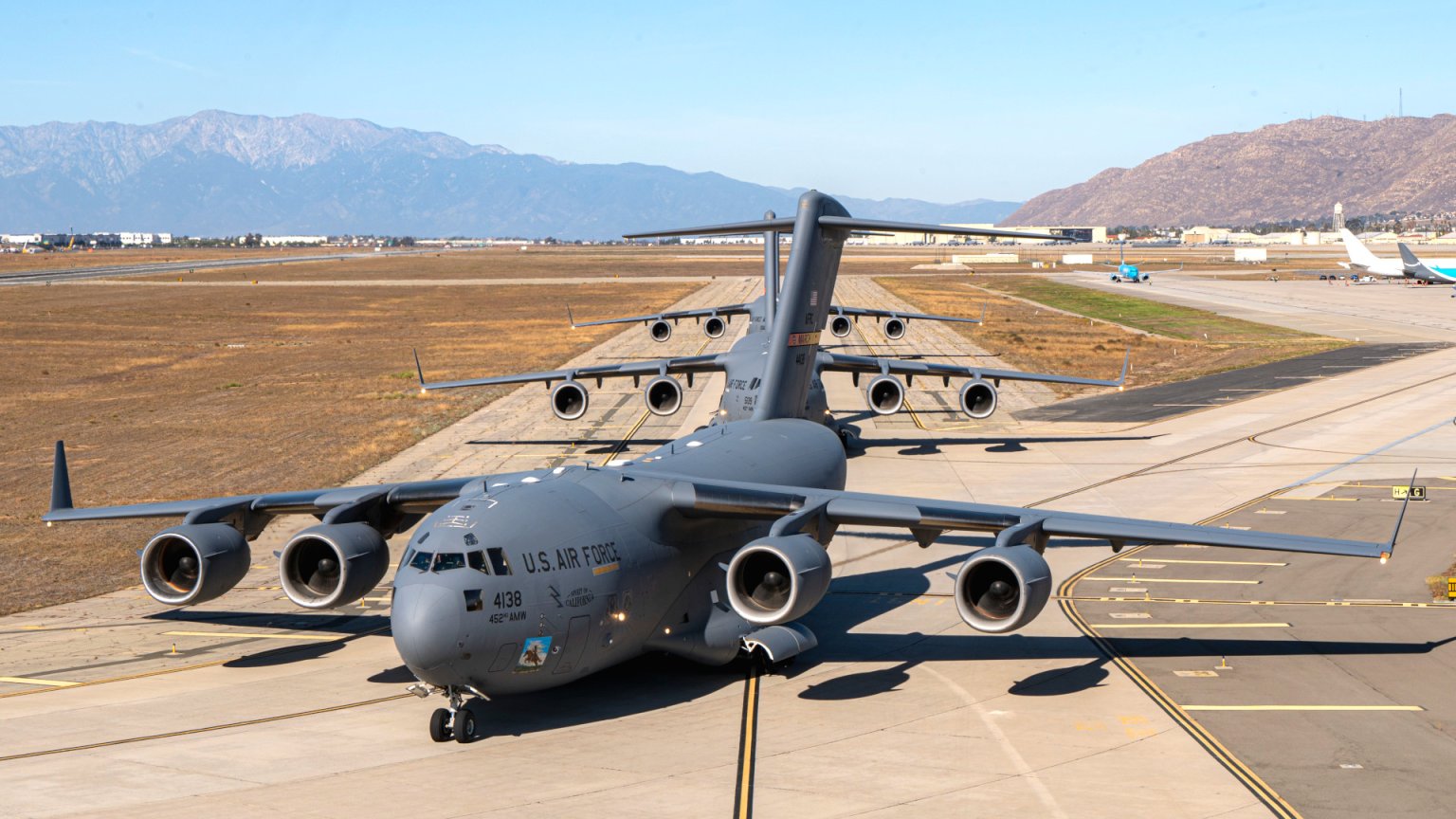
https://www.twz.com/air/boeing-encourag ... iscussions
More pictures at link
Boeing “Encouraged” By C-17 Production Restart Discussions
Congress recently asked the USAF for a briefing on the feasibility of buying new C-17s and allies have interest too.
Joseph Trevithick
Published Jun 11, 2026 1:55 PM EDT
379
Add TWZ(opens in a new tab)
More information
USAF
The TWZ Newsletter
Weekly insights and analysis on the latest developments in military technology, strategy, and foreign policy.
Email address
Enter your email
Sign Up
Terms of Service and Privacy Policy
Operators of the C-17 Globemaster III have been reaching out to Boeing about possibly restarting the product line, and the company has been “encouraged” by these engagements. Separately, Congress recently directed the U.S. Air Force to prepare a formal briefing on the feasibility of acquiring new Globemaster IIIs. The Air Force’s C-17 fleet is critical for U.S. power projection globally. At the same time, a succession of crises in recent years has put serious strain on these aircraft, and questions have already been raised about the viability of the current plan to keep them flying through 2075.
The House Committee on Armed Services added the requirement for the C-17 production restart briefing to a report accompanying the latest draft of the annual defense policy bill, or National Defense Authorization Act (NDAA), last week. The Air Force took delivery of its last Globemaster III in 2013, and has some 222 of these airlifters in service today. The air arms of Australia, Canada, India, Kuwait, Qatar, the United Arab Emirates, and the United Kingdom also have smaller fleets of these airlifters. Three more of these aircraft are operated under the Strategic Airlift Capability (SAC) initiative, a multi-national arrangement with several European members, as well as the United States. Boeing shuttered the C-17 line entirely in 2015.
Boeing Pieces Together the Last C-17 on the Line thumbnailBoeing Pieces Together the Last C-17 on the Line
“The committee recognizes that the existing C-17 fleet continues to bear significant operational demands supporting combatant commander requirements, humanitarian assistance missions, and global mobility operations,” the provision in the House Committee on Armed Services’ report notes. “The committee is concerned that future operational demands may place additional strain on the existing C-17 fleet.”
“Therefore, the committee directs the Secretary of the Air Force to provide a briefing to the House Committee on Armed Services not later than March 1, 2027, assessing the feasibility of restarting the production line for the C-17 aircraft,” it adds.
The committee wants the Air Force’s briefing to at least include the following:
“An assessment of the technical and industrial feasibility of restarting the C-17 production line, including the status of tooling, supplier base viability, workforce availability, and potential reconstitution costs.”
“An estimate of the timeline required to reestablish production and deliver the first newly produced aircraft.”
“A cost estimate for restarting the production line and procuring additional aircraft, including options for limited procurement and multi-year procurement.”
“An evaluation of alternative approaches to increasing strategic airlift capacity, including service life extension programs, modernization of existing aircraft, procurement of commercial derivative cargo aircraft, and expansion of the Civil Reserve Air Fleet.”
“An assessment of potential international partner interest in participating in or contributing to a restarted production line.”
A row of US Air Force C-17s. USAF
TWZ subsequently reached out to Boeing to ask about the company’s current position on rebooting C-17 production.
“Our goal is to help our customers be successful, and we work with them to develop innovative solutions to meet their mission needs, including development and production partnerships,” a Boeing spokesperson told us this week. “We are proud of our continued support for the unique, mission-proven capabilities that the C-17 Globemaster III delivers to the U.S. Air Force and eight allied nation partners.”
At the Paris Air Show last year, Turbo Sjogren, Vice President and General Manager of Boeing Global Services-Government Services, had told Shephard Defense that talks with an unnamed country about a possible C-17 production restart were in their “early infancy.”
“It is a very extraordinary effort to do” and is “reflective of the utility of the aircraft,” he also said at the time, according to Shephard.
Boeing has also now said that it is always willing to work to better understand the requirements and needs of its customers. Any talk about the prospect of restarting C-17 production would also have to be viewed in the broader context of the Air Force’s still-evolving requirements for the Next Generation Air Lift (NGAL) program. The service’s current NGAL plans envision a single aircraft replacing the very different C-17 and C-5 Galaxy fleets, as you can read more about here.
A C-5 Galaxy, at left, and a C-17, right. USAF
TWZ also reached out to the U.S. Air Force about the recently requested briefing.
It is unclear what it might cost to get the C-17 line restarted and what the unit price of these new-production aircraft would be in the end. There are various factors at play, including whether Boeing retains any relevant tooling, the knowledge base of its current workforce, the state of third-party supply chains, and the availability of physical space to build the airplanes. Back in 2019, the company sold off the facilities in Long Beach, California, where it built the original run of Globemaster IIIs.
More than a decade ago, the RAND Corporation did conduct a detailed, independent analysis that explored options for resuming production of the baseline C-17A, a new C-17B, and a significantly revised “fuel efficient” C-17FE derivative.
The C-17B was “a variant Boeing has proposed that adds centerline landing gear, a tire deflation/inflation system, higher-thrust engines, advanced flaps, and an advanced situational awareness and countermeasures system,” according to RAND’s report. The C-17FE derivative “would have a narrower fuselage, up-rated engines, a double-element flap system, winglets, a longer loading ramp, a shorter cargo door, and a modified horizontal tail.”
A graphic offering a very general comparison between the C-17A and the proposed C-17FE. Boeing
RAND said that it could cost between $2.1 and $2.7 billion in 2011 dollars to begin making C-17A models again after a pause, depending on how much tooling Boeing retained. The cost ranges would be $4.6 to $6.4 billion for new production of the improved C-17B version, and $6.2 billion to $7 billion to start building the C-17FE derivative. Billions more would be required to actually procure the aircraft, with unit prices being highly dependent on the total size of the production, as outlined in the table below. If nothing else has changed, these cost projections would still be significantly higher today just due to inflation.
RAND
As an aside here, RAND published a similar assessment of the options for restarting production of the F-22 Raptor in 2011. That report factored heavily into a study the Air Force subsequently delivered to Congress on that topic back in 2017, which you can read more about here.
Foreign participation in new production of C-17s could help defray costs, and is one of the points the House Armed Services Committee specifically wants the Air Force to address in its briefing. As TWZ noted last year after Turbo Sjogren made comments at the Paris Air Show, Boeing’s discussions at that point might not have been with the U.S. government. Earlier in 2025, then-Japanese Prime Minister Shigeru Ishiba had expressed interest in buying Globemaster IIIs, raising immediate questions about where those aircraft might come from.
It should be noted here that the U.S. Air Force’s C-17s have received various upgrades over the years, and the service continues to move ahead with other plans to improve their performance and expand their capabilities. This includes the installation of 3D-printed microvanes on the fuselage, which offer a very minor reduction in drag (approximately one percent), but that translates into real reductions in fuel consumption. All Air Force C-17s are expected to have this feature by the end of next year. Communications and data-sharing upgrades have also been a major focus area across all of the Air Force’s airlift and tanker fleets.
Boeing is now under contract for a more extensive upgrade of the flight decks on Air Force C-17s. The company says this will aid in “resolving avionics obsolescence” and integrate new open systems architectures to make it easier to add new and improved capabilities and functionality in the future.
A look inside the cockpit of a U.S. Air Force C-17. USAF
The prospect of a re-engining effort for the Globemaster III fleet has also been raised in the past, but the Air Force downplayed the value of doing so earlier this year.
When it comes to discussions about restarting C-17 production, another key factor is the lack of immediate alternative options. There is really no other aircraft in this class in production now in the United States or anywhere else in the West. Airbus has long positioned its turboprop-powered A400M as sitting in a capability space between Lockheed Martin’s C-130 family and the C-17. Embraer’s KC-390 Millennium design, which is also offered as an aerial refueling tanker, has generally been pitched as a jet-powered competitor to the C-130. China’s Y-20 and Russia’s Il-76 are really the only in-production analogs on any level to the C-17 globally.
The House Armed Services Committee has now also asked the Air Force to speak to the possibility of buying “commercial derivative cargo aircraft” and/or an “expansion of the Civil Reserve Air Fleet,” or CRAF, to help bolster airlift capacity. The CRAF is an arrangement by which the U.S. military can call upon commercial airlines and charter companies to help move cargo and personnel, which you can learn more about here.
A key issue here is that the C-17 is specifically designed for tactical operations right at the tactical edge. This includes the ability to bring combat-ready forces to far-flung locations without the need for an established airfield. Additional commercial alternatives could still be utilized in rear areas to help free up C-17s for more demanding missions and otherwise relieve stress on the Globemaster III fleet.
A C-17 at Delamar Dry Lake in Nevada during training. USAF
Questions have been increasingly raised about the survivability of the C-17 itself, especially in the context of a future high-end fight, as the threat ecosystem continues to expand and evolve. The Air Force has made clear that it is working to find new ways to bolster the defensive capabilities of all of its existing airlifters, as well as its tanker fleets, and that this is a key consideration in the evolving NGAL requirements.
TWZ has long been sounding the alarm on the need for more survivable cargo planes and tankers. The Air Force already has decades’ worth of experimental work and studies on concepts for stealthy cargo aircraft and tankers, as well as non-stealthy ones with blended-wing-body (BWB) planforms, under its belt. Over the years, several companies have publicly put forward prospective designs that could be relevant for NGAL, as well.
A wind tunnel model of a design concept for an advanced tanker and/or cargo aircraft that the Air Force explored as part of a project called Speed Agile in the late 2000s and early 2010s. USAF
A rendering of the blended-wing-body demonstrator aircraft now in development for the Air Force. USAF
When any new platform developed under NGAL actually enters service remains to be seen. The stated plan the Air Force has put forward to date would see those new aircraft replacing its C-5s first, with C-17s flying through 2075. By that point, the Globemaster III, as a type, will have been in service for 80 years.
“The C-17 is the most amazing airplane ever made. I have a lot of time in it, so I can say that. We have asked it to do a lot of things, and it’s done more than we ever planned for when we bought that airplane,” Air Force Lt. Gen. Rebecca Sonkiss told TWZ and other outlets at a roundtable on the sidelines of the Air & Space Forces Association’s (AFA) annual Warfare Symposium in February. “It has performed flawlessly, but it’s getting old too.”
Sonkiss is Deputy Commander of Air Mobility Command (AMC). She has been serving as the interim head of the command since her predecessor, Gen. John Lamontagne, became Vice Chief of Staff of the Air Force in January.
“I cannot have a gap in my strategic airlift forces, and we’re working forward on the NGAL to combine the view of the C-5 and the C-17 fleet and figure out what the next strategic airlifter needs to be. That conversation, in my book, can’t happen enough, or can’t happen fast enough,” she added at the roundtable in February. “We have to get after what next looks like, and we can’t wait until we’re shoveling it into the boneyard before we get to that discussion.”
Whether the Air Force’s future airlift plans also include buying new-production C-17s remains to be seen. For its part, Boeing does not appear to have ruled out the possibility just yet.
Contact the author: joe@twz.com