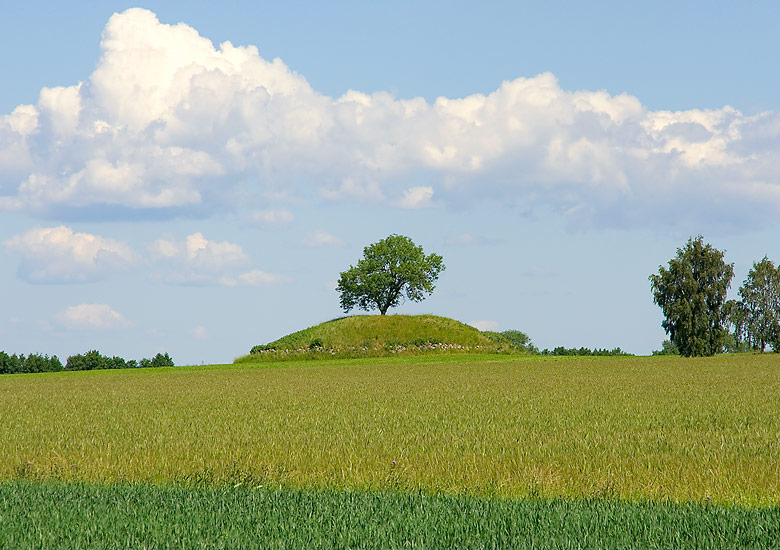
On the radar images something remarkably similar to what has been found in Old Uppsala, and a few other locations, appeared.

It was the grand hall of a King. Moreover, the measurements were almost exactly like those of a hall excavated in Old Uppsala. In excavations undertaken in 2020 and 2021 the measurements were confirmed as of a hall 47.5 meters long (about 156 feet) and 14 meters wide (46 feet) at the middle of the house. Moreover the columns which supported the structure had a diameter of 1 meter (bit over 3 feet), which suggested a building height of at least 10 meters (33 feet). There were, and still remain, four ramps up to the plateau which led to four big doors into the structure. The dating of the hall is 8th century, and use of it was restricted in time. At the middle of the 9th century the hall seems to have been torn down in a careful manner, and the top of the plateau smoothed out, likely in a ritualistic fashion as has been seen elsewhere, due to the religious aspect of these kinds of sites. The King was at the time the pre-eminent religious "priest" and would officiate over the most important ceremonies, as well as claiming descent from the gods, so the hall would also have this sacred aspect.
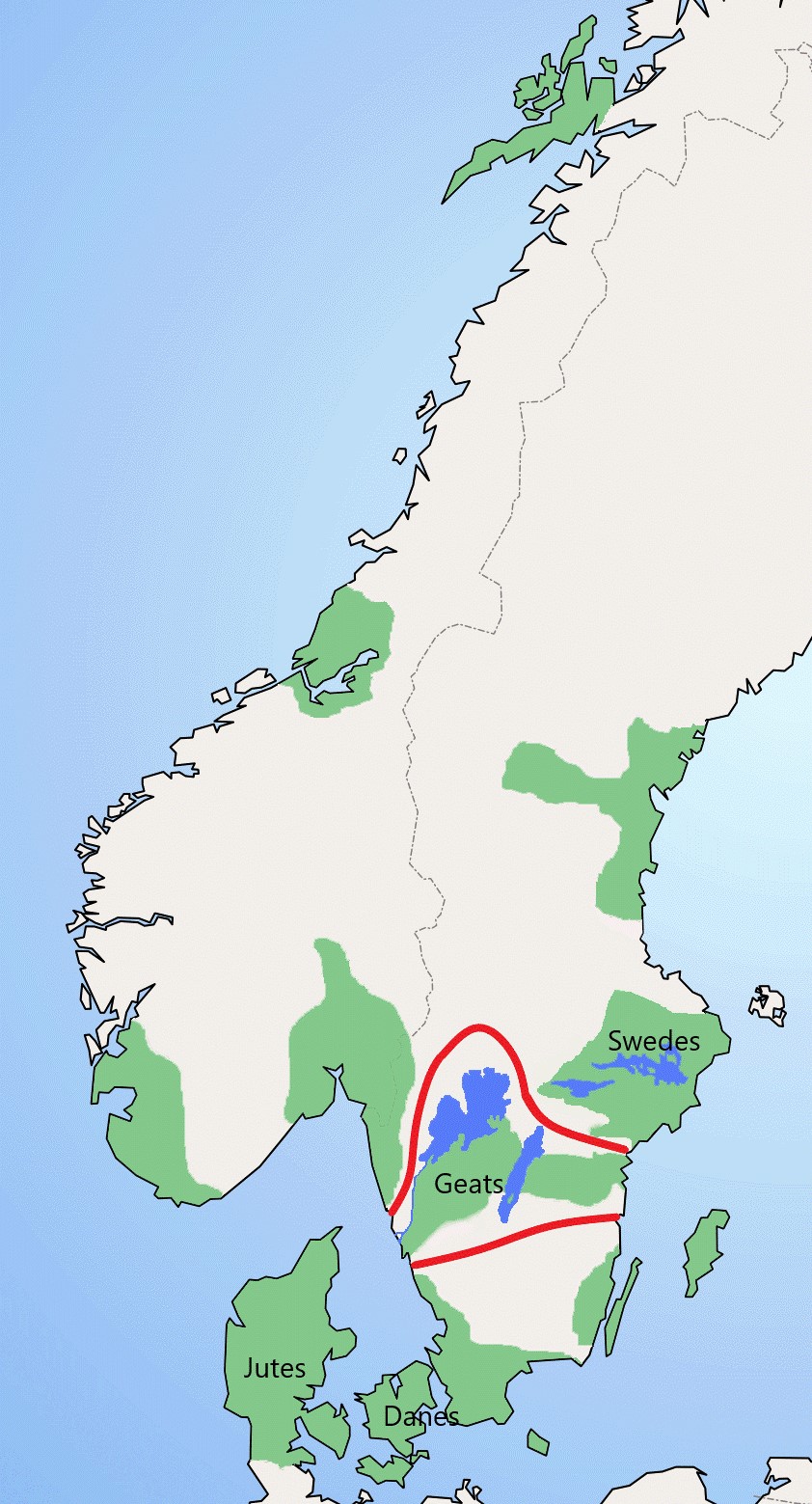
But why was the site abandoned for this purpose then? The likely explanation here is that it seems that in the period it was in use Östergötland was likely divided into three small kingdoms. Another hall from the period has been found in Ströja, towards the eastern part of the land, and archeologists believe that they known the likely approximate location of a third one in the middle between the two known ones. As we enter into the Viking era there seems to have been a consolidation of these mini-Kingdoms into larger ones, and these three small ones merged into a larger one that encompassed all of Östergötland. With the seat of the King elsewhere. In the later Viking era the belief by historians are that Olof Skötkonung was the first King to rule over both the Svea domains (Svithiod, from which the term Sweden comes), and the whole of Geatland, and thus is usually considered as the first King of a unified Sweden.
This is a map of Östergötland, the crude markings are mine. The leftmost one marks where Aska is, the middle one is where it is believed to have been a King’s hall, and the rightmost one is where the Ströya hall is. As can still be seen there is a farming belt running through the center, that where all the people and activity was in the old days. The northern and southern parts are forested and with minimal populations. So one can easily see how these three locations were suitable for governing the area. But back to Aska, because there's some interesting aspects of it that sets it apart from the rest of these sites. We've seen a hint of that above in that it has been so remarkably undisturbed for such a long time. During the excavations it was noted that there were only three minor finds dated between 850 and 1805, nearly a millennia, including a 14th century armor piercing crossbow point. There are a few finds from the 19th century, some coins and some butchers waste that was buried there around 120 years ago. So why is this? Elsewhere these places have often been in more central locations and in the hot spot during the changeover to Christianity, which meant that the Church most often aimed to eradicate these dual use religious locations by building churches on top of them. But still, it seemed odd that there were almost no everyday finds there, and no farmhouse being erected on the excellent flat plateau.
Enter the Midsummer celebrations. Celebrating Midsummer is a long standing tradition in Sweden, in latter centuries done in a fashion with a Midsummer pole, which likely was adopted from the May poles used in some other countries. But it is believed by many to have older origins than that, being connected to older fertility rituals from the pre-Christian era. This site was used for these Midsummer celebrations locally until around the beginning of the 20th century, and digging deeper into the archives an unusual thing was found. A note from the 18th century that confirmed that Midsummer celebrations were held there at the time as well, but with the addition that, according to the locals, if these celebrations weren't held at this spot misfortune would befell the animals/livestock. Now that's interesting. Because here we have a potential explanation as to why the site was left so undisturbed. It would seem that the knowledge of the site's importance from a pre-Christian fertility cult perspective had lived on in the local folk beliefs well into modern times. A near millennia after the introduction of Christianity people were still counting on an annual fertility ritual at a sacred place to keep their livestock safe. It boggles the mind.
The finds from the time that the hall was in use of course include those of a religious nature, not in the least the mysterious guldgubbar/gullgubber. These are tiny gold foil objects which have been stamped with a depiction of people. Occasionally just a man, but more often a man and a woman in what is described as a loving embrace. They are about as thing as three sheets of aluminum foil, and uses very little gold, likely as a result of the scarcity of gold during this era, post the migration period. They have been found at a number of sites in Denmark, Sweden, and Norway, most prominently in the so called sorte muld area on the Danish island of Bornholm where around 2,500 have been found. Given that they are found at these religious locations, the seats of Kings, and seemingly having been left there, with finds often being centered on the place in a hall where the King's seat should have been, they are believed to have been a form of sacrifice to the Gods/King for some likely benefit to the sacrificer.
Here's an example from Aska, around 35 of these have been found there so far in various states.

What's interesting is that although these have been made from several different stamps in different locations across Scandinavia, they figures on them tends to be very similar. Depicted with the same garb, same features and so on. There's been several suggestions as to what they depict, it is clear that the garb suggests high borne people, the woman wears a pearl necklace and so on. One proposal that seems possible to be close to the truth notes the divine origin claims of the Kings.
The most prominent example here is the Yngling dynasty in Uppsala, known as Scylfings in the Beuwulf epos, which have saga geneaologies that traces back their origin to the god Frey, who in summary is portrayed as a man who lived on earth (along with the other Norse gods) and founded the dynasty, and died and became deified after death. Notably Frey is a god of fertility. Now the Yngling dynasty appears to have been something special, and while some think that various dynasties claimed independent descent from the gods I'm of a different opinion. In Historiae Norwegiae the Norwegian royal house lays out the Yngling dynasty geneology and then explains how with the overthrowing of King Ingjald in Uppsala his son Olof fled to first Värmland (currently bordering Norway) and made himself King there, and then descendants and so on founded the Norwegian royal house. This is quite the opposite of an independent claim of divine descent, instead they are (correctly or made up) claiming the same descent via the Yngling dynasty. While Ingjald was officially the last Yngling to sit in Uppsala, one might suggest that his successor Ivar was likely also of Yngling descent further back in time, so as to maintain a divine King-Priest on the throne.
So what does this have to do with these gold foil figures? The suggestion is that these are depictions of the beginning of the Yngling dynasty. That the two figures are of Frey and his wife getting married, and thus founding the line of Kings. But that also ties back into what I said just above, that I don't think that these were independent claims of divine descent, rather that they all stem from one single line of people. The figures are as noted very similar to one another, they've been made with the exact same clothing features and style even though they've been made in widely different locations and under different Kings. If they are indeed a depiction of the beginning of the line of the divine Kings, then they depict the same exact two people everywhere. This thus leads to the suggestion that all of these locations where they have been found are of seats of Kings that all claimed the same divine descent via the Yngling dynasty to the god Frey. This is perhaps not as improbable as one might think at first. In the sagas from Iceland the introduction of the Norse religion into Scandinavia is claimed to have been from those we know as the Norse gods, Odin, Thor, Frey etc., who travelled as mortal men from their kingdom far away (Snorri Sturlasson places it by the river Don), and wound up here in Scandinavia where they established themselves as rulers and introduced their religion. If this was the pervasive belief back then, whether or not it was actually true, there must have been a strong incentive to bring in someone from the Yngling dynasty to sit as their King in various places around Scandinavia, for this would be their only way to have a divine King that is descended from the gods, and especially one descended from the god of fertility which was likely the top priority except in wartime.
Taken together with the remarkable similarity in the measurements of these Halls, they're almost as close as their could likely get with the buildings techniques of the time, the same depiction on these gold foil figures, and so on, I think we're starting to see a picture emerge where the various royal houses of the time period should perhaps be seen as a branches within an overarching family/klan that managed to, over time, lay most of Scandinavia under them. That is until the introduction of Christianity when the divine connection probably became more of a liability than a benefit, and other powerful families eventually replaced them.